I am writing to share with you my new article, “Russia, Iran and China in Latin America,” just published by the American Foreign Policy Committee in their e-journal “Defense Dossier.” The work comparatively examines the activities of the three extra-regional actors in Latin America and the Caribbean, including ways in which commercial and governmental initiatives by each compliment (and occasionally conflict or compete with) each other. I emphasize that each actor presents a different type of challenge to US interests in the region, on a different time-scale.
What is it about the libertarian infatuation with bitcoins? Ron Paul announced in early December that the bitcoin could “destroy the dollar.” He seemed to be gloating. In Chile, a collection of “anarchists, libertarians, and Ron Paul supporters” have founded a libertarian utopia they have named “Galt's Gulch,” which will accept payment in bitcoins. Sensibly, the “farm workers and suppliers” who service this community “still want to get paid in pesos.”
Is it an innate libertarian quirkiness that drives this fascination with bitcoins? A kind of universal libertarian contrariness? Or is there something else about bitcoins and libertarianism that makes for this mix?
Sanctions enforced by the UN on Iraq since the Gulf War have killed more people than the two atomic bombs dropped on Japan in 1945, including over half a million children – many of whom weren’t even born when the Gulf War began.\
Hmm, does this defy the easy-big-data narrative? VentureBeat warns us, “The Data Is Not Enough: Creative Data Scientists Make the Difference.” Not only is there a shortage of data scientists in general, we are now told firms would do well to find data scientists graced with creativity. How pesky. Writer Jordan Novet refers to a recent panel given at VentureBeat’s 2013 DataBeat/Data Science Summit headed by LinkedIn‘s former lead data scientist, Peter Skomoroch. The article relates:
“Skomoroch envisions a world not too far in the future where balance sheets will track companies’ data assets. But he and other panelists don’t just want more data to analyze. They discussed the importance of creativity as a key trait to look for in people who work with the data. That means relying on proven algorithms might not always cut it.”
Novet shares with us the perspectives of a few panel members. For example, former Kaggle president Jeremy Howard, apparently the creative type himself, described his process:
“Howard likes to just dive into data and start getting hunches about it, without knowing about the industry the data comes from and other context that others would find valuable. ‘That way, there’s no blinkers,’ he said. It might come across as a contrarian view, but Howard thinks his approach is one reason he did well in Kaggle competitions.”
Other panelists quoted in the article include Jawbone‘s VP of data, Monica Rogati and Pete Warden, CEO of Jetpac. See the story for their thoughts.
The other day I said that I thought the markets were only understandable to insiders. I may have been too generous. Read this report and draw your own conclusions.
Canada has a Rightist government so no one should be surprised that they deny climate change and have energy interests that trump lesser agencies like fisheries. They don't like facts, so why not just get rid of them literally. This is the modern equivalent of book burning. This is a loss not just to Canada but to the whole world. These databases and reports they are describing constitute a significant part of humanity's understanding of Earth. It is straight out of the Dark Ages. An act of fanaticism as was its predecessor. Then it was Christianity. Today it is The Theology of Profit.
What this report describes should not be legal in a democracy, and would not be had the Supreme Court's conservative wing not opened the floodgates to gray and black money through Citizen's United, although the trend began earlier. No one should be allowed to dump $400 mi! llion dollars into the political process in an attempt to buy an outcome in an election.
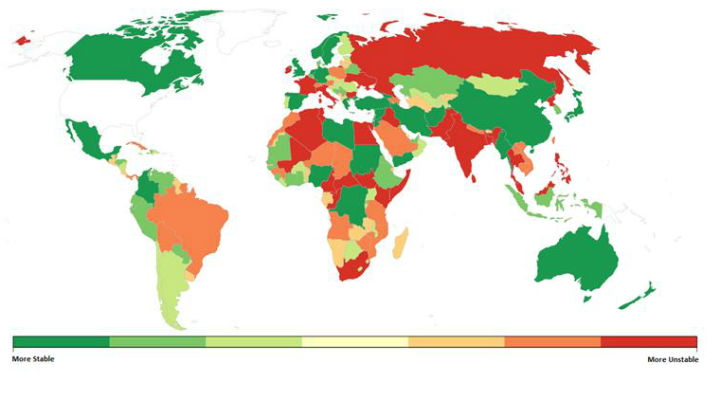
What big data tells us about next year’s crisis zones.
EXTRACTS:
….my 2011 “Culturomics 2.0” study demonstrated the unique insights gleaned from looking at how the media covers an event, rather than just what it covers.
Click on Image to Enlarge
The Global Database of Events, Language, and Tone (GDELT) project is the largest event database in the world, capturing over a quarter-billion events in every country, down to the city level — across 300 categories, from 1979 to the present, and with daily updates of 100,000 events a day.
. . . . . . .
Of course, the best part is being able to dive in yourself, so without further ado, download the complete 172-page report and take a look at the countries you are most interested in or check out how they compare in the master ranking table at the end of the report. Take a look through what a big data view of 675 million mentions of conflict tell us about how the world is changing. When you're done, sign up for the new GDELT Daily Trends Report email and get a miniature version of this delivered to your inbox each morning. Big data is giving us our first glimpse of a world in which we can map the Earth's riots as well as we can its earthquakes and hurricanes — and all from just reading the news a little more carefully.