This coordinated takedown was the sixth national Medicare fraud takedown in strike force history. In total, almost 600 individuals have been charged in connection with schemes involving almost $2 billion in fraudulent billings in these national takedown operations alone. The Medicare Fraud Strike Force operations are part of the Health Care Fraud Prevention and Enforcement Action Team (HEAT), a joint initiative announced in May 2009 between the Department of Justice and HHS to focus their efforts to prevent and deter fraud and enforce current anti-fraud laws around the country.
Outside the United States, the Pentagon controls a collection of military bases unprecedented in history. With U.S. troops gone from Iraq and the withdrawal from Afghanistan underway, it’s easy to forget that we probably still have about 1,000 military bases in other peoples' lands. This giant collection of bases receives remarkably little media attention, costs a fortune, and even when cost cutting is the subject du jour, it still seems to get a free ride.
With so much money pouring into the Pentagon’s base world, the question is: Who’s benefiting?
Russia to emerging countries: We’ll build, operate your nuclear reactors
Do you run a developing country where you’d like to build and operate nuclear reactors, but you just don’t have the expertise or the money?
Then you could turn to Russia for an all-in-one 60-year bargain.
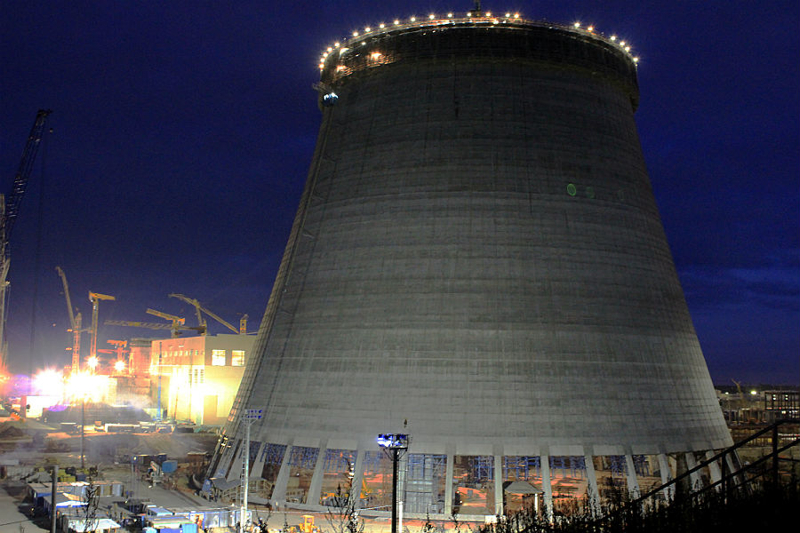
Sign on the dotted line. Russia's Rosatom will build and operate one of these for you for 60 years. Rosatom retains ownership and handles all the hassle, like waste management. Above is the Novovoronezh II reactor under construction in Russia.– Click on Image to Enlarge
State nuclear power company Rosatom “is offering a special package deal to build and operate nuclear power stations abroad in a bid to win business from developing countries, a company official was quoted on Monday as saying,” Reuters reports. “The offer to ‘Build, Own, Operate’ (BOO), also includes financing to countries seeking to build nuclear plants.”
Rosatom, which competes against the likes of Toshiba’s Westinghouse subsidiary and France’s Areva to construct reactors around the world, has in the past handed over the day-to-day operations of finished reactors to utilities. Now, it’s offering to hang around onsite after completion.
“Under the BOO model, Rosatom not only builds the nuclear plant, but also owns it and runs it for up to sixty years,” Reuters writes, citing French publication Le Figaro. “Rosatom also delivers nuclear fuel to the plants.”
“With this model, we are fully responsible for the plant’s security,” Le Figaro quoted Rosatom deputy CEO Nikolai Spassky as saying.
Rosatom has agreements to build 19 reactors outside Russia, Reuters states. According to the World Nuclear Association (WNA), in addition to Turkey those countries include Vietnam, China, India, Bangladesh, Belarus, Ukraine and Bulgaria. Russia has already built nuclear plants in China, India, Iran and Ukraine, WNA notes.
Not to be outdone, Frontier Airlines announced that for tickets booked anywhere except on its Web site, it would raise its luggage charges and impose a fee of up to $100 for certain carry-on bags, the third U.S. carrier to do this. Most economy-class passengers will also have to pay $1.99 for coffee, tea, soda and juice.
You read correctly: That fee is for a carry-on bag, not a checked bag.
Nigeria: President Goodluck Jonathan announced a “state of emergency” in three northeastern states in an attempt to curb the increasingly violent attacks by the Islamic terrorist group Boko Haram. (Note: Boko Haram is Hausa for “Western education is sinful.”)
In a televised address Jonathan said, “We are facing a rebellion and insurgency by terrorist groups which pose a very serious threat to our national unity….They have attacked government buildings and facilities. They have murdered innocent citizens and state officials. They have set houses ablaze, and taken women and children as hostages. These actions amount to a declaration of war…. I hereby declare a state of emergency in Borno, Yobe and Adamawa states.”
Comment: The three states lie in the far northeast, bordering Niger, Chad and Cameroon. The catalyst for the declaration was a coordinated attack last week in the town of Bama in Borno state. Some 200 Boko Haram fighters in buses and machine gun-mounted trucks attacked an army barracks, the policy station and the prison. They freed more than 100 prison inmates and killed 55 people, mostly police and other security forces.
Boko Haram is a fundamentalist Islamist fighting group that is dedicated to creating an Islamic state based on Sharia in northern Nigeria, which is predominantly Islamic. Its rebellion since 2009 has resulted in about 3,600 people killed, including security forces. One Nigerian analyst reported it has several hundred armed fighters, but it has significant local sympathy.
Security officials state Bokop Haram controls at least 10 of 27 local government areas in Borno state, which is the center of the insurgency. One official says the real figure could be closer to 20 of 27 because local councilors fearing assassination have fled, leaving a power vacuum filled by bearded radicals with automatic rifles.
The government judged that a suppression campaign between December 2011 and July 2012, which included a limited imposition of martial law, had nearly eliminated the threat. The latest reports indicate the movement has recovered.
Recent activity suggests Boko Haram intends to set up an Islamist administration in the territory it now controls, as well as fight government security forces. This is the pattern followed by al Qaida in the Islamic Maghreb (AQIM) in northern Mali. Boko Haram has contacts with AQIM and the style of the Bama attack plus the weapons used – machined guns and rocket propelled grenade launchers – suggest new training, new financing, more weapons and more cohesive operations characteristic of AQIM.
Recovering lost districts will be difficult for the Nigerian Army. Its past campaigns were so brutal that they alienated the local villagers and ensured tolerance if not support for Boko Haram.
The National Intelligence Model (NIM) has been used by police to do intelligence with integrity about threats, capabilities, and outcomes. This is not done by the US Government or most others. Capabilities are generally not related to threats (inputs) or outcomes (desired strategy and policy goals) because corruption clogs up the system–decisions are made on the basis of political and financial influence, and the elements of government — the FBI, for example — are not held accoiuntable for actually producing any outcomes of significance, such as the elimination of organized crime (political, financial, and street-level).
Here at Phi Beta Iota there are four strategic analytic models, one graphic on evaluating intelligence (not something anyone does now with any degree of intelligence or integrity), and one graphic on Whole of Government applied intelligence with constant integrity. Links are below. First however, Ada Bozeman's words, words we have embraced as our guiding light in creating a Smart Nation and an approach to hybrid governance in the public interest that is rooted in ethical evidence-based decision-support.
Ada Bozeman has written:
(There is a need) to recognize that just as the essence of knowledge is not as split up into academic disciplines as it is in our academic universe, so can intelligence not be set apart from statecraft and society, or subdivided into elements…such as analysis and estimates, counterintelligence, clandestine collection, covert action, and so forth. Rather … intelligence is a scheme of things entire.(Bozeman 1998: 177):[1]
Enter the info-state. The info-state – today one of a growing number of dynamic and entrepreneurial cities, city-states or small nations scattered around the world – governs as much through data as via democracy.
Scholars have for decades appreciated political mutations that drive international competition and result in new forms of governance. In 1941, Harold Lasswell emphasized the rise of politico-military elites, such as in Imperial Japan, that shaped the ideology of ‘garrison states.’ In 1996, Richard Rosecrance forecasted a transition toward ‘virtual states’ that downsized geography and outsourced production, while investing more in human and portfolio capital than territorial expansion. Building on this logic of the economic over the political, Philip Bobbitt’s Shield of Achilles (2002) traced the advent of the ‘market state’ era, in which the maximization of individual commercial opportunity defines national power and success. Japanese business strategist Kenichi Ohmae then set the stage for the info-state era in The Next Global Stage (2005), which argued that urban agglomerations of city-states resembling the medieval Hanseatic League would become the world’s power centres.
The info-state draws on numerous important attributes of these previous – and still co-existing – units. The economic footprint supersedes the territorial, the urban industrial core and its human capital pool are the locus of value, and diplomacy is exercised by commercial and knowledge centres as much as by national capitals.
But the info-state also presents new mutations that were not conceivable in previous technological periods – a peculiar convergence of the Information Age and the devolved authority of city units and clusters. The critical shift lies in the manner of policy-making enabled by new technologies: governance is practiced in ‘real-time’ – through constant consultation, rather than through traditional, staggered democratic deliberation. In a sense, this is a post-modern democracy – or even ‘post-democracy’ – that combines popular priorities with rationalist or technocratic management. On this logic, data-driven policy might mean more objective measurement of progress, more evidence-based policy, and more accountability of leadership.
In order to thrive, an info-state must provide both the security of the garrison state model and the connectedness of the virtual state. In other words, the essence of the info-state is secure connectedness. And, to be sure, this existential reliance on secure connectedness is potentially the info-state’s most prominent vulnerability.
Wickr is a free app that provides: military-grade encryption of text, picture, audio and video messages ·sender-based control over who can read messages, where and for how long ·best available privacy, anonymity and secure file shredding features ·security that is simple to use