An important question — the USA no longer does strategic intelligence and it has never done Whole of Government operational or tactical intelligence. The $60B secret world is largely worthless at all four levels of analysis:
STRATEGIC: Next Generation near, 100 years our far
OPERATIONAL: Whole of Government regional and threat/topic based campaign plans, harmonized at OMB level
TACTICAL: the here and now up to 72 hours out, not just military but Whole of Government AND multinational
TECHNICAL: not just systems acqusition but opportunity cost, return on investment, countermeasures, utility within the whole
Yesterday, during a radio talk show hosted by Mike Harris with Dr. James Fetzer and me as guests, Colonel James Hanke, a longtime friend and senior US Army intelligence officer (retired) phoned in. Hanke is the highest ranking intelligence official every to admit to false flag terrorism and to speak of it openly.
Hanke, former chief intelligence officer of NATO’s largest command, 3rd Army, former Military Attache to Israel and a recognized leader of the “mainstream” special operations community is still active within the intelligence community.
The interview below is a unique opportunity to view the “sea change” in awareness among senior intelligence personnel as to the breakdown in America’s government and security structure, enough of a “breakdown” to allow organizations to stage attacks, even assassinations, inside the United States.
Everyone knows this story, though fewer and fewer read it on paper. There are barely enough pages left to wrap fish. The second paper in town has shut down. Sometimes the daily delivers only three days a week. Advertising long ago started fleeing to Craigslist and Internet points south. Subscriptions are dwindling. Online versions don’t bring in much ad revenue. Who can avoid the obvious, if little covered question: Is the press too big to fail? Or was it failing long before it began to falter financially?
In the previous century, there was a brief Golden Age of American journalism, though what glittered like gold leaf sometimes turned out to be tinsel. Then came regression to the mean. Since 2000, we have seen the titans of the news presuming that Bush was the victor over Gore, hustling us into war with Iraq, obscuring climate change, and turning blind eyes to derivatives, mortgage-based securities, collateralized debt obligations, and the other flimsy creations with which a vast, showy, ramshackle international financial house of cards was built. When you think about the crisis of journalism, including the loss of advertising and the shriveled newsrooms — there were fewer newsroom employees in 2010 than in 1978, when records were first kept — also think of anesthetized watchdogs snoring on Wall Street while the Arctic ice cap melts.
Deserting readers mean broken business models. Per household circulation of daily American newspapers has been declining steadily for 60 years, since long before the Internet arrived. It’s gone from 1.24 papers per household in 1950 to 0.37 per household in 2010. To get the sports scores, your horoscope, or the crossword puzzle, the casual reader no longer needs even to glance at a whole paper, and so is less likely to brush up against actual — even superficial — news. Never mind that the small-r republican model on which the United States was founded presupposed that some critical mass of citizens would spend a critical mass of their time figuring out what’s what and forming judgments accordingly.
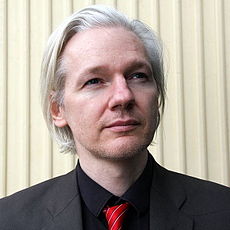
I had an opportunity to interview WikiLeaks founder Julian Assange at the Ecuadorian Embassy in London, where he has been granted political asylum since June 2012. Assange is wanted for questioning in Sweden over sex allegations, although he has never been charged. Assange believes that if sent to Sweden, he would be put into prison and then sent to the United States, where he is already being investigated for espionage for publishing hundreds of thousands of classified diplomatic and military memos on the WikiLeaks website.
EXTRACTS
Julian Assange
George W. Bush's new presidential library at Southern Methodist University in Texas has opened with great fanfare, including the attendance of Presidents Obama and former Presidents Carter, Bush Sr. and Clinton. George Bush has said that the library is “a place to lay out facts.” What facts would you like to see displayed at his library?
A good place to start would be laying out the number of deaths caused by the invasions of Iraq and Afghanistan. At Wikileaks, we documented that from 2004-2009, the US had records of over 100,000 individual deaths of Iraqis due to violence unleashed by that invasion, roughly 80% of them civilians. These are the recorded deaths, but many more died. And in Afghanistan, the US recorded about 20,000 deaths from 2004-2010. These would be good facts to include in the presidential library.
And perhaps the library could document how people around the world protested against the invasion of Iraq, including the historic February 15, 2003 mobilization of millions of people around the globe.
. . . . . . . . .
What do you think the trial [of Bradley Manning] will be like?
The Second Enlightenment Has Emerged: We Should Call It What It Is
Have you ever noticed that there's no convenient, sufficient, or satisfying way to pull all the threads together of all the inter-related branches of wisdom that we're always talking about? despite the fact that they all seem to be part of the same movement: a movement of cutting-edge wisdom?
The movement is no less than the Second Enlightenment. And I think that's what we should start calling it.
It would be a way to pull all the disparate threads together and show their connectedness to each other and their significance in the context of human history. And I think this idea should be spread until citizens and the media start asking the question, “What is this Second Enlightenmenteveryone is talking about?
There's an excellent article on American enlightenment thought at the Internet Encyclopedia of Philosophy, a peer reviewed academic resource.
Two of the six key ideas of the movement were deism and scientific progress. Deism was the idea that God is revealed through an understanding of the universal laws of nature, and that reason is the best tool for discovery, not religious dogma or the authority of custom and tradition. And whether in regard to political philosophy or scientific progress, the men of the Enlightenment believed that rational argumentation and the free exchange of ideas was the best means by which deeper truths were discovered. We are the extension of the process that they began.
But the men of the first Enlightenment were only at the dawning of an intellectual movement. There are things we understand today that they couldn't have possibly understood. The breadth and depth of our understanding is rapidly expanding. There are many new fields of thought that would astound them: human consciousness, social science, systems theory, complexity theory, collective intelligence through open-source collaboration, rapidly advancing technology. The list is virtually endless. And it's not just these specialties in themselves that are significant but the way they reflect on one another and inform one another, which is creating a new emerging reality that I think can rightly be called the Second Enlightenment.