Journal: New QDR–Pentagon Goes Intellectually AWOL

10 Security, Analysis, Budgets & Funding, Ethics, Military, Reform, Strategy, Threats
Chuck Spinney

The New QDR

The Pentagon Goes Intellectually AWOL

By FRANKLIN C. SPINNEY

Monday, February 1, 2010, was a day that should live in budgetary infamy. The Defense Department released its Quadrennial Defense Review (QDR) and its accompanying Fiscal Year 2011 budget request, which is the first year of the Fiscal Year 2011-2015 five year plan (2011-2015 FYDP). These documents are available on the internet and can be downloaded in PDF format here: QDR and the FY 2011 budget.

Even by the dismal intellectual standards of Pentagon bureaucracy, the QDR and the FY 2011 budget, taken together, establish a new standard of analytical vacuity, psychological denial, and just plane meaningless drivel. I will keep this short by using just one important case to prove my allegation. Judge for yourself if it is necessary and sufficient to make the point.

. . . . . . .

The chaos in the accounting system provides the intellectual “grease” to lubricate the engine driving narrow bureaucratic agendas that are causing the force structure meltdown. Senior decision makers can not possibly understand the trade offs they are really making when they put together a budget, assuming they wanted to, which is also in doubt.

Full Story Online

Phi Beta Iota: The Pentagon is only as competent as the combination of three factors:

Continue reading “Journal: New QDR–Pentagon Goes Intellectually AWOL”

Journal: Is There an Ecological Unconscious?

Cultural Intelligence, Earth Intelligence
Full Story Online

“There’s a scholar who talks about ‘heart’s ease,’ ” Albrecht told me as we sat in his car on a cliff above the Newcastle shore, overlooking the Pacific. In the distance, just before the earth curved out of sight, 40 coal tankers were lined up single file. “People have heart’s ease when they’re on their own country. If you force them off that country, if you take them away from their land, they feel the loss of heart’s ease as a kind of vertigo, a disintegration of their whole life.” Australian aborigines, Navajos and any number of indigenous peoples have reported this sense of mournful disorientation after being displaced from their land. What Albrecht realized during his trip to the Upper Valley was that this “place pathology,” as one philosopher has called it, wasn’t limited to natives. Albrecht’s petitioners were anxious, unsettled, despairing, depressed — just as if they had been forcibly removed from the valley. Only they hadn’t; the valley changed around them.

In Albrecht’s view, the residents of the Upper Hunter were suffering not just from the strain of living in difficult conditions but also from something more fundamental: a hitherto unrecognized psychological condition. In a 2004 essay, he coined a term to describe it: “solastalgia,” a combination of the Latin word solacium (comfort) and the Greek root –algia (pain), which he defined as “the pain experienced when there is recognition that the place where one resides and that one loves is under immediate assault . . . a form of homesickness one gets when one is still at ‘home.’ ” A neologism wasn’t destined to stop the mines; they continued to spread. But so did Albrecht’s idea. In the past five years, the word “solastalgia” has appeared in media outlets as disparate as Wired, The Daily News in Sri Lanka and Andrew Sullivan’s popular political blog, The Daily Dish. In September, the British trip-hop duo Zero 7 released an instrumental track titled “Solastalgia,” and in 2008 Jukeen, a Slovenian recording artist, used the word as an album title. “Solastalgia” has been used to describe the experiences of Canadian Inuit communities coping with the effects of rising temperatures; Ghanaian subsistence farmers faced with changes in rainfall patterns; and refugees returning to New Orleans after Katrina.

Phi Beta Iota: Seriously good stuff that comes at the same time that human feelings and emotions are being recognizes as co-intelligence to the science and humanities and (more or less moribund) social sciences.  It's about the Whole.

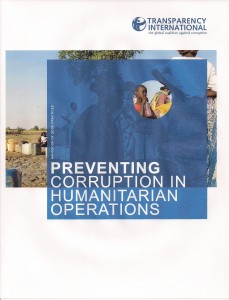
Handbook: Preventing Corruption in Humanitarian Operations–A Handbook of Good Practices

Gift Intelligence, Law Enforcement, Peace Intelligence, Stabilization
Full Document Online

Based on five years of investigation in the aftermath of the 2004 tsunami.  The bottom line from our point of view is three-fold:

1.  All money collected for an ostensible campaign must be “tagged” and audited and pooled so that the US military among others can draw down on the common fund and cover all costs associated with US military mobilization and continuing Stabilization & Reconstruction Operations.

2.  We need a Stabilization & Reconstruction Intelligence Support Plan that includes Peace Jumpers and immediate air breathing wide area surveillance upon which to build a bottom-up needs assessment and Reverse TIPFID.  Push the information perimeter all the way out to pre-loading approval contingent on having a big air docking space and small air or land or sea intermediate delivery channels.

3.  We finally need to get serious about “preaceful preventive measures” as called for by General Al Gray, USMC, then Commandant of the Marine Corps, in his seminal article “Global Intelligence Challenges for the 1990's,” American Intelligence Journal (Winter 1989-1990).  His staff assistant for that piece was Robert Steele.  We need a Whole of Government and Multinational Engagement information sharing and sense-making hub and spoke network built around the US defense open source intelligence program.  IOHO.

Explicatory Online Information:

Continue reading “Handbook: Preventing Corruption in Humanitarian Operations–A Handbook of Good Practices”

Journal: Haiti Catastrophe Updat 2 Feb 10 AM

08 Wild Cards
Full Story Online

Haiti aid operation still has way to go, U.N. says

Providing shelter to an estimated 1 million homeless is first priority now that search and rescue efforts have ended and most life-threatening injuries have been treated, John Holmes said.  “We still have a significant way to go before reaching everybody who needs food, and on the shelter side as well,” the U.N.'s emergency relief coordinator told a news briefing.  “This is a potentially volatile environment and we have to make sure it doesn't degenerate from fights over food into more serious civil unrest,” he said.  Some 7,000 tents have been distributed and another 50,000 tents are in the pipeline.

Phi Beta Iota: They appear to be feeding 140,000 or so a day (out of two million) and now tell us that 50,000 tents are planned for two million homeless who will not be under real shelter for 1-2 years.  40 people per sent, no sanitation, this just gets better and better.

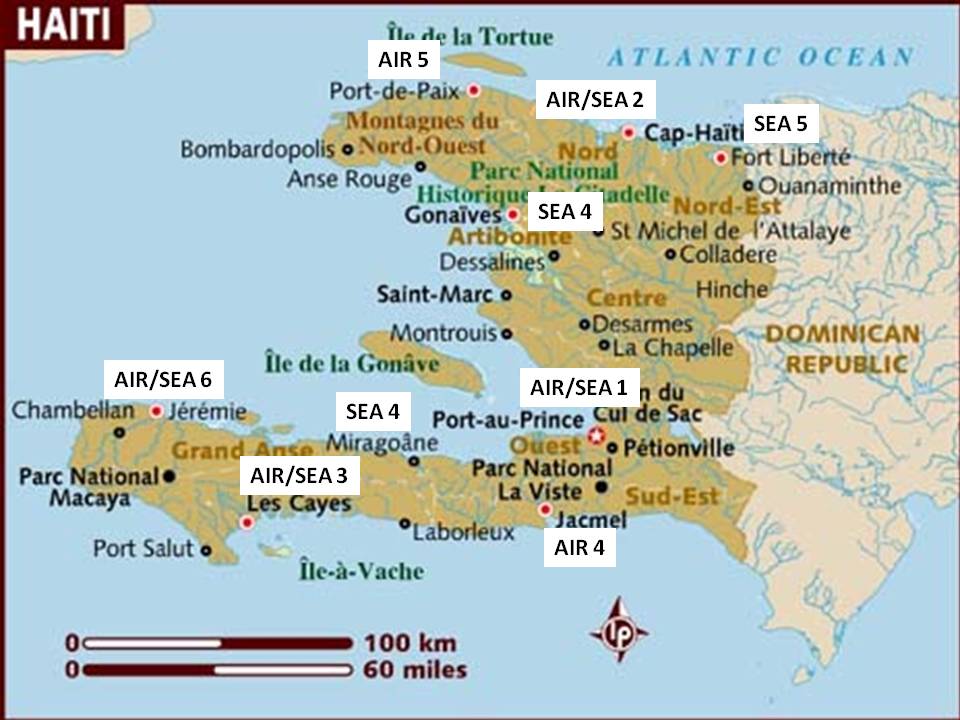
Triage Big Air Elsewhere, Use ALL of the Air and Sea Ports

Red Cross: Haiti airport remains major bottleneck

WASHINGTON — American Red Cross officials in Washington say there is a waiting list of 1,000 flights to land at Haiti's airport, hindering the delivery of relief supplies.

Phi Beta Iota: What part of triaging big air into little air and big boat cargo into small boat cargo are we not understanding here?  The LAST place we need 1000 airplanes full of supplies is in Port-au-Prince.  There is also no reason why we cannot be doing drive-by C-130s with pallets of water, food, tents, and sanitation tools and supplies.  TWO MILLION out of ten million.  This seems a fairly obvious challenge of scope and depth , what are we missing here, almost three weeks after these people were rendered homelesss?  If the Red Cross were serious, which it is not, with 230 million of new dollars in the bank, it would be hiring fleets of small aircraft and logistics helicopters, gridding the island with an advance strategy created with the government and the US military, and putting the supplies where the people need to go to get out of the center of catastrophe, Port-au-Prince.

Continue reading “Journal: Haiti Catastrophe Updat 2 Feb 10 AM”

Journal: Politics of Fear–Spending on National Insecurity

10 Security, Analysis, Budgets & Funding, Collective Intelligence, Military, Peace Intelligence, Reform, Threats
Chuck Spinney

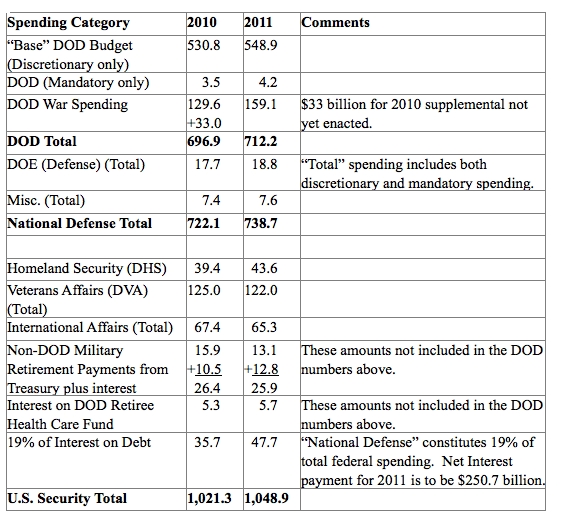
Answer: It all depends on what you think should be included, but once this is clear — this spending will be be exempt from any cutbacks needed to reduce the deficit.

The Table prepared by Winslow Wheeler, Director, Straus Military Reform Project within the Center for Defense Information.

Chuck

Winslow Wheeler, Straus Military Reform Project.

Search: 20 global problems to solve in 20 years

Searches

In a perfect world the book review would have come up directly:

Review: High Noon–20 Global Problems, 20 Years to Solve Them

The quirks of WordPress are good and bad.  Good is that everything is indexed instantly.  Bad is that every post citing the book or related to the book you are searching for comes up also, generally in reverse chronological order.  Patience is rewarded by seeing all the dots connected across the literature, the above reference came up on pages 6 and 7 of the search 20 global problems to solve in 20 years, evidently the book has been entered twice, we will not delete the second so as to not distrub any existing linkbacks.

Search: cmoc handbook

Searches

cmoc handbook was too far off to show the below correct hit:

Reference: Civil Military Operations Center (CMOC)

See also all the other handbooks using the menu item, Handbooks (37).  For broad brush overview of the value of this web site in terms of the 750 pioneers that have contributed, use Historic Contributions (226).  Finally, the menu for References (238) and its many subdivisions.  Stabilization & Reconstruction is another useful term.  The domestic term is Emergency Preparedness.

This web site focuses on public intelligence in the public interest, and has a major focus to that end on Multinational Engagement and specifically multinational multifunctional information sharing and sense-making, all extraordinarily relevant to civil-military operations abroad and emergency responses at home.

Pending the creation of UN, UNASUR, and African Union open source multinational engagement networks, the most interesting developments are in relation to the UN's Joint Military Analysis Center (JMAC)  and its counterpart Joint Operations Center (JOC).

noble gold