Officers’ Call–Conversation About Iraq I

05 Civil War, 08 Wild Cards, 10 Security, Ethics, Memoranda, Military, Officers Call, Peace Intelligence, Strategy
Iraq Truth in Eight Pages

One of the great things about being the touchstone for public intelligence is the contacts that are made by students, officers and enlisted personnel serving in the field, and so many others.

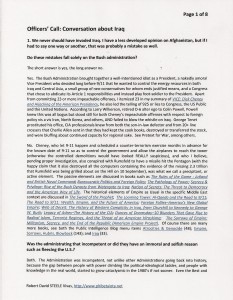
While we were in Denmark, an officer now serving in Iraq sent us some questions that we answered to the best of our ability.  The questions alone are listed here.  For the answers, click on the cover.

1. We never should have invaded Iraq. I have a less developed opinion on Afghanistan, but if I had to say one way or another, that was probably a mistake as well.

Do these mistakes fall solely on the Bush administration?

Was the administrating that incompetent or did they have an immoral and selfish reason such as fleecing the U.S.?

Was it shortsighted political gain objectives with an underestimation of the downside?

We will have at least double the amount of dead service members before these conflicts are over as were killed during the 9/11 attacks.  I read somewhere that we have 75,000 amputees due to the two conflicts not to mention the amount of PTSD.  Who has the blood on their hands? Certainly nobody is willing to admit mistakes.

I don't understand how Cheney can even think about spouting off after how the conflicts have gone. Where is the cost vs gain analysis?

2. Once we did invade, we didn't have a solid plan and we didn't bring nearly enough troops if we planned on staying. Was this mainly Rumsfeld's fault?


Continue reading “Officers’ Call–Conversation About Iraq I”

Journal: Abnormal Abductive Advances

Collaboration Zones, Communities of Practice, Ethics, Key Players, Policies, Threats, True Cost

WIRED Danger Room Full Story Online

‘Impossible’ Device Could Propel Flying Cars, Stealth Missiles

David Hambling October 29, 2009

The Emdrive is an electromagnetic drive that would generate thrust from a closed system — “impossible” say some experts.

To critics, it’s flat-out junk science, not even worth thinking about. But its inventor, Roger Shawyer, has doggedly continued his work. As Danger Room reported last year, Chinese scientists claimed to validate his math and were building their own version.

Shawyer gave a presentation earlier this week on the Emdrive’s progress at the CEAS 2009 European Air & Space Conference. It answered few questions, but hinted at how the Emdrive might transform spaceflight — and warfare. If the technology works, that is.

Continue reading “Journal: Abnormal Abductive Advances”

Journal: US Lacks Basic Intelligence at the Top

Collaboration Zones, Communities of Practice, Ethics, Key Players, Policies, Strategy, Threats

CNS News Full Story Online

New Study Reveals Connection Between Enforcing Immigration Laws and National Security

Friday, October 30, 2009

By Penny Starr, Senior Staff Writer

A new study by the conservative think tank Center for Immigration Studies (CIS) reveals the connection between enforcing immigration laws and national security – sometimes in chilling detail.

Phi Beta Iota: It's all connected. Until the US Government understands the two graphics below (each leads to a separate briefing any adult should be able to comprehend), the Republic will continue its nose dive into the cluster of Third World nations we have abused and now will join for lack of integrity and intelligence among our leaders, military as well as civilian.

Continue reading “Journal: US Lacks Basic Intelligence at the Top”

Journal: US Naivete In Afghanistan, Neglecting Iraq

05 Civil War, 08 Wild Cards, 10 Security, Methods & Process, Military, Peace Intelligence, Policy, Strategy

AP IMPACT: Troops already outnumber Taliban 12-1

BRUSSELS – There are already more than 100,000 international troops in Afghanistan working with 200,000 Afghan security forces and police. It adds up to a 12-1 numerical advantage over Taliban rebels, but it hasn't led to anything close to victory.

Transcripts Of Defeat

London — THE highly decorated general sat opposite his commander in chief and explained the problems his army faced fighting in the hills around Kabul: “There is no piece of land in Afghanistan that has not been occupied by one of our soldiers at some time or another,” he said. “Nevertheless much of the territory stays in the hands of the terrorists. We control the provincial centers, but we cannot maintain political control over the territory we seize.

Continue reading “Journal: US Naivete In Afghanistan, Neglecting Iraq”

Search: Civitas Maxima

Collaboration Zones, Communities of Practice, Ethics, Key Players, Mobile, Policies, Real Time, Searches, Threats

Intriguing and illuminating.  Thank you.

Amazon Page
Amazon Page

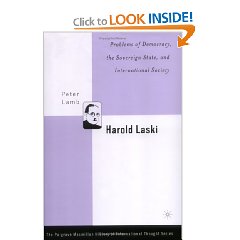
Harold Laski: Problems of Democracy, the Sovereign State, and International Society

Laski's concerns turn out to have much in common with those of present-day social democratic commentators – in particular the capacity of a state to effect social justice in conditions of global interdependence.

Peter Lamb's study of this overly neglected thinker is a highly relevant recovery. This lucid, well-judged and sympathetic account of Laski's later thought on the ‘myth' of the sovereign state is highly pertinent for cosmopolitan democrats, students of normative international relations and seekers of a genuinely radical ‘third way'.

Continue reading “Search: Civitas Maxima”

Journal: True Cost of Drugs

07 Health, True Cost

Explaining Research – How much do drugs really cost to develop?

Although this does not seem like a fact that most people would commit to memory, somehow the average American has come to know that, not only is it insanely expensive to create a new drug and bring it to market, but it is expensive to the tune of $800 million dollars. Why is this important?  It is the reason most often cited for why medications are so expensive in the United States.

So what is wrong with the figure?  A number of things.  First, let’s just approach the study from an economic standpoint.  The actual out of pocket costs for developing a drug in the Tufts study were about $400 million, half of the final number.  How did it get to $800 million then? Through a fancy piece of economic sleight of hand known as “opportunity costs of capital.”

Continue reading “Journal: True Cost of Drugs”

Journal: True Cost of Coal

05 Energy, True Cost
Full Story Online
Full Story Online

Coal Costs the US $62 Billion in External Costs –

NRC Report

October 28th, 2009

Last week the National Research Council (part of the National Academy of Science) released a report that the US Government commissioned back in 2005 to find the true cost of our energy titled, “Hidden Costs of Energy: Unpriced Consequences of Energy Production and Use.”

The quick and dirty: Our energy production and use in 2005 cost us $120 billion in externalities, over half of which, $62 billion, come from coal.

noble gold