The modern world has become a multi-strata layering of bullshit in the form of propaganda. The layers are so multiple and piled so deep that everyone seems to have forgotten where they put the truth. I was going to say that it's like a train of propaganda, where each individual car acquires mass from being linked to every other car. But even that understates it. Rather than a linear train of propaganda, it more like a network of propaganda that spreads out in every direction, creating a fog of illusion that even the best of us have difficulty completely seeing through.
From rap to ‘radicalisation scores', today's e-jihadists are more than just consumers – but they tend to keep it all online
Jarret Brachman
Guardian, 3 February 2012
EXTRACT:
In 2012, al-Qaida's senior leadership is several heartbeats away from extinction. Their affiliate groups in Yemen, Algeria and elsewhere remain embattled. What remains is a global support movement that is rabid, technologically empowered, but less concerned with the al-Qaida brand name or all that came along with it. Al-Qaida's global movement today is sloppy and self-centred. It is only the most zealous few who seek to live up to their legendary status in the virtual world these days. The problem for intelligence and law-enforcement professionals is identifying that needle in the online jihadi haystack.
Phi Beta Iota: There are two competing narratives, neither of which is properly researched and documented. Narrative A (our tentative preference) has all of these Al Qaeda stories as part of a contrived joint Israeli-led but US supported disinformation campaign to justify armed force against Iran. Narrative B (equally plausible, but the point is we do not actually know) has Iran — these are Persians, not ragheads — well-prepared to do asymmetric attacks via multiple channels including the remnants of Al Qaeda or Al Qaeda posers. This would including exploding apartments in Tel Aviv. We really don't know, and it is a rather important question.
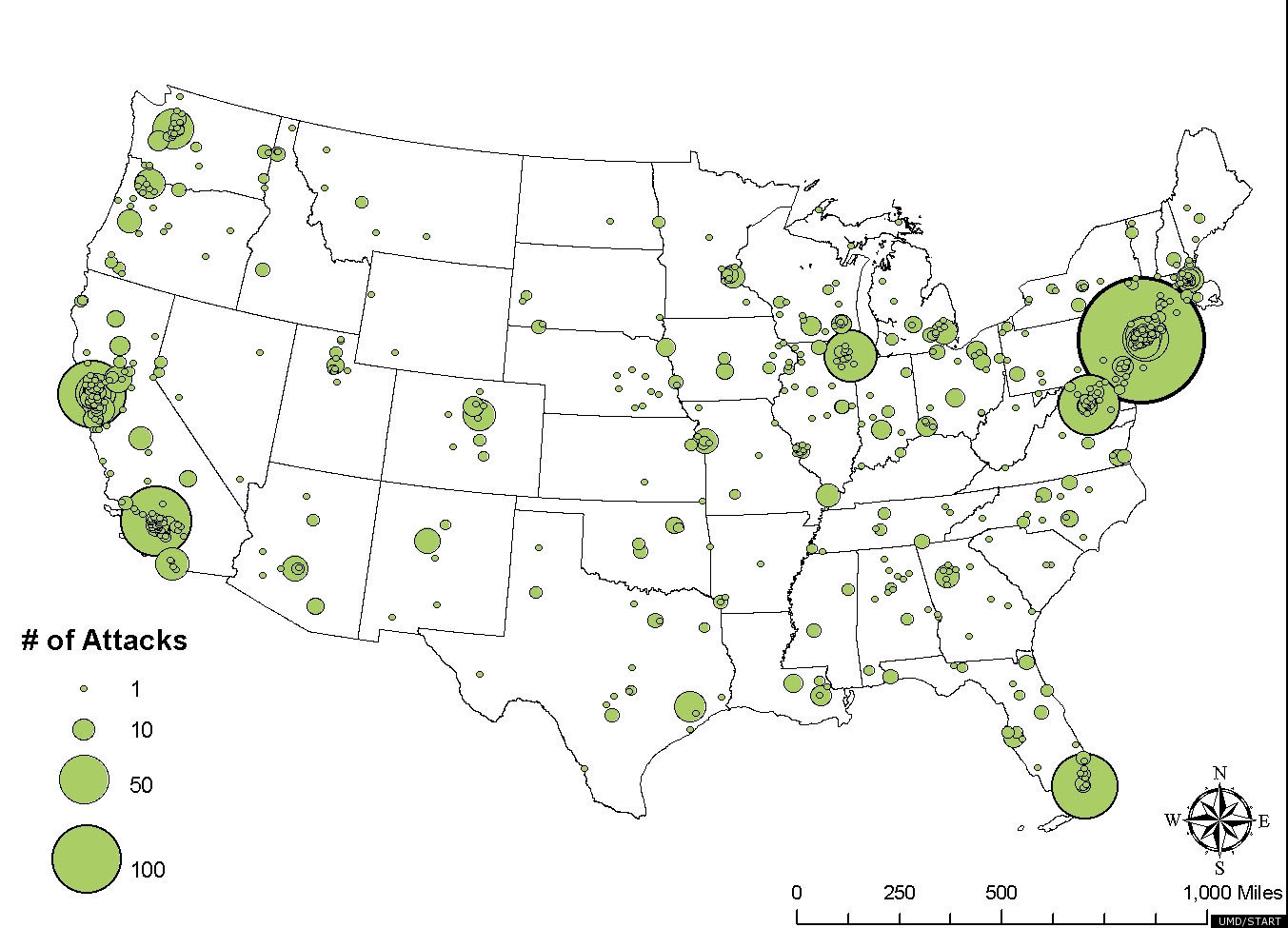
Can science predict where terrorists will strike? Not quite. But researchers at the University of Maryland (UMD) and the University of Massachusetts, Boston (UMB) have created a detailed map of where terrorism attacks have occurred since 1970 – and it reveals some big surprises.
The map's accompanying study, conducted at the UMD's National Consortium for the Study of Terrorism and Responses to Terrorism (START), found that while certain areas (those surrounding Manhattan and Los Angeles, for example) have endured as terror ‘hot spots' throughout the study, others have come and go. In the 2000s, for example, there has been a higher-than-average rate of attacks in Maricopa County, AZ, Phoenix's county. King County, WA, on the other hand, was a terror hot spot in the 1970s and 1980s, but has been largely quiet since.
Click on Image to Enlarge
The START researchers called 65 of the nation's 3,143 counties hot spots, although that only means that these counties experienced higher than the national average of 6 attacks from 1970-2008.
The study, which looked at all 3,143 U.S. counties, also found that terrorism hot spots and motivations have changed dramatically from decade to decade. Where do terrorists come from? In the last decade, many politicians have conjured the image of Islamic fundamentalists from the Middle East. But in the 1970s, many attacks classified as ‘terrorist' came from left-wing groups in Berkeley, San Francisco and surrounding areas.
The research showed a strong association between the county in which a terrorist attack occurred and its motivation. “For example,” a University of Maryland statement notes, “Lubbock County, Texas, only experienced extreme right-wing terrorism while the Bronx, New York, only experienced extreme left-wing terrorism.”
Similarly, particular ideologies' inclination to terrorist attacks varied over the years.
“The 1970s were dominated by extreme left-wing terrorist attacks,” co-author Bianca Bersani, assistant professor of sociology at UMB, said. “Far left-wing terrorism in the U.S. is almost entirely limited to the 1970s with few events in the 1980s and virtually no events after that.” Perhaps unsurprisingly, domestic left-wing terrorism overwhelmingly took place in the San Francisco Bay area during the Vietnam War.
Other interesting findings include the fact that “religiously motivated attacks occurred predominantly in the 1980s, extreme right-wing terrorism was concentrated in the 1990s and single issue attacks [‘e.g., anti-abortion, anti-Catholic, anti-nuclear, anti-Castro'] were dispersed across the 1980s, 1990s and 2000s.”
The researchers hope that the insights from the study can be used to determine the relationship between terrorism and ordinary crime, which has historically been much easier to predict.