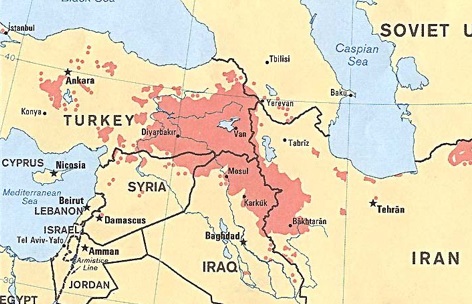
The below Reuters report describes one of the emerging regional complexities being unleashed by the Syrian civil war. At issue is Syria's Kurdish Question — yet another legacy of the dissolution of the Ottoman Empire that continues to haunt the Middle East and the world after almost 100 years. President Wilson's reckless promises of nationhood to all minorities in his 14 Points were not fulfilled by the machinations and back room deals of the Versailles Peace Conference in 1919. Today the Kurds, with a population of about 25 million, are the world's largest ethnic group without a state. But this population sits astride the modern borders Turkey, Iraq, Iran, and Syria, as the map below shows. And so, the Kurdish Question is grounded in the tectonic fault lines of (1) Turkish-Arab-Persian-Kurdish cultures, (2) the shared Fertile Crescent water resources of the Tigris/Euphrates watershed, (3) the larger Sunni-Shia religious schism (most Kurds are Sunni, but some Kurds in Iran are Shia), (4) the wealth and poverty of the northern tier of the Persian Gulf oil basin, and (5) the toxic legacy of Western colonialism (including the Israeli poison pill inserted into the region by an opportunistic then guilt ridden West). In recent years, most of the world's attention has been focused on the Kurdish subquestions in Turkey and Iraq, and to a lesser extent in Iran (don't forget the US sellout of the Iraqi Kurds with the help of the Shah of Iran, who had his own Kurdish problem), while Syria's Kurds have been the most forgotten of these minority questions — but as the attached report shows, the Syrian civil war has unleashed a new dimension to active Kurdish separatism that greatly complicates an already complicated regional situation.
Syrian Kurds' military gains stir unease
BY ERIKA SOLOMON AND ISABEL COLES
BEIRUT/ARBIL Mon Nov 11, 2013
(Reuters) – With a string of military gains across northeastern Syria, a Kurdish militia is solidifying a geographic and political presence in the war-torn country, posing a dilemma for regional powers.
Long oppressed under Syrian President Bashar al-Assad and his father before him, Kurds view the civil war as an opportunity to gain the kind of autonomy enjoyed by their ethnic kin in neighboring Iraq.
But their offensive has stirred mixed feelings, globally, regionally and locally, even among some fellow Kurds, who say the Kurdish fighters have drifted into a regional axis supporting Assad, something they deny.

 Nearly 100 years after its creation, the power of the U.S. Federal Reserve has never been greater. Markets and governments around the world hold their breath in anticipation of the Fed Chairman's every word. Yet the average person knows very little about the most powerful – and least understood – financial institution on earth. Narrated by Liev Schreiber, Money For Nothing is the first film to take viewers inside the Fed and reveal the impact of Fed policies – past, present, and future – on our lives. Join current and former Fed officials as they debate the critics, and each other, about the decisions that helped lead the global financial system to the brink of collapse in 2008. And why we might be headed there again. (From