This is very much an edited work, with most of the entries being but two or three pages in length. All of the authors are world-class proven naturalists and related professionals, and the photography that accompanies each work is top of the line. Of all the bio-diversity books available, this one appears to be both the easiest to digest and the most pleasing to the eye.Biodiversity is an option-generator. More diversity, more options for the future. See also Howard Bloom, World Brain.
Hyperdisease happens more often than we might think, and is very relevant to concerns today about the collapse of public health. See also Laurrie Garrett, Betrayal of Trust.
Biological elements are being inserted into commercial off the shelf products with unanticipated effects, some of which are damaging to humans. One noteworthy example: Corning added an ingredient to its tubes to make them less brittle, and scientists were finding their experiments infected and contaminated. Corning would not reveal what had changed, claiming it was a trade secret. Independent investigation finally determined that there was a synthetic chemical mimicking estrogen and having the effect of an estrogen injection on the cells exposed to the Corning tubes. Buyers beware–there would appear to be some disclosure standards required!
Mass catastrophes have occurred many times over history, eliminating up to 75% of all living things, with varied outcomes in the millions of years thereafter. See also David Keys, Catastrophe, on the most recent, the Dark Ages, circa 535 A.D.
Naturalists and natural science–the study of nature in its own environment, are endangered. Most universities are failing to support this vital area of study, with a result that our understanding of nature stems largely from lab work and computer models that are far removed from reality. See also John Paul Ralston, Voltaire's Bastards.
I highly recommend this book. It is both discouraging (so much yet to be done to stabilize the world) and encouraging (many good things being done by many small groups).
Most Miss Point: Book Excells At Highlighting Our Weaknesses,
>November 3, 2001
Wesley K. Clark
Every citizen should read this book so they can instruct their elected representatives and vote for military reform. As things now stand, we will lose the war on terrorism over time because of the perennial flaws in our system that this book identifies.Don't Bother Us Now. The U.S. political system is not structured to pay attention to “early warning”. Kosovo (as well as Croatia and Serbia beforehand and later Macedonia) were well known looming problems, but in the aftermath of the Gulf War, both Congress and the Administration in power at the time said to the U.S. Intelligence Community, essentially: “don't bother us anymore with this, this is inconvenient warning, we'll get to it when it explodes.” We allowed over a hundred thousand to be murdered in genocide, because our political system was “tired.””Modern war” is an overwhelming combination of micro-management from across the varied nations belonging to the North Atlantic Treaty Organization; a reliance on very high-tech weapons with precision effect that are useless in the absence of precision intelligence (and the lawyers insist the intelligence be near-real-time, a virtual impossibility for years to come); and an obsession with avoiding casualties that hand-cuffs our friendly commanders and gives great encouragement to our enemies.
Services versus Commanders. The military services that under Title 10 are responsible for training, equipping, and organizing the forces–but not for fighting them, something the regional commanders-in-chief must do–have become–and I say this advisedly–the biggest impediment to the successful prosecution of operations. The detailed story of the Army staff resistance to the use of the Apache helicopters is the best case study I have ever seen of how senior staff generals with political access can prevent operational generals with field responsibilities from being fully effective. In combination with the insistence of the services that forces be held back for Korean and Persian Gulf threats that might not be realized, instead of supporting a real war that existed in Europe, simply stated, makes it clear that there is a “seam” between our force-creating generals and our force-fighting generals that has gotten *out of control.* The fog of war is thickest in Washington, and the greatest friction–the obstacles to success in war–are largely of our own making.
Lawyers, Fear, and Micro-Management. Just as we recently witnessed a lawyer overruling the general to avoid killing the commander of the Taliban, General Clark's war was dominated by lawyers, a fear of casualties, and micro-management, from Washington, of his use of every weapons system normally left to the discretion of the field commander. This has gotten completely out of hand. Within NATO it is compounded by multi-national forces whose commanders can refuse orders inconsistent with their own national view of things, but reading this book, one is left with the clear understanding that General Clark was fighting a three-front war at all times: with the real enemy, with the media, and with Washington–his NATO commanders were the least of his problems.
Technology Loses to Weather and Lacks Intelligence. Throughout the book there are statements that make it clear that the U.S. military is not yet an all-weather military, and has a very long way to go before it ever will be. Aligned with this incapacity is a high-technology culture that suffers from very weak maintenance and an almost complete lack of intelligence at the level of precision and with the timeliness that is needed for our very expensive weapons to be effective. Nothing has changed since MajGen Bob Scales wrote his excellent Firepower in Limited War, pointing out that artillery still cannot be adequately supported by the intelligence capabilities we have now.
Strategic Mobility Shortfalls, Tactical Aviation Constraints. Although General Clark judges the air war to have been a success, and an essential factor in facilitating “coercive diplomacy”, he also communicates two realities about U.S. military aviation: 1) we do not have the strategic aviation lift to get anywhere in less than 90-180 days, and his request for a 75 day mobilization was not possible as a result; and 2) our tactical aviation assets are so specialized, and require so much advance preparation in terms of munitions, route planning, and so on, that they cannot be readily redirected in less than a full day. A full day. This is simply outlandish.
We Don't Do Mountains. No statement in the book hurt me more than one by an Army general telling General Clark that his plans for the ground campaign could not be supported by the U.S. Army because “we don't do mountains” This, in combination with the loser's attitude (no casualties) and the general reluctance of the services to put their high-tech capabilities like the Apache at risk in a real war, sum up the decrepitude of the U.S. military leadership and the Revolution in Military Affairs-Andrew Gordon in Rules of the Game has it exactly right-the post Viet-Nam and post Cold War era has left us with a bunch of high-tech chickens in control of military resources, and we need to find ourselves some rat-catchers able to redirect our military toward a lust for man to man combat in every clime and place-and the low-tech sustainable tools to do the job.
General Clark's concluding words, on page 459: “In Kosovo my commanders and I found that we lacked the detailed prompt information to campaign effectively against the Serb ground forces. Most of the technologies we had been promoting since the Gulf War were still immature, unable to deal with the vagaries of weather, vegetation, and urban areas, or the limitations of bandwidth and airspace. The discrete service programs didn't always fit together technically. And (sic) the officers who operated the programs were not qualified to work across service lines and did not understand the full range of national capabilities. I worried about the nature of Joint skills even among senior officers.” Are we ready? No.
The Heart of Asymmetric Advantage is NOT Technology,
October 28, 2001
MacGregor Knox
This is the only serious book I have been able to find that addresses revolutions in military affairs with useful case studies, a specific focus on whether asymmetric advantages do or do not result, and a very satisfactory executive conclusion. This book is strongly recommended for both military professionals, and the executive and congressional authorities who persist in sharing the fiction that technology is of itself an asymmetric advantage.
It merits emphasis that the author's first conclusion, spanning a diversity of case studies, is that technology may be a catalyst but it rarely drives a revolution in military affairs–concepts are revolutionary, it is ideas that break out of the box.
Their second conclusion is both counter-intuitive (but based on case studies) and in perfect alignment with Peter Drucker's conclusions on successful entrepreneurship: the best revolutions are incremental (evolutionary) and based on solutions to actual opponents and actual conditions, rather than hypothetical and delusional scenarios of what we think the future will bring us. In this the authors mesh well with Andrew Gordon's masterpiece on the rules of the game and Jutland: we may be best drawing down on our investments in peacetime, emphasizing the education of our future warfighters, and then be prepared for massive rapid agile investments in scaling up experimental initiatives as they prove successful in actual battle.
The book is noteworthy for its assault on fictional scenarios and its emphasis on realism in planning–especially valuable is the authors' staunch insistence that only honesty, open discussion among all ranks, and the wide dissemination of lessons learned, will lead to improvements.
Finally, the authors are in whole-hearted agreement with Colin Gray, author of Modern Strategy, in stating out-right that revolutions in military affairs are not a substitute for strategy as so often assumed by utopian planners, but merely an operational or tactical means.
This is a brilliant, carefully documented work that should scare the daylights out of every taxpayer–it is nothing short of an indictment of our entire current approach to military spending and organization. As the author's quaintly note in their understated way, in the last paragraph of the book, “the present trend is far from promising, as the American government and armed forces procure enormous arsenals only distantly related to specific strategic needs and operational and tactical employment concepts, while continu[ing], in the immortal words of Kiffin Rockwell, a pilot in the legendary First World War Lafayette Escadrille, to ‘fly along, blissfully ignorant, hoping for the best.'”
Lest the above be greeted with some skepticism, let us note the 26 October 2001 award of $200 billion to Lockheed for the new Joint Strike Fighter calls into serious question whether the leadership in the Pentagon understands the real world–the real world conflicts of today–all 282 of them (counting 178 internal conflicts) will require the Joint Strike Fighter only 10% of the time–the other 90% of our challenges demand capabilities and insights the Pentagon is not only not capable of fielding, it simply refuses to consider them to be “real war.” Omar Bin Laden beat the Pentagon on 11 September 2001, and he (and others who follow in his footsteps) will continue to do so until we find a military leadership that can lead a real-world revolution in military affairs…. rather than a continuing fantasy in which the military-industrial complex lives on regardless of how many homeland attacks we suffer.
Gets Many Big Things Right–But Revolution Fizzles,
October 28, 2001
Bill O'Reilly
This is a really great book with 20 short chapters that span the full range of American life from class, money, and sex to politics, race, religion and personal relations.
There are some really sharp insights here, and a fundamental honesty, that should inspire the majority of voters–those who earn an honest wage and go about their business while being polite to others.
Best of all, O'Reilly has beat the media system and earned the power to tell it as he sees it, without bowing to the censorship that characterizes most news programs today, obsessed as they are with entertainment.
There is a down side–this one man show is just that, and both his own Republican party as well as the Democratic party have both sold out to class, corporate money, and a status quo that has the average tax payer paying for all the perks at the top.
There is a lot of beef to O'Reilly, but as one who agrees with most of what is on his mind, I am left with the unanswered question: where's the revolution? Where are campaign finance reform and a massive turn-out of voters able to take back the government and bring common sense back into government?
O'Reilly talks a good show, let's see if he can take it to the next level and start both a web site and a popular reform movement.
Together with “Enigma” and “The Black Tulip” by Milt Bearden, and of course the George Smiley series by John Le Carre, this is one of my few really recommended fictional accounts related to espionage.The art of lying to one's own people, at multiple levels of duplicity, some venal, much of it unnecessary, has helped to mystify, confuse, and sometimes glorify the intelligence profession.
As an intelligence professional myself, I will simply say that this is one of my top six and that it would not be called fiction if it did not depart for the pure realities as much as it does. This book captures the “essence” of duplicity within government in a time of war, and I find the whole book absolutely captivating and worthwhile.
For captivating true life signals intelligence there are several books one can go to, including those by James Bamford on the American system (Puzzle Palace, Body of Secrets) but for really getting into the enormity of the challenges and the thrill of the individual code-breakers when they succeeded, this is the book I recommend.
It completely ignores the enormous contributions made by the Poles (who gave the English two Enigma machines at the beginning of the war) as well as the heroic deeds of Tommy Brown (youngest George Medal winner at 16, survived with code materials taken from a sinking German ship), but I have found no better novel to communicate the absolute goose-bump emotional roller-coaster that the Bletchley Park gang experienced.
If anything, this novel convey a human side to code-breaking that offsets the modern-day obsession with massive computers.
Brilliant, Relevant Today, OpIntel Thrills, Deep Insights,
September 30, 2001
Patrick Beesley
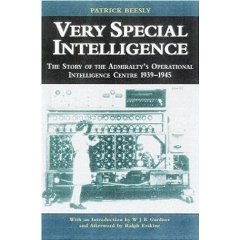
This is a brilliant piece of work, and extremely relevant today. Had America had an Operational Intelligence (OpIntel) Plot (24/7 operationally-oriented put it all together all the time watch center), I daresay the terrorist attacks on America would have been prevented in good time.I started reading this book the week prior to the attacks, having bought it off the shelves of the Army War College bookstore, whose judgment I have always respected, and I have been absolutely absorbed–thrilled–with the deep insights that this work provides on how best to manage an operationally-oriented watch center that does “all-source fusion” against a constantly changing real-time real-world threat.
It became clear to me as I worked through every word of this superior work that modern intelligence has become too bureaucratic and that all-source analysis has become too distant from both the sources and the consumers. The Operational Intelligence Center (OIC) whose story is told here worked with no fewer than seventeen distinct sources streams, each with its own idiosyncrasies, its own fits and starts–and it worked directly with its operational clients, fully appraised of friendly plans and intentions and able to provide workmanlike inputs at every turn. We need to get back to this approach!
There are a number of vital lessons to be learned from this book, which I recommend in the strongest terms as one of my “top ten” relevant *today*. Among them:
Sharing Secrets Matters. It was the Russians who helped the British get started in 1914 with a gift of a German Naval Signal book, and it was the Poles who saved the day early on in World War II with a gift of two working Enigma machines.
Ops Must Sleep With Intel. Too many times I have seen operators ignore intelligence because they do not understand it-there are too many breakdowns in communication along the way, and if the operators have not trained with, lived with, slept with, caroused with, their intelligence counterparts, the two cultures do not come together effectively in times of crisis.
Ops Cannot Do Raw Sources. The corollary of the above is that Ops simply cannot keep up with the nuances of sources and is not able to evaluate sources in context to good effect.
Intel Must Sleep With Ops. The intelligence propensity to compartment everything to the point of meaningless, and the “green door” mentality that is especially characteristic of the crypto-analysis community, amounts to a death wish. Some secret sources must be “ultra” secret, but some form of bridge is needed-the OpIntel Center (which the U.S. Navy, alone within today's US secret bureaucratic archipelago, does well) appears to be a vital and relevant solution.
Plots Must Be Co-Located and Ideally Integrated. Early separation and distance between the intelligence plot, the commercial shipping plot and the operational plot leads to waste and death. Ultimately an integrated plot, or at least a blue-green plot next door to the red plot, is absolutely vital to effective prosecution of real-time war.
Lose the Old Guys. The first thing that needs doing when preparing for a long war is to lose the old guys. No disrespect intended, but as has been documented time and again, those that get promoted in peacetime bureaucracies tend to be too conformist and too subservient to peacetime protocols to adapt well to unconventional and very fast-moving wartime conditions. [Present company always excepted!.]
Hire the Retired. This is not a contradiction. Old guys with big egos and high ranks have to go-but bringing in the best of the retired, generally at the field grade level, can have an extraordinary positive impact in the rapid maturation and stabilization of the full-speed-ahead wartime watch.
Doctrinal Disputes Kill. Unless there is a homeland defense doctrine that fully integrates and exercises the capabilities and internal cultures of the Air Force, Navy, Coast Guard, and civilian agencies (and civilian agencies!) there will be a year or two of major and almost catastrophic losses until it gets sorted out the hard way.
Home Arrogance Kills (UK Version). The persistent unwillingness of home side personnel to admit that their own security measures can be broken by clever enemies, and the general sloppiness of all hands with respect to Operations Security (OPSEC) will take a heavy toll.
Home Arrogance Kills (US Version). There is a theme with regard to the Americans. While their money and their manpower are gratefully accepted, their arrogance knows no bounds. They entered the war believing that there was nothing the British could teach them-further on into the war, the Americans risked Ultra by acting too aggressively on its information.
Red Cell Oversight Needed. One thing that jumped out at me from this book was the urgent need for having a very senior person-a retired Chairman of the Joint Chiefs of Staff, for example, managing a Red Cell to provide oversight over operational decisions to exploit the most sensitive sources. [By this I mean, a senior authority who can overrule and forbid operations whose success might endanger the special source.]
Negative Reports Matter. I was really struck by the circumstances surrounding a German break-out up the Channel, in which a number of normally reliable and overlapping intelligence collection endeavors all were forced back by weather, broken down or what-not. From this I took the lesson that negative reports matter. By failing to report to the OIC on their non-status, they failed to focus the OIC on all the possibilities. Thinking the flank covered, the OIC left the flank open.
Tommy Brown Matters. The book ends on a marvelous note, pointing out that without the heroism of Tommy Brown, a 16 year old cabin boy and youngest recipient of the George Medal as well as two other adults who died in the process of grabbing vital enemy signals materials off a sinking vessel, the allies would have been deaf for much of 1943. At the end of the day the best technical intelligence comes down to a brave human who risks all to make it possible.