Review: Nemesis–The Last Days of the American Republic

4 Star, Empire, Sorrows, Hubris, Blowback

NemisisSorrows of Empire is Better,

March 2, 2007

Chalmers Johnson

I found this book to be disappointing. Sorrows of Empire, by the same author, is better than both this book, and his first book in the same theme, “Blowback.”

This is as good a current review as any, with respect to America's unilateral militarism and the corruption associated with the military-industrial complex. It ends appropriately with a focus on the lunacy of trying to “dominate” space, something the Chinese just demonstrated is impossible with their successful destruction of a satellite in space, from the ground.

The book, as some other reviewers suggest, very uneven. There are many other books I have read that go well beyond this one, such as Chomsky's books, “War is a Racket,” “The Cheating Culture,” “Confessions of an Economic Hit Man,” “The Soul of Capitalism,” and so on (see all my lists).

The final chapter highlights the recurring themes across the three books:

a) The use of Executive secrecy to avoid Congressional and public oversight

b) The illegal Executive “signing statements” and other renunciations of explicit legislative mandates

c) The degree to which special interests, and especially special interests from within the military-industrial complex

d) The vulnerability of the US economy, which now focuses largely on military production while out-sourcing most other manufacturing

e) The Enron-style accounting that characterizes the Pentagon, which in my personal view is a sophisticated means of stealing money from the indidividual taxpayer, and transferring it to the major corporations and the banks behind them

The book ends with a mix of resignation and hope. Americans can choose, in 2008, between Empire and Democracy. It is doubtful that Bush and Cheney will be impeached. The degree to which the public has ignored all the evidence commonly understood by the 9-11 Truth Movement, and all of the evidence about White House manipulation and fabrication of intelligence with respect to Iraq, Iran, and North Korea, is quite troubling.

AA Mind the GapClick Here to Vote on Review at Amazon,

on Cover Above to Buy or Read Other Reviews,

I Respond to Comments Here or There

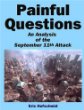
Review: Painful Questions–An Analysis of the September 11th Attack

6 Star Top 10%, 9-11 Truth Books & DVDs

Painful QuestionsThe Author Hits It Out of the Park–Video is Spectacular,

March 2, 2007

Eric Hufschmid

This is one of the best 9-11 books (with its own video) and I am persuaded by this author and others that 9-11 has not been properly investigated, and that there has been a major cover-up. The video is very powerful, very detailed, very thoughtfully narrated, and carries this book and this author to the very top of the list of reasoned and thus authoritative contributions.

Unlike the other 9/11 books I have reviewed, this book, which is letterhead size, is a brilliantly compelling collection of color photographs, color diagrams, thoughtful calculations, and plain text in two columns. The book and the DVD represent, in my opinion, the single best personal effort, and the single most credible case, to the effect that 9-11 was a huge scam on the American public.

The book, and the DVD, are *exhaustive*. There is no better word.

I especially like the author's discussion of the Oklahoma City bombing as a preview of a diversion (the truck bomb versus two airplanes) combined with controlled demolitions. Unexploded bombs are reported to have been found at the Federal Building, with news clippings. The author also covers the destruction of a wedding hall in Israel, and the downing of an Egyptian airplane, as rehearsals for 9-11.

I personally believe that the WTC were brought down by controlled demolitions planted by order of Larry Silverstein, but I am not certain if his action was done in partnership with Rudy Guliani and Dick Cheney, or on his own. The author does not mention the aspestos problem facing Larry Silverstein, for that I recommend viewing the DVD “Loose Change” as well as “9/11 The Press for Truth.”

I also believe that the evidence strongly suggests that the Pentagon was hit by a missile fired by the US, and that there has been a massive cover-up.

I am relatively certain that 9-11 was allowed to happen, and that the majority of those who died–over 80%–died by order of Larry Silverstein, with or without the explicit protective consent of Dick Cheney.

I am quite certain that the 9-11 Commission was a deliberate cover-up, and that Controlled Demolition, all of the WTC security people, the insurance executives, and key Pentagon officials have not been properly investigated.

One day these monsters will be held to account. I have to say, on the basis of all that I have read, viewed, and thought, that it is not Bin Laden that has brought down the Republic, but rather Dick Cheney. Our most fearsome enemies are domestic, not foreign.

Bottom line: the political leadership of America can not be trusted and are almost certainly guilty of high crimes and misdemeanors (see my lists on holding Cheney accountable, and on impeachment guides for citizens).

For those skeptics that continue to believe their government, see the points made in my reivew of the below superb revisionist history:
Someone Would Have Talked: The Assassination of President John F. Kennedy and the Conspiracy to Mislead History

AA Mind the GapClick Here to Vote on Review at Amazon,

on Cover Above to Buy or Read Other Reviews,

I Respond to Comments Here or There

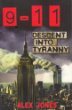
Review: 9-11 Descent into Tyranny–The New World Order’s Dark Plans to Turn Earth into a Prison Planet

5 Star, 9-11 Truth Books & DVDs

9-11 DescentImportant Pieces of the Puzzle,

March 2, 2007

Alex Jones

I agree with those that suggest that the author goes over the top sometimes, but I will also be quite explicit in saying that I think Alex Jones is a very important part of the patriotic truth movement, and all that he does is in my view at least 80% vital to improving public intelligence in the public interest.

This book plays out a theme that relates the bombing of the Federal Building in Oklahoma with 9-11, and I read through it at the same time that I was watching the DVD “Painful Questions” which actually had news clips about additional unexploded bombs being found in the Federal Building after the fact.

I am increasingly frustrated as I read so many of these books, each with vital tid-bits, many of which I can see correlating with one another, but yet no one anywhere has cut the spines off all these great books, digitized them, and created a visual diagram that makes sense of all this.

One thing I am certain of: the White House and Larry Silverstein are both hiding information from the public, and one day we will have proof of the degree to which elements of our own government allowed 9-11 to happen and went the extra step of helping to murder thousands of Americans solely and exclusively to manipulate a mandate for combining a police state at home with a unilateral ;militarism-terrorism abroad.

AA Mind the GapClick Here to Vote on Review at Amazon,

on Cover Above to Buy or Read Other Reviews,

I Respond to Comments Here or There

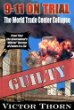
Review: 9-11 on Trial

5 Star, 9-11 Truth Books & DVDs

9-11 On TrialClassic Example of Public Intelligence,

March 2, 2007

Victor Thorn

This is yet another of the many excellent books from Pregressive Press, with lots of details and lots of common sense.

My only regret is that despite the many excellent blogs and websites surrounding the 9-11 lies and deceptions, there is still no single sense-making facility that could “rack and stack” specific individuals like Dick Cheney, Rudy Guliani, and Larry Silverstein such that the public could demand, and get, indictments and grand jurys and everything else.

AA Mind the GapClick Here to Vote on Review at Amazon,

on Cover Above to Buy or Read Other Reviews,

I Respond to Comments Here or There

Review: World Population and Human Values–A New Reality

5 Star, Environment (Problems), Environment (Solutions), Strategy, Values, Ethics, Sustainable Evolution

AA Book CoverA Classic from the Originator of “Epoch B”,

March 2, 2007

Jonas Salk

I sought this book out used because it was recommended to me by a very smart person thinking about the decline of governments and the rise of the corporation.

Salk was the originator of the concept of “Epoch B” leadership, in which the emphasis shifts from things to thoughts.

Since it is no longer readily available, I will highlight the three charts that conclude the book:

1) A ladder with feedback loops with the following circles stacked above one another: Ecology, Society, Individual, Physiology, Molecular Biology.

2) Epoch B characteristics: Values and Behavior in Equilibrium instead of Growth & Expansion; Technology balancing between Agricultural and Future Industrial (True Cost/Natural Capitalism); Environmental Carrying Capacity Stable and Declining rather than Increasing; and Low Growth Raates instead of High.

3) Finally, in triangles within a circle, we have the Exnvironmental Opportunities and Limitations articulated through the Social, Policial, and Ecnomic sides of the largest triangle. Within that triangle, we have Education, Religion, and Socioeconomic Conditions as the factors impacting on the individual. The intermediate triangle has Behavior, Attitudes, and Values surrounding the smallest triangle, which is labeled Bio-Evolution.

The bottom line on this book, as with Will and Ariel Durant's “Lessons of History,” is that the endgame is about morality, legitimacy, reconcilation, and balance.

AA Mind the GapClick Here to Vote on Review at Amazon,

on Cover Above to Buy or Read Other Reviews,

I Respond to Comments Here or There

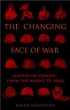
Review: The Changing Face of War–Lessons of Combat, from the Marne to Iraq

5 Star, War & Face of Battle

Changing Face War5 stars on its chosen focus, 4 for lack of larger context,

March 1, 2007

Martin van Creveld

Martin Van Crevald is one of a handful of military scholars without peer–others I hold is such regard include Colin Gray, Max Manwaring, Steve Metz, and Ralph Peters.

In relation to its chosen focus, the lessons of combat and the changing face of war, this is a capstone book unlike any other, and it will be a long-standing classic in the field, useful as both a primer for those new to the strategic study of war, and for those long in the tooth wishing to reflect back with what comprises a survey of both the literature and the century of war.

The conclusion is daunting. Like Will and Ariel Durant, and Clauswitz, the author concludes that the primary determinant of victory is not mass or technology, but rather the moral factor. Being “in the right,” being on one's home ground, being supported by many others because of solidarity in “being right,” is to money and technology and hubris at 10 to 1 if not 100 to 1.

The conclusion, and the work as a whole, are also slightly disappointing, not because of any imperfection in what is included, but because the book ends where I wished for it to begin. The author notes that asymmetric opponents can only be defeated by either deep precision intelligence that is by definition non-official in cover and native in capability; or pre-emptive attacks that nail all the key individuals early enough to prevent the insurgency from gaining momentum.

By choice, the author does not address the larger moral issues of global behavior, strategic budget priorities, international alliances, global labor standards, anti-corruption measures to prevent American elites from bribing foreign elites to loot their commonwealths for the benefit of the few and against the interests of the many, and so on. In short, this seminal work is out of today's context and does not address tomorrow's needs. Max Manwaring's The Search for Security: A U.S. Grand Strategy for the Twenty-First Century and Uncomfortable Wars Revisited (International and Security Affairs Series) as well as his “Environmental Security” are perhaps better foundations for future leaders contemplating the avoidance of war and the proliferation of peace. Colin Gray's point in Modern Strategy that time is the one thing we cannot replace nor buy, has been lost on the leaders from 1990 to date–we have wasted 50 years (see both The Fifty-Year Wound: How America's Cold War Victory Has Shaped Our World and The Unconquerable World: Power, Nonviolence, and the Will of the People and done terrible damage while wasting trillions.

This book is most valuable as the epitaph for the military-industrial complex in America, but sadly, this Administration not only does not get it, they are expanding the walking dead model into Homeland Security, with the full acquiescence of the largely witness Democratic majority in the House of the Representatives.

The movie War Games like Gandhi (Widescreen Two-Disc Special Edition), got it right. The only way to win a war in today's era is to not fight it at all. General Al Gray, USMC, then Commandant of the Marine Corps, got it right in 1988, writing in the American Intelligence Journal (Winter 1988-1989), about the need to focus on revolutionary and terrorist-spawning conditions, the urgency of funding “peaceful preventive measures,” and the importance of open source information.

Twenty years later, the Americans are giving lip service to “stabilization and reconstruction” while making a complete fiasco of both Afghanistan and Iraq. No less than $12 billion in cash courtesy of the Federal Reserve in New York, has gone missing from Iraq.

There are other works that I recommend in addition to this one. On the counter-insurgency side there is The Sling and the Stone: On War in the 21st Century as well as Learning to Eat Soup with a Knife: Counterinsurgency Lessons from Malaya and Vietnam; see also my varied lists including the asymmetric war list. At the higher level of making peace I recommend Ambassador Mark Palmer's superb Breaking the Real Axis of Evil: How to Oust the World's Last Dictators by 2025; Robert McNamara's DVD The Fog of War – Eleven Lessons from the Life of Robert S. McNamara as well as the DVD Why We Fight; and Blight & McNamara, Wilson's Ghost: Reducing the Risk of Conflict, Killing, and Catastrophe in the 21st Century as well as William Shawcross's Deliver Us from Evil: Peacekeepers, Warlords and a World of Endless Conflict. One last recommendation: Peacekeeping Intelligence: Emerging Concepts for the Future.

Brains, not bullets; belief systems, not weapons systems; are what the current and future conflicts are all about. America is way behind the power curve, and all current public intelligence indicators suggest that America will sink to British levels of non-influence, while Brazil, China, India, Indonesia, Iran, Russia, and Veneuzela–and some Wild Cards such as Malaysia, South Africa, and Turkey, “take off” and leave us behind.

Martin Van Crevald is the ultimate scribe of war, and he has closed the era of big war with this superb overview.

AA Mind the GapClick Here to Vote on Review at Amazon,

on Cover Above to Buy or Read Other Reviews,

I Respond to Comments Here or There

Review: Collapse–How Societies Choose to Fail or Succeed

5 Star, Complexity & Catastrophe

Collapse FailSolid, specific, provocative, and useful call to action,

February 26, 2007

Jared Diamond

Let's get a couple of things straight before I enter my review:

1) There is no debate on this issue. There are the honest folk with the facts on their side, and then there are the unethical oil companies (Exxon leading the way) that have adopted the tobacco industry strategy of trying to sow doubt and turn facts into disputable theories, and the intellectual whores who do their bidding for money.

2) What's different today, apart from Al Gore's achieving global effect, is that the public now has a digital memory and digital sense-making. The World Index of Social and Environmental Responsibility (WISER), under the leadership of Paul Hawkin,Blessed Unrest: How the Largest Movement in the World Came into Being and Why No One Saw It Coming is going to do what neither Lester Brown (Plan B 3.0: Mobilizing to Save Civilization, Third Edition) nor Lori Wallich (Seattle street demonstrations against WTO) have been able to achieve. It's over. The people have won. See A Power Governments Cannot Suppress The only question now is how soon we liquidate the dictators and corporations that refuse to attend to the people's needs for a sustainable earth.

Here is my review, focusing mostly on specifics that are not in the other reviews.

Published in 2005, this book is more relevant and more useful now that Al Gore has finally impacted on the public consciousness in a big way. Climate change and global warming are now understood by all to be very real and very close to a tipping point.

It is in this context that I am glad I have waited to read this book. The author has been praised by many for combining an understanding of geopolitics with an understanding of environmental causes and effects. Here are a few of the things that stayed with me:

1. Although the High-Level Threat Panel of the United Nations placed Poverty and Infectious Disease above Environmental Degradation, the author points out that Ecocide must now be seen as much more dangerous to the planet as a whole than either disease of proliferation and a nuclear event (which by the sheerest coincidence, Michael Scheuer of Imperial Hubris: Why the West Is Losing the War on Terror has just told the NYT will happen soon–but see my review of Paul Williams' Osama's Revenge: THE NEXT 9/11 : What the Media and the Government Haven't Told You for a complete overview).

2. The author has conducted arduous research and lined up a number of case studies to support his five part framework of examining the topic of how societies choose to succeed or fail. They are:

a. Environmental degradation, whether man=made or natural
b. Climate change (as distinct from desertification, deforestation, etc.)
c. Hostile neighbors
d. Less friendly neighbors (loss of support)
e. Societies' responses

3. On this latter point, the one thing we have control over, the author reminds me of the book Catastrophe & Culture: The Anthropology of Disaster (School of American Research Advanced Seminar Series), when he lists the following factors as causing disaster to turn into catastrophe and collapse:

a. Lack of anticipation
b. Lack of perception once upon us (denial starts here)
c. Impact of a selfish few unobserved or uncontested by the majority
d. Insulated elite not realizing or caring about impacts on the majority
e. Continued refusal, or inability, to solve the challenges (denial continues here)

The author emphasizes that the principal negative of globalization is that it assures a global collapse–there is no longer any insulation from diseases or other ill-effects of a collapse elsewhere.

Following a detailed review of specific past case studies (you can spend the time in the middle of the book, or read all my other reviews for a more diverse overview), the author lists twelve factors challenging all of us today:

1. Destruction of natural habitats
2. Over-fishing to point oceans and rivers do not replenish
3. Loss of diversity (which is essential to balanced complexity)
4. Soil impoverishment (top soil farming blows away the top soil)
5. Peak Oil and declining availability of fossil fuels for the larger population
6. Dramatic decreases in replenishable fresh water (aquifers down 1 meter each year)
7. REDUCTION of solar energy due to climate change. This was the only thing in the book I did not know already. Climate change REDUCES the degree to which solar energy can be harvested. This is HUGE.
8. Toxic chemicals in the ground, water, and atmosphere (see my reviews of the marvelous books, Pandora's Poison: Chlorine, Health, and a New Environmental Strategy and Blue Frontier: Dispatches from America's Ocean Wilderness as well as The Blue Death: Disease, Disaster, and the Water We Drink
9. Alien species (in sense of rabbits over-running Australia)
10. Human activities
11. Increased population
12 Increased per capita impact (i.e. an order of magnitude worse than just increased population.

There are two paragraphs that in my view are priceless gifts from the author in this context, and the merit quoting here:

Page 429. “The remaining solution to the tragedy of the commons is for the consumers to recognize their common interests are to design, obey, and enforce prudent harvesting quotas themselves. That is likely to happen only if a whole series of conditions is (sic) met: the consumers form a homogeneous group; they have learned to trust and communicate with each other; they expect to share a common future and to pass on the resources to their heirs; they are capable of and permitted to organize and police themselves; and the boundaries of the resource and of its pool of consumers are well defined.”

Page 487. “The public has the ultimate responsibility” to define the accountability of big business and the justice framework that big business must respect.

The latter extract is part of the author's chapter-length observation that without big business on board, nothing the consumer groups do will matter. This is of course true, and the question is, do we win over big business with boycotts, boycotts, new forms of public corporation, and perhaps (my favorite) the end of corporate personality.

The author ends on a positive note: of all the societies facing collapse, only ours, today, has the opportunity to learn from the past. I would add to this, only ours has the Internet and the dramatic increase of transpartisanship among concerned and informed citizens. We the People can indeed restore the power of the people, and the sensibility of the people, to all that hold in trust for the future of Earth and Humanity.

AA Mind the GapClick Here to Vote on Review at Amazon,

on Cover Above to Buy or Read Other Reviews,

I Respond to Comments Here or There

noble gold