Review: A Symphony in the Brain–The Evolution of the New Brain Wave Biofeedback

5 Star, Consciousness & Social IQ, Education (General)

Brain SymphonyIdeal Starting Point–Bigger than Neuropsycholoy,

February 25, 2007

Jim Robbins

EDIT of 6 Julk 09 to point to related new book, Musicology: The Key Concepts (Routledge Key Guides)

I got this book from another person who felt that biofeedback has matured to the point that it is vastly superior to medication for children with attention-deficit disorders, or adults with anger or impatience issues.

Although it was published in 2001, I agree with the reviewers that say this is an ideal starter book. I am so impressed by the very balanced, methodical presentation that this author provides, that I am scheduling a
biofeedback evaluation session to see for myself.

Other reviewers have done a superb job on the meat of this book, so my usual summative review is not necessary. Instead, I want to emphasize the relevance of this book to the future of the planet. As with another book I reviewed over a year ago, on the emergent integration of psychology and neuroscience, I have become convinced that macro-neuroscience (belief systems of entire cultures or grops) and micro-neuroscience (individual issues now responsive to learned biofeedback) are going to become the PRIMARY science ofthe future. We have to cut health care costs in the USA by 75% over the next ten years–there are only three ways to do that: preventive medicine, alternative medicine, and an end to price gouging by big pharma.

The US Government is wasting trillions of dollars on a heavy-metal military that is not only not going to win in Iraq, but is making the problem worse by being an occupying power and by inspiring jihadists worldwide. At the same time, the US Government is talking the talk about Public Diplomacy, Strategic Communication, and Information Operations–a more substantive variation of Psychological Operations (PSYOP), but they are NOT walking the walk. Funding for the understanding and remediation of evil belief systems is non-existent, and funding for ensuring that our own children receive the best and most innovation education is also not there. We should be melding psychology, sociology, anthropology, neuroscience, political and economic science, and so on, and we should be thinking, as Howard Bloom does in “Global Brain” how to bring to bear the full resources of our Nation on creating an educated stable population capable of creating infinite wealth.

This book is therefore, in my opinion, the very tip of the iceberg on what could become the “American Way of Peace” in the 21st Century. First we have to take our government and our military away from the neo-cons, and restore our reputation as America the good. Getting biofeedback introduced very early into all our schools would be an excellent place to start.

This book made a believer out of me, and I am relatively certain that once I experience biofeedback for myself under supervision, I am going to want to adopt it as a personal tool.

Collective Intelligence: Mankind's Emerging World in Cyberspace
Global Brain: The Evolution of Mass Mind from the Big Bang to the 21st Century
The New Craft of Intelligence: Personal, Public, & Political–Citizen's Action Handbook for Fighting Terrorism, Genocide, Disease, Toxic Bombs, & Corruption
The Tao of Democracy: Using Co-Intelligence to Create a World That Works for All
World Brain (Essay Index Reprint Series)

AA Mind the GapClick Here to Vote on Review at Amazon,

on Cover Above to Buy or Read Other Reviews,

I Respond to Comments Here or There
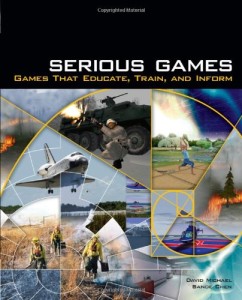
Review: Serious Games–Games That Educate, Train, and Inform

5 Star, Best Practices in Management, Education (General), Education (Universities), Games, Models, & Simulations, Intelligence (Collective & Quantum), Intelligence (Commercial), Intelligence (Government/Secret), Intelligence (Public)
Amazon Page
Amazon Page

Superb Overview for both Novice Games, and Non-Gamer Sponsors of Games,

February 25, 2007

David Michael, Sande Chen

This book is exactly what I hoped for when I ordered it from Amazon. In fact, it is much more. The first part, in three chapters, talks about new opportunities for game developers, defines serious games, and talks about design and development issues.

Then the book surprises. It has entire chapters on EACH of the following: Military Games, Government Games, Educational Games, Corporate Games, Healthcare Games, and a chapter on Political, Religious, and Art Games.

Following final thoughts, the book surprises again. The appendices are world-class. Appendix A is a tremendous listing of Conferences (13 in all), and Organizations (6), Contests (1, Hidden Agenda, $25K prize–we need MORE); web sites (6, less impressive than I hoped), and publications (5). Appendix B is a survey with results, and Appendix C is a very fine bibliography as well as a very helpful Glossary of terms in the field, and an index.

Ever since I saw the US Army sponsor the Serious Games summit, and then saw the emergent success of Games for Change, I realized that we were at the beginning of a major explosion of innovation that could change the world.

In my view, Serious Games need to become the new hub for life-long education, for inter-cultural understanding, and for simulating belief systems, including evil belief systems, at both the macro and micro neuroscience levels. The Earth Intelligence Network was just created this year in order to feed free real-world public intelligence to all Serious Gamers as well as to Transpartisan policy and budget developers.

In my humble opinion, Serious Games is the next big leap in the global Internet, especially when integrated with the Way of the Wiki such that open source software standards can allow games on every threat, every policy, every budget, every location, to interact and to empower the public with tools for sense-making and consensus-building that were once limited to a small elite.

This book was everything I hoped for, and much more. I am not now and never intend to be a game developer. I want to see Serious Games expand from isolated toy-like games that focus on one small issue in isolation, to a vibrant “Co-Evolution” Sphere that in an increasingly accurate representation of the Earth, past, present, and future. This book is my ground zero in observing this field, and I have very high hopes for the future of Serious Games.

Vote and/or Comment on Review


Review: Underground Buildings–More Than Meets the Eye

5 Star, Nature, Diet, Memetics, Design, Values, Ethics, Sustainable Evolution

Underground BuildingsPhenomenal, Practical, Superb Photographs, Detailed,

February 23, 2007

Loretta Hall

At $29 or less, this book is being given away. This is a museum-quality book in terms of the paper, the photographs, the lay-out, and the cover.

I bought this book in part because land is becoming extremely scarce around the great universities and the central business districts, and I was looking for something to help me think through how to persuade a university to let me put a building into a hill or under a playing field.

This book does that. It is a very fast read, the photographs are priceless–worth 10,000 words each as the Chinese would say–and the only thing I did not find in this book were architectural specifics and photos of underlying infrastructure (pump rooms, air cleaning rooms, etc.)

If you are contemplating the need for squeezing a building into an area that is down to the “do not disturb” green space, or if you are contemplating how to exploit existing mines, caverns, or other underground options, this exquisite book is not only useful as a tool for reflection, it will help you “make the sale” to skeptical others you have to get on board.

The author provides a list of 50 places to visit with addresses, telephone numbers, and web sites, a fine resource section for more reading, and an excellent index.

This is an all-around world-class book that is easily worth $49 or more.

AA Mind the GapClick Here to Vote on Review at Amazon,

on Cover Above to Buy or Read Other Reviews,

I Respond to Comments Here or There

Review: Earth-Sheltered Houses–How to Build an Affordable…

5 Star, Nature, Diet, Memetics, Design, Values, Ethics, Sustainable Evolution

Earth HousesInspires Confidence, Crystal Clear, Makes the Option Very Attractive,

February 23, 2007

Rob Roy

I went to some trouble to survey books centered on both underground or into rock dwellings, and also earth sheltered homes, and this book is the best I could find. It has proven to be everything I had hoped for.

This book deals with earth-sheltered homes, which are homes generally built on the ground, and then covered with natural dirt and growth on the roof only, or on the roof and the berms of earth piled against at least two of the sides after the fact of building.

This is a really excellent offering. 12 chapters, 4 appendices, and an annotated bibliography. A number of really nice color photographs on eight pages in the middle of the book, many black and white photos as well as really excellent understandable diagrams.

Take-aways include the need for extremely careful but not over the top load planning, radon as a factor to take seriously, and ANYONE CAN DO THIS.

The book covers waterproofing, insulation, and drainage, to include waste drainage where gravity rather than pumping is strongly recommended. It does not cover electrical and plumbing installation. It covers energy in relation to sunlight and windows and heat retention curtains, but does not include coverage of skylights (except as an energy loss factor), interior lights and other “plumbing.

The bottom line in the book is that a solid earth-sheltered house can be built for $10K to $20K inclusive of appliances, plumbing and so on, which makes it a lot cheaper and greatly more sustainable than a double-wide trailer home, and better in most respects than your average rambler.

With Peak Oil now upon on, the energy saving features of the earth-sheltered home are not to be taken lightly. The author document going without a need for heat from wood burning for almost an entire winter, and documents getting through any winter with 2-3 cords of wood. The home is cool in the summer without airconditioning, in part because of the natural respiration and evaporation of the earth roof with grass, moss, and wildflowers.

I want to end with praise for the publisher. Five or six times now I have bought boooks based on my interest in their content, only to find that New Society Publishers is the provider. They now rank with Wharton Publishing as one of my favored publishers, and I will be keeping an eye out for anything bearing their imprint.

AA Mind the GapClick Here to Vote on Review at Amazon,

on Cover Above to Buy or Read Other Reviews,

I Respond to Comments Here or There

Review: Global Inc.–An Atlas of the Multinational Corporation

5 Star, Atlases & State of the World, Capitalism (Good & Bad)

Global Inc.First Rate Visualization, Can Be Applied to Everything,

February 21, 2007

Medard Gabel

I was trained in the 1970's, and did my undergraduate thesis on “Multinational Corporations: Home and Country Issues.” I could have used this stellar book back then. It does for multinational corporations what “Global Reach” by Richard Barnett did, in the 1970's, but with a powerful method adapted from “State of the World” atlases.

This book could easily be converted into an online interactive serious game for change useful not only to students, but to governments. The book not only charts where and how much the multinationals are doing, but it goes into direct impacts (both benefits and external diseconomies), concluding with an absolutely brilliant section on effects of both governments and multinational corporations across the economic, health, environment, technology, culture, education, and law sectors.

The graphics are in a class by themselves, the notes are effective and to the point (if you're over 50 as I am, you may need granny glasses for some of the fine print), the overall layout is very well done, and the sources as well as the index are top-notch.

One of the principal authors of this book, Medard Gabel, was associated with Buckminster Fuller when they conceptualized the World Game, which today is still an analog gtame with cards, token, and hard-copy maps. The author has moved on to found BigPictureSmallWorld, producing serious games on hunger and other topics, and he points with great respect to Real Lives, by his friend and colleague Bob Runyan, which can be downloaded such that your teen-ager can experience the real life of a Bangladeshi girl or an Iraqi teen-ager before the US invasion.

Not only is this book tremendous on substance, I believe it is, along with State of the World Atlas and other similar books that I have reviewed in the past, the first view of what a real-time live online Earth Game will look like, where individuals can “game” and learn and act at the zip code level, the state/province level, the national level, and the global levels, first setting their social values, then interacting with the ten high level threats, the twelve policies, and the eight major players other than the EU and the US. From such a game will come informed engaged citizens who will demand moral capitalism and honest democracy.

I don't want to over-sell this book, so take the following with a grain of salf: this book is to serious games as the printing press was to the democratization of knowledge. The next big leap for mankind is going to be the use of serious games for change to help individuals at every socio-economic level and in every ideo-cultural milieu, “make sense” of all information in all languages all the time. We are now ready for the Earth Game that will allow the people to complete with elites in publicly solving global problems, and it is my view, and I believe also the view of at least one of the authors of this book, that the people working within an open global game will soundly defeat the elites who have relied for too long on very expensive secret intelligence and the deception and manipulation of public opinion, while restricting public knowledge. That era is OVER, and this book is one of the building blocks for the new world of public intelligence in the public service.

AA Mind the GapClick Here to Vote on Review at Amazon,

on Cover Above to Buy or Read Other Reviews,

I Respond to Comments Here or There

Review: Stokes Beginner’s Guide to Birds–Eastern Region

5 Star, Nature, Diet, Memetics, Design

BirdsPerfect for both novice and experienced bird lovers,

February 19, 2007

Donald Stokes

My oldest son gave me this for Christmas, and I absolutely love it. I have watched birds for years, and learned to attract them from my wife, knowledge that I transferred to my office with a deck overlooking a very large pond that has its own heron. This book sits on the office kitchen table overlooking the range of feeders (two suets, one peanut butter, one standard feeder, and three trays for bluebird worms, bluejay peanuts, and ground-feeder mixed nuts. Two water features, one of them running water.

This lovely little book has first-class photos (and as one reviewer pointed out, is organized by color with the color visible on the edge of the book), and provides short blurbs on appearance, song, preferred areas, and nests, as well as on attracting them–what to put out. Also a regional diagram that is helpful is distinguishing between birds common to the north east versus the south east.

We just participated in the national bird count, and this book surprised me with something I did not know: the difference between the downy woodpecker and the hairy woodpecker (only difference is the latter's longer bill).

This is a great portable reference and from my point of view, the best possible bird book to give to anyone with an interest in observing and attracting birds (provided they live in the Eastern United States).

AA Mind the GapClick Here to Vote on Review at Amazon,

on Cover Above to Buy or Read Other Reviews,

I Respond to Comments Here or There

Review: The Future of American Intelligence

2 Star, Intelligence (Government/Secret)

Future IntelVery Poor–Old, Tired, Out of Touch,

February 18, 2007

Peter Berkowitz

Although I respect Retired Reader very much, and have found his reviews to be very accurate, I take a special interest in the intelligence discipline and the price was right for simply taking a look directly even knowing more or less what I was buying into.

This is a very sad little book. It is the last gasp of the old dogs and the new neo-con puppies trying desperately for relevance in a world that has passed them by. The only two guys in this book that actually know what they are talking about are Reuel Marc Gerecht, former case officer, whose chapter could have been done in two lines:

1) Cut intelligence budget by three quarters, “giving money to CIA is like giving crack to a cocaine addict;” and

2) End official cover and go to a very small cadre of truly extraordinary non-official cover officers.

and Kevin O'Connell, who has the most coherent topic overview.

I will take each of these five shallow and largely out of touch (which is to say, witless about the much larger literature outside the neo-con self-licking self-absorption cone).

The Era of Armed Groups by Richard Shultz. I have to say first that Shultz is a phenomenally good academic, and his edited work “Security Studies for the 21st Century” remains a standard for the field. His chapter in this volume is 20 years too late. I will mention only one seminal work: General Al Gray, then Commandant of the Marine Corps, “Global Intelligence Challenges of the 1990's” as published in the American Intelligence Journal, Winter 1988-1989. General Gray and I (as the senior civilian founder of the Marine Corps Intelligence Command in 1988) championed this for four years inside the US Intelligence Community, from 1988-1992, and from the National and Military Intelligence Boards down, *no one wanted to hear it.*

Truth to Power? Rethinking Intelligence Analysis by Gary Schmidt. This has a core idea that is correct, that further centralizing both intelligence and homeland security is the *last* thing we should be doing, but it is completely lacking in any understanding of the 18 functionalities needed for desktop analysis such as conceptualized by Diane Webb in 1986, it does not understand the NIMA Commission Report of 1999 on the paucity of funding for integrated and distributed sense-making and broad sharing, and it completely misses the true breadth of multinational, multiagency, multidisciplinary, multidomain information sharing and shared analytic endeavors.

Restructuring the Intelligence Community by Gordon Lederman. This is an especially pathetic piece of work by the young man that was purportedly responsible for Open Source Intelligence reflections on the 9-11 Commission, where Lee Hamilton understood the issue from the Burundi Exercise when OSS.Net beat the entire US Intelligence Community overnight on the topic of Burundi, with just six phone calls. This young man is regurgitating portions of the 9-11 Commission report while neglecting the extraordinary failures of that Commission across a number of fronts. This particular chapter is the last gasp on top of the last Commission from the era of the walking dead.

A New Clandestine Service by Rauel Marc Gerecht. Gerecht could still be saved, he just needs new company. He packs the two ideas mentioned above into 35 pages. There is no mention of the five-part plan for saving the Clandestine Service by limiting new hires to one-fifth, and spreading the other four fifths to mid-career US citizen hires who have already created their cover and regional access (and are 4-level language qualified before being considered); mid-career third country principal agents; mid-career rotationals from other countries for regional Stations focused on targets of mutual concern; and straight one-time “it's just business” approaches to businessmen for specific tactical technical or other accommodations.

The Role of Science and Technology in Transforming American Intelligence by Kevin O'Connell is not bad as a superficial overview, and with more detail, more charts, and better documentation, could actually become useful. He was the staff director for the NIMA Commission, and while he is astonishingly superficial here (“data mining” are the only two words in his chapter covering what can be better understood by looking at the charts I have posted on Amazon for the book, “Wikinomics: How Mass Collaboration Changes Everything,”), he does address some challenges. His most important idea, which I credit to Jim Clapper and Mike Hayden, is that of Horizontal Integration–I did not see any mention of the equally important point made by Mike Hayden to the Intelink Conference in Boston a couple of years ago, which is that all dots must start connecting to one another from the moment they are ingested, not just in the finished production phrase. In general, however, he completely misses the reality that the US Intelligence Community is inside out and upside down (see the Forbes article on “Reinventing Intelligence”) and the next President will be well served by reducing secret intelligence to $15 billion a year, while re-directing the rest of the money to Digital Natives, Serious Games, and the Way of the Wiki (the title of my next book on intelligence).

Bottom line: This book is not worth buying unless you want to understand just how impoverished the extreme right and the neocons are with respect to the most important topic of our time, NATIONAL intelligence. You would be much better off using my lists at Amazon, and systematically reading my summative reviews of the thoughts of vastly more competent authors with vastly more diverse and nuanced views. This book is NOT about the future of American intelligence, which will be NOT Federal, NOT Secret, and NOT expensive. This book is the dying breath–an accurate representation–of the good-hearted but myopic bureaucrats that got us to today because they could not think for themselves, and were stuck in the military-industrial system, running on auto-pilot with no end in sight.

AA Mind the GapClick Here to Vote on Review at Amazon,

on Cover Above to Buy or Read Other Reviews,

I Respond to Comments Here or There

noble gold