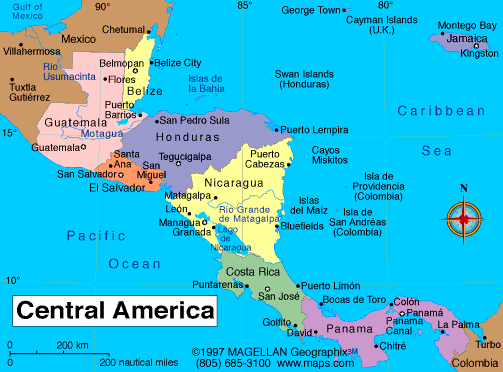
After the recent summit of the Community of Latin American and Caribbean States (CELAC), at which the U.S. was not represented, Washington is trying to get revenge in Central America. On February 2 presidential and parliamentary elections took place in El Salvador and Costa Rica.
Click on Image to Enlarge
Most predictions indicated the possibility that leftist politicians may come to power in these countries: in Costa Rica the leader of the Broad Front, Jose Maria Villalta; and in El Salvador, Salvador Sanchez Ceren, the candidate from the Farabundo Marti National Liberation Front (FMLN). It was not ruled out that there could be a second round of elections, as in both countries there were record numbers of presidential candidates; the electorate was divided, and it was difficult to get enough votes to win. That is what occurred.
In Costa Rica, Villalta was unexpectedly eliminated from the presidential race, having taken third place among the candidates. The propaganda campaign conducted against him by the local oligarchs and U.S. intelligence, who portrayed him as a «Bolivarian agent» financed by «populist» countries, played a role. «My opponents could not accuse me of corruption, so they called me a communist,» lamented Villalta. Now Araya Monge, the candidate from the ruling National Liberation Party; and Luis Solis Rivera of the Citizens’ Action Party, whose political platform is described in the media as «leftist», will fight for victory.
However, one should not have any illusions. The “leftness” of Solis Rivera is highly dubious. He has been in good standing at the American embassy since he studied at Tulane University in New Orleans and at the University of Michigan as a Fulbright Scholar. Solis Rivera could be called the political understudy of Oscar Arias, the former president of Costa Rica and an agent of Washington’s influence in Central America used for systematic attacks on «populist regimes».
By sharing what we already have (time, energy, money, goods, foods, skills) we can create communities of abundance. By changing our idea of what it means to be sustainable people, families, and businesses, and working together to achieve it instead of alone in our own silos of eco-guilt, we will rediscover our commonalities, our connections, our passions.
We are the change we’ve been waiting for. Movements like Occupy Wall Street and Idle No More show that we’re ready for a shift away from the false power of things and toward the galvanizing power of people. Sustainability, efficiency, and happiness will emerge as by-products, and our communities will become cleaner, happier places to live.
Sectional Headers Only:
Building a Sharing Economy
Sharing Bolsters the Local Economy
Sharing Encourages Community Involvements
Sharing Encouraged Self-Sufficient Behavior and Accountability
Sharing Encourages Innovation and Entrepreneurship
Sharing Grants Access to Under-Served Populations
Sharing Reduces Waste
Sharing Enhances Relationships and Increases Knoweldge
Sharing Protects the Environment
Uberflip is a new web publishing tool that allows a company to easily create a social hub populated with the most relevant content coming from their main media properties, including blogs, RSS feeds, social media channels, images and videos, presentations and PDF documents.
Uberflip publishing metaphor is the “hub” in which, similarly to Rebelmouse and Pressly you can create multiple channels where you either aggregate or curate theme-specific content.
Among Uberflip unique features there is the ability to import and convert PDF documents into editable flipbooks, an array of widgets that can be added to integrate more functionalities (e.g.: Disqus comments) and a call-to-action feature allowing you to integrate customizable and elegant subscription boxes that directly connect to your newsletter provider (e.g.: Malchimp).
My comment: Compared to Rebelmouse, Pressly, Uberflip is a tough contender. Its key strengths are the elegant and clean output design, which displays excellently also on tablets and smartphones and the breadth of features for curating and collecting content (e.g.: custom collections). Uberflip is also the only tool of this kind that integrates a PDF to flipbook conversion engine, allowing you to integrate any company PDF into one or more collections in a beautiful format to view.
The Basic version, which allows for one hub with multiple channels, one custom collection and one CTA costs $49.95/month. Higher priced versions at 199 and 499/mo allow for using your custom domain, more collections, CTAs and additional features including analytics and other features.
Thad Starner is one of several pioneers who have been personally experimenting with continuous visual input devices, sometime called wearable computing. To most people it looks like he has a screen attached to his eyeball. Starner wore his for years (as has others like Steve Mann, who started doing this earlier). They are living the dream/nightmare of being on the web 24/7, even while walking. So what is it like?
The newest adopter of 3D printing isn't some hobbyist in a basement — it's NASA.
The agency is already building some of its customized spacecraft and instrument parts using 3D printing, and someday soon, astronauts might even make tools and replacement by 3D printing them in space.
[ Editor's Note: Henry Giroux, a frequent author for Tikkun magazine, calls for a movement that challenges what Giroux calls “the neoliberal nightmare” and presents a new language of civic values and social responsibility.The ESRA–the Environmental and Social Responsibility Amendment to the U.S. Constitution, and the Spiritual Covenant with America at www.spiritualprogressives.org are examples of how the Network of Spiritual Progressives is creating a cadre of people who do precisely what Giroux thinks is needed to counter Neoliberalism's war against the radical imagination. –Rabbi Michael Lerner ]
Neoliberalism’s War Against the Radical Imagination.
By
Henry Giroux
McMaster University
Democracy is on life support in the United States. Throughout the social order the forces of predatory capitalism are on the march dismantling the ideological and material traces of the welfare state, increasing the role of corporate money in politics, waging an assault on unions, expanding the corporate-surveillance-military state, promoting widening inequalities in wealth and income, defunding higher education, privatizing public education, waging a war on women’s reproductive rights, and undercutting public faith in the defining institutions of democracy.[i] As market mentalities and moralities tighten their grip on all aspects of society, democratic institutions and public spheres are being downsized, if not altogether disappearing. As these institutions vanish—from higher education to community health care centers– there is also a serious erosion of the discourses of community, justice, equality, public values, and the common good.
We increasingly live in societies based on the vocabulary of ‘choice’ and a denial of reality – a denial of massive inequality, social disparities, the irresponsible concentration of power in relatively few hands, and a growing machinery of social death and culture of cruelty.[ii] As power becomes global and is removed from local and nation-based politics, more and more individuals and groups are being defined by a free floating class of ultra-rich and corporate power brokers as disposable, redundant, or a threat to the forces of concentrated power. Disposability has become the new measure of a neoliberal society in which the only value that matters is exchange value and matters of compassion, social responsibility, and justice are relegated to the dustbin of an older modernity that now is viewed as wither quaint or a grim reminder of a socialist past. A culture of crime and dispossession has become the organizing principle of society in which a certain kind of doubling takes place. Corporate bankers and power brokers trade with terrorists, bankrupt the economy, and commit all manner of crimes that impact on millions and they go free indicating that they are above the law and that the law is now in the hands of corrupt allies. At the same time, the US continues to criminalize all sorts of behavior ranging from dress codes to peaceful demonstrations. Low income whites, poor minorities, immigrants are being jailed in record numbers for nonviolent offenses as it becomes clear that justice is on the side of the rich, wealthy, and powerful who see these populations as both a threat and disposable. And when the wealthy do commit crimes, they rarely are sent to prison, even though millions languish under a correctional system aimed at punishing low income whites and poor minorities. One egregious example of how the justice system works in favor of the rich was on full display in Texas recently. Instead of being sent to prison, Ethan Couch, a wealthy teen who killed four people while driving inebriated was given ten years of probation and ordered by the judge to attend an expensive rehabilitation facility that cost $450,000 a year, which will be paid for by his parents. The defense argued that he had “affluenza,” a “disease” in which children of privilege allegedly are never given the opportunity to learn how to be responsible.[iii] In this case, irresponsibility becomes a virtue for the rich and allows them to actually kill people and escape the reach of justice. Under such circumstances, justice becomes a euphemism for injustice as wealth and power dictate who benefits and who doesn’t by a system of law that now enshrines lawlessness. One consequence of this doubling of justice is the emergence of a growing number of people, especially young people, who increasingly inhabit zones of hardship, suffering, exclusion, joblessness, and terminal exclusion. In addition, fear misplaced from an authoritarian government and those social conditions which makes survival more important than the quest for the good life. Under such circumstances, Americans live in a sinister web of ethical and material poverty manufactured by a state that trades in suspicion, bigotry, state sanctioned violence, and disposability. Democracy loses its character as a disruptive element, a force of dissent, an insurrectional call for responsible change, and degenerates into an assault on the radical imagination, reconfigures itself as a force for bleaching all ethical and moral considerations, and thrives in a state of exception, which in reality is a state of permanent war. A culture of greed, greed, dispossession, fear, and surveillance has now been normalized.

 The U.S. Counterattack in Central America