John Robb: One Man Can Change the World…

Civil Society, Ethics
0Shares
John Robb
John Robb

Update on One Man vs. the World

When I wrote Brave New War back in 2006, I made this aggressive projection on how rapid technological change would change warfare:

The threshold necessary for small groups to conduct global warfare has finally been breached, and we are only starting to feel its effects.  Over time, in as little as perhaps twenty years and as the leverage of technology increases, this threshold will finally reach its culmination — with the ability of one man to declare war on the world and win.

It seems that we are on track with my projection.  Recently, we saw individuals leveraging the power of computers and networks launch (open source) protests that toppled governments.   It didn't end there.  Edward Snowden (love him or hate him) proved it is possible to wage a one-man information war against the biggest, most powerful national security establishment in the world.   The US government.  A country that spends more than all other countries in the world combined on national defense. He was able to:

  • steal the crown jewels of the US security system by himself,
  • initiate an information war against the entire US national security bureaucracy while eluding capture, and
  • initiate economic disruptions that have done billions of dollars in damage to US corporations (from Boeing to RSA).

Continue reading “John Robb: One Man Can Change the World…”

SchwartzReport: West Virginia Water Contains Formaldehyde

12 Water
0Shares
Stephan A. Schwartz
Stephan A. Schwartz

This story is so sad and demoralizing. The truth is West Virginia is essentially a carbon energy plantation not a state. And West Virginians, rather than develop alternative employment opportunities, have been brainwashed into feeling a kind of fierce pride in their subjugation.

West Virginia Water Contains Formaldehyde, Official Says
KILEY KROH – Climate Progress

See Also:

Water @ Phi Beta Iota

Nik Peachey: Verification Handbook

OSINT Generic
0Shares
Nik Peachey
Nik Peachey

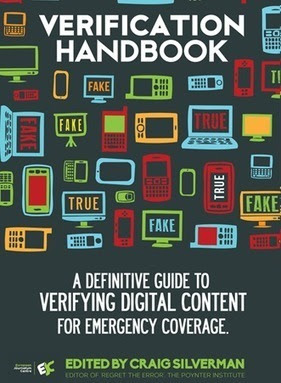
Although this was written for journalists, I think it has some really valuable insights for educators and students when it comes to verifying the authenticity of information. Excellent stuff. A MUST read.

Authored by leading journalists from the BBC, Storyful, ABC, Digital First Media and other verification experts, the Verification Handbook is a groundbreaking new resource for journalists and aid providers. It provides the tools, techniques and step-by-step guidelines for how to deal with user-generated content (UGC) during emergencies.

Click on Image to Enlarge

HANDBOOK HOME PAGE

Jean Lievens: What Is P2P? An Introduction

Money, P2P / Panarchy, Resilience
0Shares
Jean Lievens
Jean Lievens

“We can’t continue with a system that creates wealth, but that’s also destroying the planet and creating so much social inequality. I think that after 400 years of this, we know it doesn’t work. We need a new system to reclaim all these communal values”

Julie Tran from MakeChangeTV interviews Michel Bauwens

“We can’t continue with a system that creates wealth, but that’s also destroying the planet and creating so much social inequality. I think that after 400 years of this, we know it doesn’t work. We need a new system to reclaim all these communal values”

What would a post capitalist economy look like? Julie Tran from Makechange TV interviews Michel Bauwens to inquire on the particulars of P2P or “Peer to Peer” philosophy. Bauwens gives clear, direct answers to questions such as: “What is a P2P economy?”, “How does it differ from Communism or Capitalism?”, “Is it the same as collaborative consumption or crowdsourcing?”, “Will it be become a main trend of the future?”.

To round out the video, we also include a short text below, written by Bauwens for Open Thoughts dealing with value, sustainable commons-based production and how P2P works within society.

Openness, a necessary revolution into a smarter world

Continue reading “Jean Lievens: What Is P2P? An Introduction”

Berto Jongman: Mind Control in the 21st Century – Overview of the State of the Art and Future Prospects

Advanced Cyber/IO, IO Deeds of War
0Shares
Berto Jongman
Berto Jongman

Mind Control in the 21st Century-Science Fiction & Beyond

Pravda, 05.02.2014  By Steven DiBasio

***Part One*** Conspiracy Theory?

“Mind control” is a topic commonly perceived as “conspiracy theory” or “X-Files” fare. That is, it is seen as possibly not “real,” and certainly not something about which one should be “overly” concerned. This attitude at least partially arises from the widespread belief or assumption that the human brain is so complicated-(“the most complex entity in the universe” is a common formulation)-that it has not, and perhaps cannot, be comprehended in any depth.

One writer, for example, describes the brain as of “perhaps infinite” complexity, while another, David Brooks of the New York Times, writes that it is “probably impossible” that “a map of brain activity” could reveal mental states such as emotions and desires. Similarly, Andrew Sullivan, blogger and former editor of The New Republic, opines that neuroscience is still in its “infancy,” and that we have only begun “scratching the surface” of the human brain, and links to a New Yorker piece in support of that position.

And the cover story for the October 2004 issue of Discovery Magazine entitled “The Myth Of Mind Control” advises the reader that while mind control is a “familiar science-fiction” staple, there is little reason for real concern, because actually deciphering the “neural code” would be akin to figuring out other “great scientific mysteries” such as the “origin of the universe and of life on Earth,” and is therefore hardly likely. According to the article, as the brain is “the most significant mystery in science” and quite possibly “the hardest to solve,” mind control remains at worst a distant concern.

The underlying idea seems to be that sophisticated mind control is unlikely without understanding the brain; and we do not understand the brain.

Understanding the “Neural Code”

Continue reading “Berto Jongman: Mind Control in the 21st Century – Overview of the State of the Art and Future Prospects”

Berto Jongman: Utility of Informal NGOs (e.g. BRICS)

Cultural Intelligence, Non-Governmental, Peace Intelligence
0Shares
Berto Jongman
Berto Jongman

The BRICS and the Future of ‘Informal' IGOs

Are informal intergovernmental organizations such as the BRICS the answer to our future security problems? Felicity Vabulas believes that states are beginning to see their virtues, which include diplomatic flexibility, rapid crisis response, and an unquestioning respect for national interests.

By Felicity Vabulas for ISN

Around the world, the efficacy, equity, and legitimacy of intergovernmental organizations (IGOs) are increasingly being questioned. As Stewart Patrick of the Council on Foreign Relations notes, “there has been no movement to reform the composition of the UN Security Council to reflect new geopolitical realities. Meanwhile, the World Trade Organization (WTO) is comatose, NATO struggles to find its strategic purpose, and the International Energy Agency courts obsolescence by omitting China and India as members.”

IGOs have never been a “magic bullet” solution for the world’s security challenges. Because they embody path dependence, they always reflect distributions of power that are quickly outpaced by reality. Today, states are increasingly making use of forms of governance outside of traditional institutions such as the European Union or the United Nations. In particular, informal intergovernmental organizations (a term I coined in an article co-authored with Duncan Snidal) are emerging as both substitutes and complements to existing formal IGOs—in areas as diverse as finance and security. The interplay between informal and formal institutions is what is generating the “messy multilateralism” that has characterized the opening decades of the 21st century.

Why informal intergovernmental organizations?

Informal IGOs are defined as an explicit group of associated states having explicitly shared expectations (rather than formalized treaties) that participate in regular meetings but have no independent secretariat, headquarters, or permanent staff. In its initial years, the Basel Committee on Banking Supervision (BCBS) was a good example of an informal IGO: states shared a common goal to cooperate on banking supervision, but they did not codify their agreement under international law. Other examples include the G8, the Concert of Europe, the Nuclear Suppliers Group, and the Paris Club.

Typically, states have preferred informal IGOs for five reasons:

Continue reading “Berto Jongman: Utility of Informal NGOs (e.g. BRICS)”