My $50,000 Twitter Username Was Stolen Thanks to PayPal and GoDaddy
I had a rare Twitter username, @N. Yep, just one letter. I’ve been offered as much as $50,000 for it. People have tried to steal it. Password reset instructions are a regular sight in my email inbox. As of today, I no longer control @N. I was extorted into giving it up.
Tuesday February 18, 2014
10:30 a.m. to 12 noon
Hardin Room, Church Center for the United Nations
777 UN Plaza (Corner of 44th Street and 1st Ave)
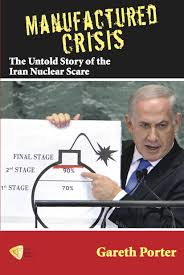
Gareth Porter is an investigative journalist and writer on US foreign and military policy. He has written four previous books, including Perils of Dominance: Imbalance of Power and the Road to War in Vietnam (University of California Press, 2005). His journalism has been published in The Nation, Inter Press Service, Truthout, and elsewhere. In 2012, he was awarded the Martha Gellhorn Prize for Investigative Journalism by Frontline Club in London.
In Manufactured Crisis, Gareth Porter shows that the narrative that Western governments and media created over the course of two decades that Iran was pursuing a covert nuclear weapons program was based on falsehoods and fabricated “evidence”.
File this one under: “studiously ignored by major media.”
I posted this story in August of 2012. It was based on a Truthout interview of a man who did drug reviews for the FDA. He examined applications to approve new medical drugs for public consumption.
Pharmaceutical companies must have their new drugs certified as safe and effective before they can enter the market, before doctors can prescribe them. The FDA does this certification. Thumbs up or thumbs down. The drug is okay or it isn’t.
Here’s the story:
In a stunning interview with Truthout’s Martha Rosenberg, former FDA drug reviewer, Ronald Cavanagh, exposes the FDA as a relentless criminal mafia protecting its client, Big Pharma, with a host of mob strategies.
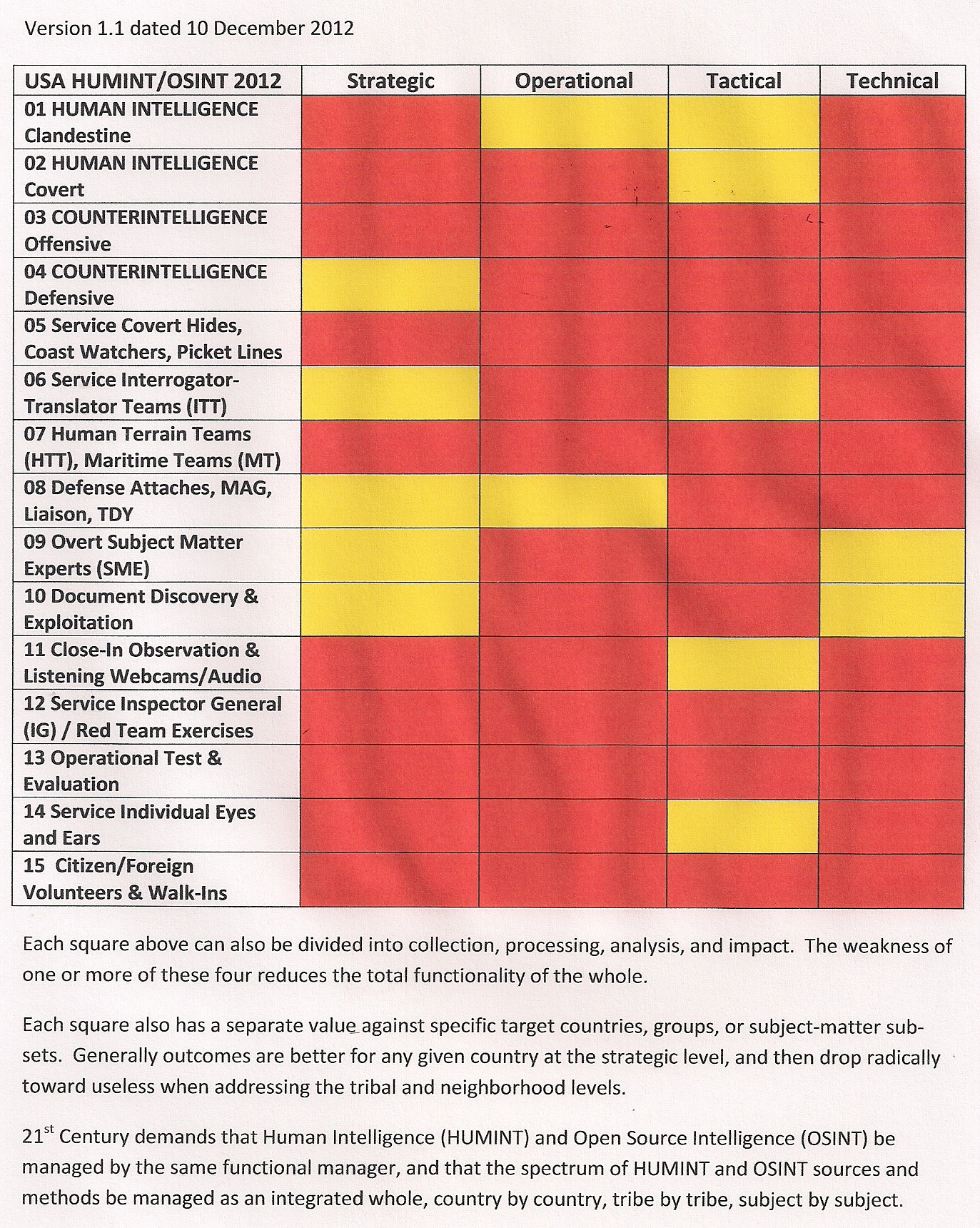
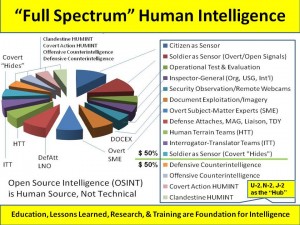
HUMAN INTELLIGENCE (HUMINT): As with many other definitions, this one has been abjectly corrupted by over two centuries of government emphasis on secret sources & methods to the exclusion of proper stewardship of education, open source intelligence, and research. HUMINT is any process that relies on a human mind to collect, process, and convert data and information into intelligence. 99% of HUMINT is not secret or expensive. Most of its is also not in English. Below is illustrated a concept for “Full Spectrum HUMINT” that leads to Organizational Intelligence and ultimately to a Smart Nation, a Smart Continent (Africa First), and a Prosperous World at Peace.
Phi Beta Iota: Robert Steele is available to mentor, train, & manage 21st Century HUMINT/OSINT operations. OSINT is HUMINT, not TECHINT. HUMINT is best done multinationally, not unilaterally. Clandestine HUMINT cannot be done from within official cover installations. Clandestine HUMINT can generally not be done by active duty personnel with a corafam shoe mind-set or by young people who have led boring US-based lives. To be effective, HUMINT requires a cultural, historical, and linguistic analytic foundation and a ruthless pervasive counterintelligence safety net — none of these are characteristic of USA “HUMINT” at this time. Email him at robert.david.steele.vivas [at] gmail [dot] com. Non-US governments and non-state emissaries are welcome to communicate as securely as they wish to 11005 Langton Arms Court, Oakton VA 22124.
Content strategy, at its core, is really easy. It’s all about organizing information in a way that it can be easily searched and retrieved. It’s about labelling files and folders so that they make sense. Val Swisher’s analogy about content strategy being like one’s closet still stands at the heart of it. If you can organize your closet and identify the different clothing pieces in order to categorize them, then you understand how to do content strategy. The only difference is that instead of having shirts, skirts, pants, and shoes to organize, you have folders of documents, webpages, and multimedia. The method of making sure that users can find those documents, webpages, and multimedia should be streamlined, clear, concise, and user-friendly. As content strategists and user advocates, it’s all about making sure that what the audience is viewing looks and reads well, and what the content managers can maintain easily.
Ultimately, when creating a content strategy and setting it up for maintenance, do it correctly now, even if it’s time consuming. If for no other reason, it’ll save time and headaches later. It’s not difficult. It’s just common sense.
How is crowd organization produced? How are crowd-enabled networks activated, structured, and maintained in the absence of recognized leaders, common goals, or conventional organization, issue framing, and action coordination? We develop an analytical framework for examining the organizational processes of crowd-enabled connective action such as was found in the Arab Spring, the 15-M in Spain, and Occupy Wall Street. The analysis points to three elemental modes of peer production that operate together to create organization in crowds: the production, curation, and dynamic integration of various types of information content and other resources that become distributed and utilized across the crowd. Whereas other peer-production communities such as open-source software developers or Wikipedia typically evolve more highly structured participation environments, crowds create organization through packaging these elemental peer-production mechanisms to achieve various kinds of work. The workings of these ‘production packages’ are illustrated with a theory-driven analysis of Twitter data from the 2011–2012 US Occupy movement, using an archive of some 60 million tweets. This analysis shows how the Occupy crowd produced various organizational routines, and how the different production mechanisms were nested in each other to create relatively complex organizational results.


 Naoki Hiroshima