Steven Aftergood: Secrecy News Combined Federal Campaign Number is 11539 — Support Secrecy News If You Can

Ethics
0Shares
Steven Aftergood
Steven Aftergood

SUPPORT SECRECY NEWS, IF YOU CAN

We hope that all Secrecy News readers will give generously to charitable causes that help relieve those who are in distress, near and far.

But if you have something left over and you find our work interesting or useful for your own purposes, then we hope you may also contribute to Secrecy News and the FAS Project on Government Secrecy.

If your situation permits, please consider making a tax deductible contribution to the Federation of American Scientists to support Secrecy News.  (Thanks to those who have already done so!)

Donations can be made online (specify that your donation should be directed to “government secrecy”).  If contributing via Paypal or CFC (account number 11539), send us a separate email to let us know you want your contribution allocated to the FAS Project on Government Secrecy.  Checks payable to FAS may also be mailed to:

Secrecy News
Federation of American Scientists
1725 DeSales Street N.W.
6th Floor
Washington D.C. 20036

Phi Beta Iota: Across the years, there have been a small handful of individuals and very small organizations that have consistently demonstrated deep integrity and an abiding commitment to the public interest.  Steven Aftergood and Secrecy News are among them.  Our own contribution to CFC will be split between Special Operations and Secrecy News.  We urge one and all to consider earmarking a portion of the their annual CFC contribution to Secrecy News, account 11539.


Steve Aftergood: Pentagon Drone Program Cut in Half, New Military Doctrine

Military
0Shares
Steven Aftergood
Steven Aftergood

PENTAGON DRONE PROGRAMS TAPER OFF, AND NEW MIL DOCTRINE

The Department of Defense budget for research and procurement of unmanned aerial systems (UAS), or drones, is on a distinctly downward slope.

The FY 2014 budget request included $2.3 billion for research, development, and procurement of unmanned aerial systems, a decrease of $1.1 billion from the request for the fiscal year 2013.

“Annual procurement of UAS has gone from 1,211 in fiscal 2012 to 288 last year to just 54 in the proposed FY14 budget,” according to a recently published congressional hearing volume.

See “Post Iraq and Afghanistan: Current and Future Roles for UAS and the Fiscal Year 2014 Budget Request,” hearing before the House Armed Services Committee, April 23, 2013.

Among the questions for the record published in the new hearing volume, DoD officials were asked: “Who is responsible for developing privacy protections for military UAV operations inside the United States?”

Some other noteworthy new doctrinal and congressional defense-related publications include the following.

Continue reading “Steve Aftergood: Pentagon Drone Program Cut in Half, New Military Doctrine”

Marcus Aurelius: SecDef Puts Humans on the Block

Ethics, Military
0Shares
Marcus Aurelius
Marcus Aurelius

SECDEF speaks; see article below.  Key points:

  • First SOF Truth, equally applicable to every single element of the Joint Force, has been forgotten:  HUMANS ARE MORE IMPORTANT THAN HARDWARE.  First SOF Truth, repeat after me, Mr. Secretary:  HUMANS ARE MORE IMPORTANT THAN HARDWARE.
  • Troops and families — carriers of the rifles and the rucksacks and standers of the night watches — rather than contractors will bear the burden.

– – – – – – –

Defense Secretary Chuck Hagel warned Tuesday that troops and their families will be asked to sacrifice on pay and benefits to preserve readiness in an era of tighter budgets.

SecDef Chuck Hagel
SecDef Chuck Hagel

Hagel listed politically-charged changes to compensation and personnel policy as one of his top six priorities in reforming the military following the wars in Iraq and Afghanistan as the department gears up to meet new challenges.

“This may be the most difficult” to achieve among his six priorities, Hagel said of proposals to trim pay increases, overhaul TRICARE and review retirement benefits while adapting to cuts in personnel.

“Without serious attempts to achieve significant savings in this area, which consumes roughly half of the DoD budget and is increasing every year, we risk becoming an unbalanced force,” Hagel said.

The alternative was to have a military that is “well-compensated, but poorly trained and equipped, with limited readiness and capability,” Hagel said in a keynote address to a Global Security Forum 2013 sponsored by he Center for Strategic and International Studies.

Continue reading “Marcus Aurelius: SecDef Puts Humans on the Block”

Berto Jongman: Bits, Bytes, & Stuff

Cultural Intelligence, Peace Intelligence
0Shares
Berto Jongman
Berto Jongman

60 Terrorists Plots (Allegedly) Foiled in USA

Air Force of the Jihad

Blocking China with Land-Based Anti-Ship Missile Alliance

Chemical Warfare – Destroying the Last 20%

Cyberattacks Timeline (1-16 OCT 13)

Cybersecurity Threats Rising

Data Science Field Guide

Dataset of Political Regimes

DEBATE: Hayden versus Gellman on Leaderks versus Whistleblowers

DoD Chemtrail Handbook

Egyptian Intelligence

Gambling with Security

Global Human Right to Privacy

Invisible Bike Helmet (Swedish Women Invent)

Kennedy and Space Cooperation – 50th Anniversary

Stuxnet Infects Russian Nuclear Facility

Untold Story of War: US Veterans Face Staggering Epidemic of Unemployment, Trauma, & Suicide

US Military Suicide Rate

Viet-Nam Veteran Stereotype

John Maguire: Moray B. King: Zero Point Energy, EVO Clusters, and Paradigm Shifts

05 Energy
0Shares
John Maguire
John Maguire

Moray B. King: Zero Point Energy, EVO Clusters, and Paradigm Shifts

Interview with Moray B. King. Moray has been working as an electrical and systems engineer for over 30 years. During that time, in parallel, he has done extensive independent research into the standard physics literature concerning both zero point physics and self-organizing systems. He has also conducted extensive research into the patents and experiments of inventors who have reported anomalous energy gains over the decades. He is considered one of the leading authorities on the subject of Zero Point Energy, and has written two books on the topic titled: Tapping the Zero Point Energy, and Quest for Zero Point Energy. Most recently Moray gave a presentation titled “Water, Plasmoids, and Zero Point Energy” at this year's Breakthrough Energy Movement Conference.

Patrick Meier: Live Crisis Map of Disaster Damage Reported on Social Media

Crowd-Sourcing, Data, Design, Geospatial, Governance, Innovation, P2P / Panarchy, Resilience
0Shares
Patrick Meier
Patrick Meier

Live Crisis Map of Disaster Damage Reported on Social Media

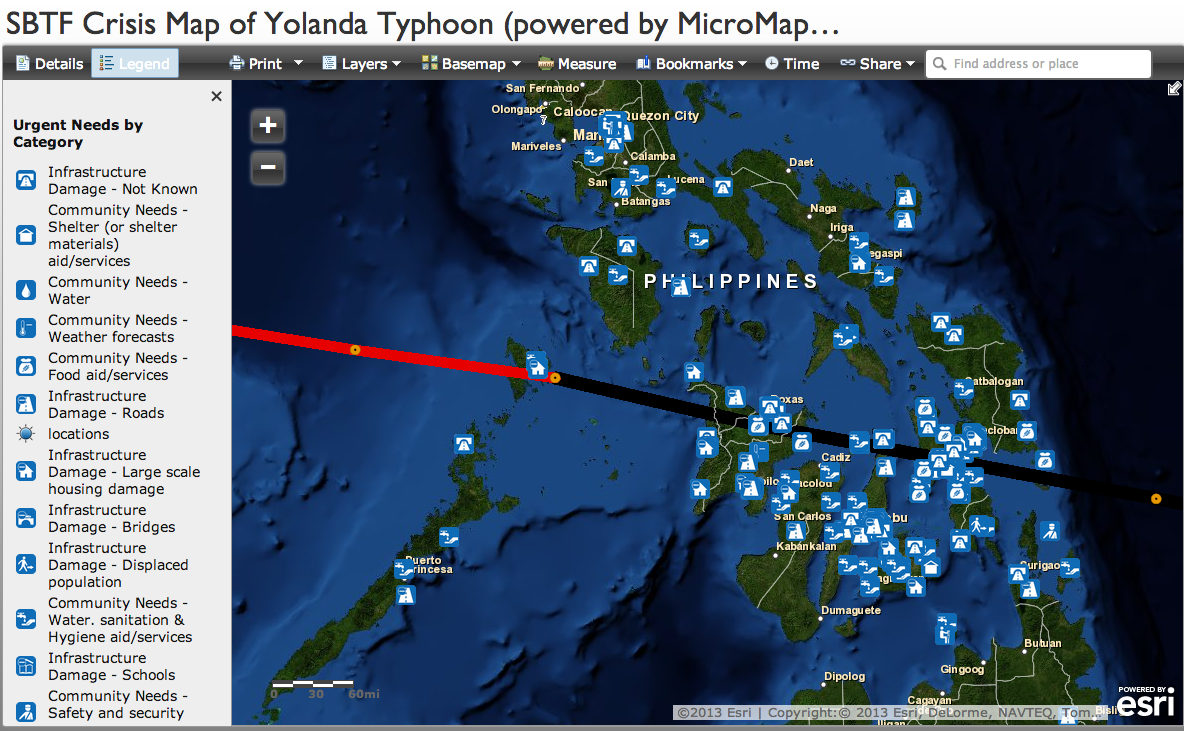
Digital humanitarian volunteers have been busing tagging images posted to social media in the aftermath of Typhoon Yolanda. More specifically, they’ve been using the new MicroMappers ImageClicker to rate the level of damage they see in each image. Thus far, they have clicked over 7,000 images. Those that are tagged as “Mild” and “Severe” damage are then geolocated by members of the Standby Volunteer Task Force (SBTF) who have partnered with GISCorps and ESRI to create this live Crisis Map of the disaster damage tagged using the ImageClicker. The map takes a few second to load, so please be patient.

YolandaPH Crisis Map 1

The more pictures are clicked using the ImageClicker, the more populated this crisis map will become. So please help out if you have a few seconds to spare—that’s really all it takes to click an image. If there are no picture left to click or the system is temporarily offline, then please come back a while later as we’re uploading images around the clock. And feel free to join our list-serve in the meantime if you wish to be notified when humanitarian organizations need your help in the future. No prior experience or training necessary. Anyone who knows how to use a computer mouse can become a digital humanitarian.

The SBTF, GISCorps and ESRI are members of the Digital Humanitarian Network (DHN), which my colleague Andrej Verity and I co-founded last year. The DHN serves as the official interface for direct collaboration between traditional “brick-and-mortar” humanitarian organizations and highly skilled digital volunteer networks. The SBTF Yolanda Team, spearheaded by my colleague Justine Mackinnon, for example, has also produced this map based on the triangulated results of the TweetClicker:

YolandaPH Crisis Map 2
There’s a lot of hype around the use of new technologies and social media for disaster response. So I want to be clear that our digital humanitarian operations in the Philippines have not been perfect. This means  that we’re learning (a lot) by doing (a lot). Such is the nature of innovation. We don’t have the luxury of locking ourselves up in a lab for a year to build the ultimate humanitarian technology platform. This means we have to work extra, extra hard when deploying new platforms during major disasters—because not only do we do our very best to carry out Plan A, but we often have to carry out  Plans B and C in parallel just in case Plan A doesn’t pan out. Perhaps Samuel Beckett summed it up best: “Ever tried. Ever failed. No matter. Try Again. Fail again. Fail better.”