SmartPlanet: Saltwater-Cooled Greenhouse Grows Crops in the Sahara

01 Agriculture, 05 Energy, Earth Intelligence
2Shares
Click on Image to Enlarge

Saltwater-cooled greenhouse grows crops in the Sahara

How do you grow vegetables in arid areas? Reverse the trend of desertification, the Sahara Forest Project proposes.

The project combines existing technologies — such as the evaporation of saltwater to create fresh water along with solar thermal energy tech — to utilize what we have (saltwater, CO2) to produce what we need (food, fresh water and energy).

This week, the project, which is supported by fertilizer companies, reached a milestone. Its Qatar pilot plant produced 75 kilograms of crops (like cucumbers) per square meter annually while consuming only sunlight and seawater, Science reports. That’s comparable to commercial farms in Europe.

At the center of the project is a saltwater-cooled greenhouse, Science explains:

At one end, salt water is trickled over a gridlike curtain so that the prevailing wind blows the resulting cool, moist air over the plants inside. This cooling effect allowed the Qatar facility to grow three crops per year, even in the scorching summer. At the other end of the greenhouse is a network of pipes with cold seawater running through them. Some of the moisture in the air condenses on the pipes and is collected, providing a source of fresh water.

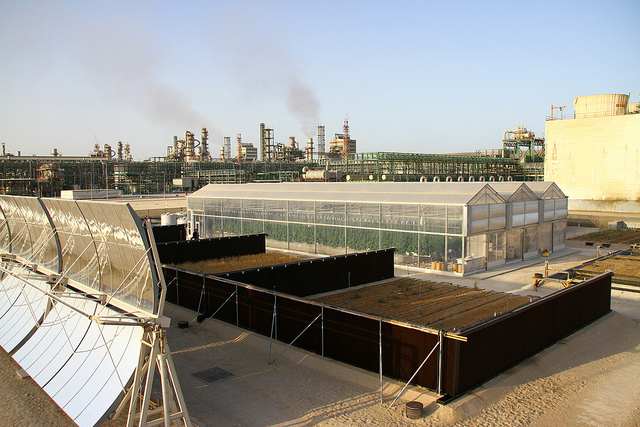
One surprising side effect is how the cool, moist air that was leaking out encouraged plants to grow spontaneously outside. By reducing exterior air temperatures with “evaporator hedges” (pictured), the plant was able to grow crops like barley and salad rocket (arugula), along with useful desert plants around the seawater greenhouse.

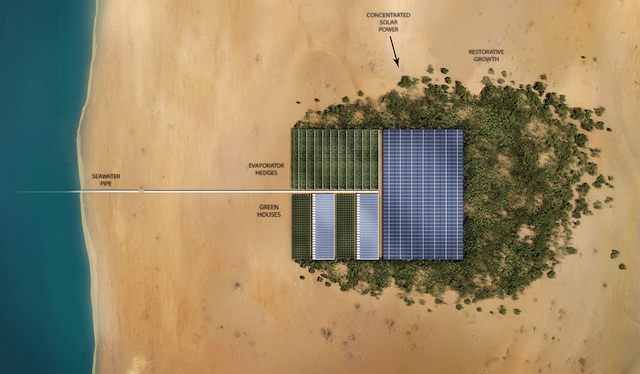
Another key element of the facility is the concentrated solar power plant:

This uses mirrors in the shape of a parabolic trough to heat a fluid flowing through a pipe at its focus. The heated fluid then boils water, and the steam drives a turbine to generate power. Hence, the plant has electricity to run its control systems and pumps and can use any excess to desalinate water for irrigating the plants.
Click on Image to Enlarge

“The big question is economic feasibility,” says Richard Tutwiler at the American University in Cairo. “How much did it cost to produce 75 kg of cucumbers per square meter?”

The project has also experimented with culturing heat-tolerant algae, growing salt-tolerant grasses for fodder or biofuel, and evaporating the concentrated saline the plant emits to produce salt, Science reports.

The Qatar plant is 1 hectare with 600 square meters of growing area inside. Next up: a 20-hectare test facility near Aqaba, Jordan.

[Via Science]

Images: Sahara Forest Project

Rickard Falkvinge: Free Does Not Mean Exempt from Criticism

Cultural Intelligence
0Shares
Rickard Falkvinge
Rickard Falkvinge

“Free” Does Not Mean “Exempt From Criticism”

Posted: 11 Nov 2013 12:56 PM PST

Freedom of Speech – Zacqary Adam Green:  “What is everyone complaining about? This is a free service, and [large corporation] can do whatever they want with it!” That’s true. Also wrong. Please stop saying it.

There’s always outrage whenever a popular online service like YouTube, Google, Facebook, Twitter, Tumblr, Flickr, or Whatevr makes some kind of unpopular change, or when unscrupulous business practices come to light. And in return, there’s always outrage at the outrage. “The service is free,” they say, “and it’s owned by a private company. Go use something else if you don’t like it.”

This is usually code for “I disagree with your complaint, and I get insecure and anxious when people have opinions that aren’t mine, because it reminds me of how alone I am in the universe. Therefore I am lashing out rather than attempting to explore my capacity for empathy.” It’s also a pretty weak argument.

Continue reading “Rickard Falkvinge: Free Does Not Mean Exempt from Criticism”

Berto Jongman: Chinese Lightbulb Wi-Fi

Cloud, Innovation, Spectrum
0Shares
Berto Jongman
Berto Jongman

Chinese scientists discover light bulbs can produce Wi-Fi

China is having a light-bulb moment. Scientists from the Shanghai Institute of Technical Physics have discovered that a microchip embedded one-watt LED bulb is capable of emitting Wi-Fi, with enough signal strength to provide internet for four computers.

The discovery, aptly named “Li-Fi,” relies on the use of special LED light bulb that operate with light as the carrier instead of traditional radio frequencies.

Click on Image to Enlarge

Data rates as fast as 150 megabits per second were achieved with the new Li-Fi connection, making it faster, cheaper and more energy efficient than traditional Wi-Fi signals.

Li-Fi apparently only uses five percent of the energy required to power Wi-Fi-emitting devices, which rely on energy cooling systems to supply Internet to cell towers and Wi-Fi stations.

Though the discovery has huge potential in the way we use Internet connection, Li-Fi is still in a crude testing stage, since it doesn't work if the light bulb is turned off or if light bulbs are blocked. That doesn't seem like such a huge burden, though: it just means you'll have to leave your lights on if you want to surf the Web. No more online shopping binges in the dark!

Li-Fi demonstrations will take place on November 5 in Shanghai at the International Industry Fair, where 10 kits will be tested out. A bright future seems to be in store for Li-Fi usage, which could range from using car headlights or focused light to transmit data, among many other potential applications.

Sepp Hasslberger: One Planet One Engine

05 Energy, Commercial Intelligence, Earth Intelligence
0Shares
Sepp Hasslberger
Sepp Hasslberger

The Cyclone Engine; USES ANY FUEL with NO ENGINE MODIFICATIONS

After last weeks story on the Raphial Morgado and MYT™ Engine I Thought I would do a series on other innovative engine technologies. The Cyclone engine may only have average fuel efficiency, but does have many advantages over conventional engine technology. These include reducing emissions, and the ability to run on any type of fuel without any modifications,  It can be converted to a heat engine harvesting waste heat.

To date, Cyclone has over 1,000 hours of running (on fuel!) and testing of the engines, They have achieved verified thermal efficiencies above 30%, and is very close to putting the first of these engine models into small-scale commercial production.

cyclone-engine-3Popular Science magazine named the clean, green Cyclone Engine as the 2008 Invention of the Year.  the engine’s inventor and company CEO, Harry Schoell has followed a path that would be a good example for many investors and researchers. “In less than a few years he has systematically undertaken the development and building of a company in a very professional way. i am not endorsing the technology but the processes of how to take something from the drawing board to market. There is still a ways to go, but progress is being made as will be illustrated in the following press release.

Read full article (technical details and more).

Patrick Meier: Digital Humanitarians: From Haiti Earthquake to Typhoon Yolanda

Crowd-Sourcing, Data, Design, Geospatial, Governance, Innovation, Mobile, P2P / Panarchy, Resilience
0Shares
Patrick Meier
Patrick Meier

Digital Humanitarians: From Haiti Earthquake to Typhoon Yolanda

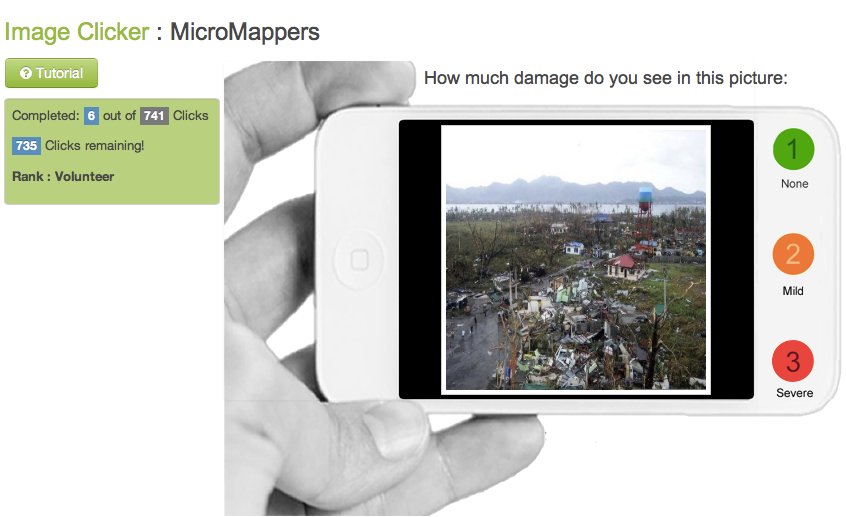
We’ve been able to process and make sense of a quarter of a million tweets in the aftermath of Typhoon Yolanda. Using both AIDR (still under development) and Twitris, we were able to collect these tweets in real-time and use automated algorithms to filter for both relevancy and uniqueness. The resulting ~55,000 tweets were then uploaded to MicroMappers (still under development). Digital volunteers from the world over used this humanitarian technology platform to tag tweets and now images from the disaster (click image below to enlarge). At one point, volunteers tagged some 1,500 tweets in just 10 minutes. In parallel, we used machine learning classifiers to automatically identify tweets referring to both urgent needs and offers of help. In sum, the response to Typhoon Yolanda is the first to make full use of advanced computing, i.e., both human computing and machine computing to make sense of Big (Crisis) Data.

ImageClicker YolandaPH

We’ve come a long way since the tragic Haiti Earthquake. There was no way we would’ve been able to pull off the above with the Ushahidi platform. We weren’t able to keep up with even a few thousand tweets a day back then, not to mention images. (Incidentally, MicroMappers can also be used to tag SMS). Furthermore, we had no trained volunteers on standby back when the quake struck. Today, not only do we have a highly experienced network of volunteers from the Standby Volunteer Task Force (SBTF) who serve as first (digital) responders, we also have an ecosystem of volunteers from the Digital Humanitarian Network (DHN). In the case of Typhoon Yolanda, we also had a formal partner, the UN Office for the Coordination of Humanitarian Affairs (OCHA), that officially requested digital humanitarian support. In other words, our efforts are directly in response to clearly articulated information needs. In contrast, the response to Haiti was “supply based” in that we simply pushed out all information that we figured might be of use to humanitarian responders. We did not have a formal partner from the humanitarian sector going into the Haiti operation.

Yolanda Prezi

What this new digital humanitarian operation makes clear is that preparedness, partnerships & appropriate humanitarian technology go a long way to ensuring that our efforts as digital humanitarians add value to the field-based operations in disaster zones. The above Prezi by SBTF co-founder Anahi (click on the image to launch the presentation) gives an excellent overview of how these digital humanitarian efforts are being coordinated in response to Yolanda.

While there are many differences between the digital response to Haiti and Yolanda, several key similarities have also emerged. First, neither was perfect, meaning that we learned a lot in both deployments; taking a few steps forward, then a few steps back. Such is the path of innovation, learning by doing. Second, like our use of Skype in Haiti, there’s no way we could do this digital response work without Skype. Third, our operations were affected by telecommunications going offline in the hardest hit areas. We saw an 18.7% drop in relevant tweets on Saturday compared to the day before, for example. Fourth, while the (very) new technologies we are deploying are promising, they are still under development and have a long way to go. Fifth, the biggest heroes in response to Haiti were the volunteers—both from the Haitian Diaspora and beyond. The same is true of Yolanda, with hundreds of volunteers from the world over (including the Philippines and the Diaspora) mobilizing online to offer assistance.

A Filipino humanitarian worker in Quezon City, Philippines, for example, is volunteering her time on MicroMappers. As is customer care advisor from Eurostar in the UK and a fire officer from Belgium who recruited his uniformed colleagues to join the clicking. We have other volunteer Clickers from Makati (Philippines), Cape Town (South Africa), Canberra & Gold Coast (Australia), Berkeley, Brooklyn, Citrus Heights & Hinesburg (US), Kamloops (Canada), Paris & Marcoussis (France), Geneva (Switzerland), Sevilla (Spain), Den Haag (Holland), Munich (Germany) and Stokkermarke (Denmark) to name just a few! So this is as much a human story is it is one about technology. This is why online communities like MicroMappers are important. So please join our list-serve if you want to be notified when humanitarian organizations need your help.

Bio

SmartPlanet: Marijuana Next Great US Industry?

Commercial Intelligence, Cultural Intelligence
0Shares

smartplanet logoIs marijuana the next great American industry?

By | November 8, 2013, 9:11 AM PST

The legal U.S. marijuana market is projected to grow 64 percent to $2.34 billion by 2014 and exceed $10 billion by 2018, making it one of the fastest growing industries in the country, according to ArcView Market Research.

The pace of growth is even expected to eclipse the expansion of the global smartphone market, ArcView Group CEO Troy Dayton said in the company’s second State of Legal Marijuana Markets report released this week.

The recent legalization of marijuana use by adults in Colorado and Washington is largely what’s driving the market expansion. Adult use in Washington and Colorado is projected to add $359 million and $208 million to their respective markets in 2014.

Fourteen more states including Alaska, Oregon, Hawaii, Maine, California and Arizona are expected to adopt legal adult use laws in the next five years, which would accelerate the market’s growth rate, the report says.

California is already the largest state market at $980 million, according to the report. And the state doesn’t even have an adult use law on the books. California only has a medical marijuana law.

Continue reading “SmartPlanet: Marijuana Next Great US Industry?”

Marcus Aurelius: WaPo (Carter/Barno) on Military Isolation

06 Family, 11 Society, Cultural Intelligence, Military
0Shares
Marcus Aurelius
Marcus Aurelius

Invite your attention to following generally overstated (IMHO) article and my accompanying comments in yellow-highlighted red. 

Happy Veterans' Day

How the military isolates itself — and hurts veterans

By Phillip Carter and David Barno, Published: November 8

Phillip Carter and retired Lt. Gen. David Barno are veterans of Iraq and Afghanistan, respectively, and senior fellows at the Center for a New American Security.

In Afghanistan and Iraq, the wire ringing our bases divided two starkly different worlds. Inside the wire, life revolved around containerized housing units, cavernous dining facilities, well-appointed gyms and the distant but ever-present risk of a falling rocket or mortar round. Outside the wire, Afghans and Iraqis tried to live their lives amid relative chaos. They didn’t fully understand what we were doing there. And when we ventured out, we struggled to navigate their world.

Continue reading “Marcus Aurelius: WaPo (Carter/Barno) on Military Isolation”