General and Ambassador Karl Eikenberry on the Persistent Failure of US Understanding in Afghanistan

02 Diplomacy, 03 Economy, 08 Wild Cards, 09 Justice, 10 Security, 11 Society, Corruption, Director of National Intelligence et al (IC), DoD, Government, Idiocy, Ineptitude, IO Deeds of War, Lessons, Military, Officers Call, Peace Intelligence
0Shares
Karl W. Eikenberry
Karl W. Eikenberry

使用谷歌翻译在下一列的顶部。

गूगल अगले स्तंभ के शीर्ष पर अनुवाद का प्रयोग करें.

Google sonraki sütunun üstünde Çevir kullanın.

Используйте Google Translate на вершине соседней колонке.

گوگل اگلے کالم میں سب سے اوپر ترجمہ کا استعمال کریں.

Emphasis below added by Milt Bearden, former CIA chief in Pakistan also responsible for the field aspects of the CIA's covert support against Soviet forces in Afghanistan.

Foreign Affairs, September/October 2013

ESSAY

The Limits of Counterinsurgency Doctrine in Afghanistan
The Other Side of the COIN

Karl W. Eikenberry
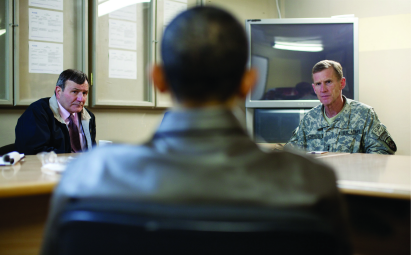
Eikenberry, Obama, and General Stanley McChrystal in Afghanistan, March 2010. (Pete Souza / White House)

KARL W. EIKENBERRY is William J. Perry Fellow in International Security at the Center for International Security and Cooperation at the Freeman Spogli Institute for International Studies at Stanford University. He served as Commanding General of the Combined Forces Command–Afghanistan from 2005 to 2007 and as U.S. Ambassador to Afghanistan from 2009 to 2011.

Since 9/11, two consecutive U.S. administrations have labored mightily to help Afghanistan create a state inhospitable to terrorist organizations with transnational aspirations and capabilities. The goal has been clear enough, but its attainment has proved vexing. Officials have struggled to define the necessary attributes of a stable post-Taliban Afghan state and to agree on the best means for achieving them. This is not surprising. The U.S. intervention required improvisation in a distant, mountainous land with de jure, but not de facto, sovereignty; a traumatized and divided population; and staggering political, economic, and social problems. Achieving even minimal strategic objectives in such a context was never going to be quick, easy, or cheap.

Of the various strategies that the United States has employed in Afghanistan over the past dozen years, the 2009 troop surge was by far the most ambitious and expensive. Counterinsurgency (COIN) doctrine was at the heart of the Afghan surge. Rediscovered by the U.S. military during the wars in Afghanistan and Iraq, counterinsurgency was updated and codified in 2006 in Field Manual 3-24, jointly published by the U.S. Army and the Marines. The revised
doctrine placed high confidence in the infallibility of military leadership at all levels of engagement (from privates to generals) with the indigenous population throughout the conflict zone. Military doctrine provides guidelines that inform how armed forces contribute to campaigns, operations, and battles. Contingent on context, military doctrine is
meant to be suggestive, not prescriptive.

Broadly stated, modern COIN doctrine stresses the need to protect civilian populations, eliminate insurgent leaders and infrastructure, and help establish a legitimate and accountable host-nation government able to deliver essential human services. Field Manual 3-24 also makes clear the extensive length and expense of COIN campaigns:  “Insurgencies are protracted by nature. Thus, COIN operations always demand considerable expenditures of time and resources.

Continue reading “General and Ambassador Karl Eikenberry on the Persistent Failure of US Understanding in Afghanistan”

Milt Bearden: HIST 9 April 2009 Obama’s War

08 Wild Cards
0Shares
Milt Bearden
Milt Bearden

使用谷歌翻译在下一列的顶部。

गूगल अगले स्तंभ के शीर्ष पर अनुवाद का प्रयोग करें.

Google sonraki sütunun üstünde Çevir kullanın.

Используйте Google Translate на вершине соседней колонке.

گوگل اگلے کالم میں سب سے اوپر ترجمہ کا استعمال کریں.

Foreign Affairs, April 9, 2009

POSTSCRIPT

Obama's War
Redefining Victory in Afghanistan and Pakistan

Milton Bearden

MILTON BEARDEN served as CIA station chief in Pakistan from 1986 to 1989, where he was responsible for that agency's covert action program in support of the Afghan resistance to the Soviet-supported government.

Since the United States first dispatched troops to Afghanistan in October 2001, the war in Afghanistan has been an orphan of U.S. policy. But with the release last week of a revamped U.S. policy toward Afghanistan and Pakistan, the conflict has, by default, become Barack Obama's war.

In a Foreign Affairs essay [1] from November/December 2001, I chronicled the disasters that have befallen all foreign invaders of Afghanistan, from Alexander the Great to the Soviet Union. Now, more than seven years into the U.S. intervention, the Obama administration must confront many of the same problems faced by all previous
occupiers of this rugged land. How the United States manages its presence there over the next year will determine if it can break the pattern.

Continue reading “Milt Bearden: HIST 9 April 2009 Obama's War”

Milt Bearden: HIST March/April 2009 Curse of the Khyber Pass

08 Wild Cards
0Shares
Milt Bearden
Milt Bearden

使用谷歌翻译在下一列的顶部。

गूगल अगले स्तंभ के शीर्ष पर अनुवाद का प्रयोग करें.

Google sonraki sütunun üstünde Çevir kullanın.

Используйте Google Translate на вершине соседней колонке.

گوگل اگلے کالم میں سب سے اوپر ترجمہ کا استعمال کریں.

National Interest, March/April 2009

Curse of the Khyber Pass

Milt Bearden

Milton Bearden is a retired CIA officer who managed the cia’s covert assistance to the Afghans from Pakistan during the Soviet occupation of Afghanistan. He also served in Hong Kong, Switzerland, Nigeria, Sudan and Germany.

As the United States settles into its . eighth year of military operations in . Afghanistan, and as plans for ramping up U.S. troop strength are under way, we might reflect on an observation made by the Chinese military sage, Sun Tzu, about twenty-five hundred years ago:

In military campaigns I have heard of awkward speed but have never seen any skill in lengthy campaigns. No country has ever profited from protracted warfare.

These words tell the tale of the string of superpowers that have found themselves drawn into a fight in the inhospitable terrain we now call Afghanistan. Their stories of easy conquest followed by unyielding rebellion are hauntingly similar, from the earliest accounts of Alexander’s Afghan campaign, when, in 329 bc, the great warrior found the struggle longer, more brutal and more costly than his battle in Persia. And through six centuries the Mughals never managed to bring the Afghans to heel, and most certainly not the Pashtuns. Of course, there were also the disastrous expeditions of Britain and the Soviet Union. Now it is up to the Obama administration to try to change the long odds in what will become America’s longest war.

Continue reading “Milt Bearden: HIST March/April 2009 Curse of the Khyber Pass”

Milt Bearden: HIST Nov/Dec 2001 Afghanistan Graveyard of Empires

08 Wild Cards
0Shares
Milt Bearden
Milt Bearden

使用谷歌翻译在下一列的顶部。

गूगल अगले स्तंभ के शीर्ष पर अनुवाद का प्रयोग करें.

Google sonraki sütunun üstünde Çevir kullanın.

Используйте Google Translate на вершине соседней колонке.

گوگل اگلے کالم میں سب سے اوپر ترجمہ کا استعمال کریں.

Foreign Affairs, November/December 2001

Afghanistan Graveyard of Empires

Milton Bearden

MILTON BEARDEN served as CIA station chief in Pakistan from 1986 to 1989, where he was responsible for that agency's covert action program in support of the Afghan resistance to the Soviet-supported government.

THE GREAT GAME

MICHNI POINT, Pakistan's last outpost at the western end of the barren, winding Khyber Pass, stands sentinel over Torkham Gate, the deceptively orderly border crossing into Afghanistan. Frontier Scouts in gray shalwar kameezes (traditional tunics and loose pants) and black berets patrol the lonely station commanded by a major of the legendary Khyber Rifles, the militia force that has been guarding the border with Afghanistan since the nineteenth century, first for British India and then for Pakistan. This spot, perhaps more than any other, has witnessed the traverse of the world's great armies on campaigns of conquest to and from South and Central Asia. All eventually ran into trouble in their encounters with the unruly Afghan tribals.

Continue reading “Milt Bearden: HIST Nov/Dec 2001 Afghanistan Graveyard of Empires”

Eagle: New March on Washington for Civil Rights + Black Liberation RECAP

Ethics
0Shares
300 Million Talons...
300 Million Talons…

New March on Washington focuses on modern civil rights

WASHINGTON — Tens of thousands gathered today on the nation's “front yard,” the National Mall near the Lincoln Memorial, yearning for a bit of the transcendent sense of racial unity heralded on this spot by Martin Luther King 50 years ago in his “I Have a Dream” speech.

From steps where King spoke, orators highlighted what they said was the unfinished business of achieving a broader sense of equality in America, while also offering hope that much has and will change.

“We cannot give up. We cannot give out. And we cannot give in,” Rep. John Lewis (D-Ga.), the only surviving speaker from the 1963 March, said to cheering throngs. While he acknowledged that the brutal days of civil right struggles are now gone, the push for a more perfect America remains. “We must get out there and push and pull.”

Read full article and watch vbideo.

Continue reading “Eagle: New March on Washington for Civil Rights + Black Liberation RECAP”