Placeholder. Original site is crashing constantly today. Bottom line is that “dream” is a soft translation palatable to Westerners, the actual translation is closer to China being restored — as the Middle Kingdom has always considered itself – to the central dominating position over the world. More later.
Elizabeth Weaver Engel and Jeff De Cagna are the authors of a small but very useful guide to Content Curation originally written for membership groups, and first published in November 2012. The guide offers a good introduction to why content curation is so important, how it can help any organization and what are the key things to know about it for anyone who knows little or nothing about it. From the original PDF guide, entitled “Attention Doesn't Scale: The Role of Content Curation in Membership Associations“:
“Content curation provides a potential path to a new type of thought leadership, one that is more suited to a world where information is no longer the scarce resource. Focus is. Meaning is. Wisdom is.
But that type of support will require a signicant shift in our business models.
For decades, associations have been in the business of generating information.
Our challenge now is to transform ourselves into being in the business of sense-making, helping members distinguish what new information is most relevant and integrate that information into their mental categories, and meaning-making, helping them understand the implications of that new information for their worldviews.”
Lots of good tips, references and relevant resources listed. Provides good foundational reference for any serious business reader. Good intro to content curation. Resourceful. Informative. 8/10. Pass it on.
When NATO undertook the job of providing air support for Libyan rebels one of the actions they were tacitly supporting was the demolition of the Libyan state security apparatus. A hated tool of repression, those employed in it were slaughtered where ever they were found, offices were looted, files were burned, and systems destroyed. The effort to stabilize the country now involves their former colonial masters, the Italians, helping to rebuild this government function. Rebuilding the Libyan Intelligence provides a decent read with Italian to English translation.
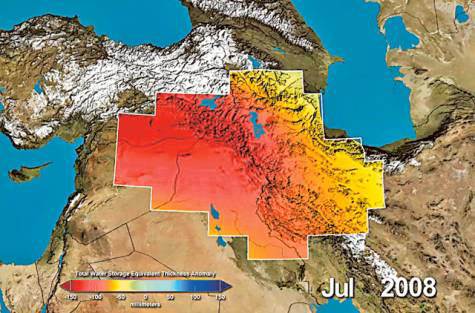
From the beginning of 2003 to the end of 2009, portions of Iran, Iraq, Turkey and Syria that lie within the Tigris and Euphrates river basins shed 117 million acre-feet of water. That’s roughly equivalent to the volume of the Dead Sea.
Since then the position of the ADDNI/OS has been abolished, the long-standing director of the OSC that did so much damage in his ignorance and arrogance has retired, to be replaced by a second stringer from the NRO, and of course we now know that there is no management, no integration, and no oversight of intelligence collection and covert action — nor is there any management, integration, and oversight of everything else: processing, analysis, outreach, sharing, or the creation of ethical evidence-based decision-support, which is simply not what the US secret world does. It collects — everything — as espensively as possible. It kills with drones — with a 98% error rate — and also very expensively. It does nothing useful to Whole of Government to to creating a prosperous world at peace, a world in which the USA can enjoy the fruits of peace, commerce, and friendship.
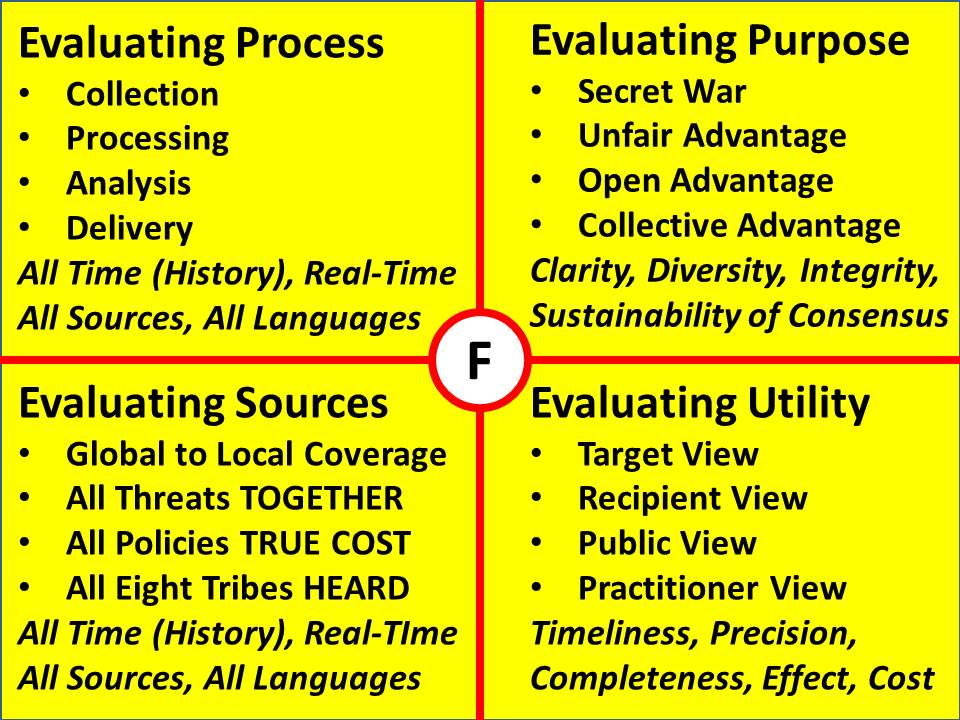
Below are a few graphics and high-level pieces on what the US intelligence should look like. They are logical extensions of the earlier pieces published in the early 1990's.
When the wealthy nations of the world meet as the G8 or in any other gathering, it's interesting to imagine what they would do if they followed the golden rule, valued grandchildren, disliked unnecessary suffering, or wished to outgrow ancient forms of barbarism, or any combination of those.
The United States alone is perfectly capable, if it chooses, of enacting a global marshall plan, or — better — a global rescue plan. Every year the United States spends, through various governmental departments, roughly $1.2 trillion on war and war preparations. Every year the United States foregoes well over $1 trillion in taxes that billionaires and centimillionaires and corporations should be paying.
If we understand that out-of-control military spending is making us less safe, rather than more — just as Eisenhower warned and so many current experts agree — it is clear that reducing military spending is a critical end in itself. If we add to that the understanding that military spending hurts, rather than helping, economic well-being, the imperative to reduce it is that much clearer.
If we understand that wealth in the United States is concentrated at medieval levels and that this concentration is destroying representative government, social cohesion, morality in our culture, and the pursuit of happiness for millions of people, it is clear that taxing extreme wealth and income are critical ends in themselves.
Still missing from our calculation is the unimaginably huge consideration of what we are not now doing but easily could do. It would cost us $30 billion per year to end hunger around the world. We just spent nearly $90 billion for another year of the “winding down” war on Afghanistan. Which would you rather have: three years of children not dying of hunger all over the earth, or year #13 of killing people in the mountains of central Asia? Which do you think would make the United States better liked around the world?