It searches only the 35,000 Web sites that our staff of research experts and librarians and teachers have evaluated and approved when creating the content on findingDulcinea. We constantly evaluate our search results and “fine-tune” them, by increasing the ranking of Web sites from organizations such as the Library of Congress, the Smithsonian, PBS and university Web sites.
SweetSearch helps students find outstanding information, faster. It enables them to determine the most relevant results from a list of credible resources, and makes it much easier for them to find primary sources. We exclude not only obvious spam sites, but also marginal sites that read well, but lack academic or journalistic rigor. As importantly, the very best Web sites that are often buried on other search engines appear on the first page of SweetSearch results.
Home Page
To see a short video of us demonstrating SweetSearch, click here.
For more, including a comparison of search results between SweetSearch and Google and Bing, read this blog post.
We'd love to get your feedback on SweetSearch. Try your own searches and let us know what you think by e-mailing info@dulcineamedia.com.
SweetSearch.com is owned and operated by Dulcinea Media. Click here to learn more about our Company and staff.
“If it is 85% accurate, on time, and I can share it, this is a lot more useful to me than a compendium of Top Secret Codeword materials that are too much, too late, and require a safe and three security officers to move around the battlefield.” Navy Wing Commander who led the lead flight over Baghdad in Gulf I
Consequences of Excessive Secrecy & Corruption
“The danger is, you'll become something like a moron. You'll become incapable of learning from most people in the world, no matter how much experience they may have in their particular areas that may be much greater than yours.” Daniel Ellsberg
“(There is a need) to recognize that just as the essence of knowledge is not as split up into academic disciplines as it is in our academic universe, so can intelligence not be set apart from statecraft and society, or subdivided into elements…such as analysis and estimates, counterintelligence, clandestine collection, covert action, and so forth. Rather, and as suggested earlier in this essay, intelligence is a scheme of things entire. And since it permeates thought and life throughout society, Western scholars must understand all aspects of a state's culture before they can assess statecraft and intelligence.” Adda Bozeman
“Is what we are doing in accepting false numbers beyond the bounds of reasonable dishonesty?” Sherman Kent
“Intelligence without communications is noise.” Al Gray “If you cannot communicate your intelligence to the person who needs it because it is over-classified and they do not have the US rigamarole clearances, it is useless.” DefDog
“Everybody who's a real practiioner, and I'm sure you're not all naive in this regard, realizes that there are two uses to which security classification is put: the legitimate desire to protect secrets, and the protection of bureaucratic turf. As a practitioner of the real world, it's about 90 bureaucratic turf, 10 legitimate protection of secrets as far as I am concerned.” Rodley B. McDaniel, then Executive Secretary of the National Security Council
Phi Beta Iota: In 1993 Robert Steele testified to the Presidential Commission on Secrecy and identified the “cement overcoat” of excessive secrecy. Nothing has changed–indeed, it has gotten much worse. To be effective, intelligence must be multinational and default to the secret level when dealing with plans and intentions, and to the unclassified level when dealing with context. It takes balls as well as brains to come out from behind the green door of zero accountability and zero utility through excessive secrecy.
WEST PALM BEACH, Fla. — Former Florida Gov. Jeb Bush says he'd consider running as vice president with Mitt Romney, but doubts he'll ever be asked.
Bush tells the conservative website Newsmax that Florida Sen. Marco Rubio is “probably the best” choice to share the ticket with Romney, the presumptive GOP presidential nominee. Bush said he hopes the freshman senator is offered the No. 2 slot and accepts it.
Rubio has said repeatedly that he isn't interested in leaving the Senate.
Bush said he'd consider running if Romney were to ask him. But the former governor added that he's not sure running for vice president is the right thing for him and said he's doubtful he'd even receive the call.
Includes Video with Bush Family sealing the deal — Walker Bush (43) is being kind to Romney by being invisible.
This opens up vast possibilities of consumer-accessible imaging technologies that are less damaging than x-rays. Imagine your tricorder decked out with a terahertz chip…
“A hi-tech chip allows a phone to ‘see through' walls, wood and plastics – and (although the researchers are coy about this) through fabrics such as clothing.
“Doctors could also use the imagers to look inside the body for cancer tumours without damaging X-Rays or large, expensive MRI scanners.”
“The terahertz band of the electromagnetic spectrum, one of the wavelength ranges that falls between microwave and infrared, has not been accessible for most consumer devices.”
‘We've created approaches that open a previously untapped portion of the electromagnetic spectrum for consumer use and life-saving medical applications,’ said Dr. Kenneth O, professor of electrical engineering at UT Dallas.
A little technically complicated to install, but this filter is an example of the kind of crap-detection/information-evaluation filters that the infotentive will be able to use as filter-tech becomes more user-friendly — Howard
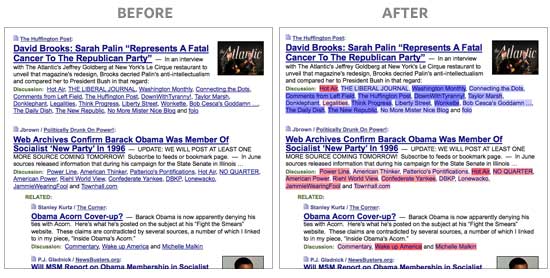
“With the help of del.icio.us founder Joshua Schachter, we used a recommendation algorithm to score every blog on Memeorandum based on their linking activity in the last three months. Then I wrote a Greasemonkey script to pull that information out of Google Spreadsheets, and colorize Memeorandum on-the-fly. Left-leaning blogs are blue and right-leaning blogs are red, with darker colors representing strong biases. Check out the screenshot below, and install the Greasemonkey script or standalone Firefox extension to try it yourself.”
David Isenberg explains that spectrum for various forms of wireless transmission and communication is treated as scarce, similar to real estate, because a scarcity model works for “cellcos” (cellular communication companies, former telcos) In fact, spectrum is infinite. [Link]
The core of the story is whether or not spectrum is a rival good. A rival good is something that when it’s used by one party can’t be used by another. The cellcos say it is. Current FCC regulation does too. But David Reed has repeatedly pointed out that physics — our understanding of physical reality — says otherwise. The article paraphrases him: electromagnetic spectrum is not finite. Not finite. In other words, infinite.
“The technology of the current satellite architecture is pretty much at its limit, and the commercial satellites are producing just about the same thing at a much lower cost,” said retired Gen. James E. Cartwright of the Marines, former vice chairman of the Joint Chiefs of Staff. “The government’s satellites are better, but the question is, What do you need? Most studies show that about 90 percent of what the military needs can be solved with commercial.”
The military also favors commercial satellites because imagery from the intelligence community cannot be easily shared with allies. “The beauty of commercial imagery is that it is unclassified,” said Walter Scott, chief technical officer of DigitalGlobe, a satellite company based in Longmont, Colo.
Phi Beta Iota: Kill MASINT, shut down the NRO, cut NSA in half, cut cyber-security by four-fifths, fund the multinational clandestine human intelligence field stations, fund the Open Source Agency (with responsibility for open source software, open spectrum, and in passing cyber-security) and move on. This is not rocket science. All it takes is integrity.