A Twitter analytics company that said it detected Osama bin Laden's death before it was reported by the news media has signed a partnership with Twitter, and is expanding the availability of its service for notifying financial firms and government clients of highly unusual events.
The company, Dataminr, described its technology at the Twitter Devnest conference last May, shortly after its service used Twitter data to report bin Laden's death to its clients before the story hit major media outlets. Today, Dataminr is announcing a partnership with Twitter allowing it greater access to tweets and their metadata, and is expanding availability of the service.
Dataminr and Twitter did not make its executives available for phone interviews, saying Dataminr customers are concerned about revealing too much information, but gave us an early copy of the press release being issued this morning. The announcement says that “Dataminr has just signed a partnership with Twitter, which includes access to the full Twitter Firehose in real-time,” and that it is unveiling “its novel technology for using Twitter’s public Tweets to create actionable signals for enterprise clients.”
One can only look on in anguish as the US Government continues to betray the public trust for lack of intelligence and integrity.
The headlines about earthquakes being related to oil and gas drilling have been common for some time now. Despite the fact that the federal government has noticed the connection at very low bureaucratic levels, the fact is that the politicized government persists in ignoring the precautionary principle and continues to betray the public trust by not stopping all activities associated with increasing earthquakes.
Earthquakes are now coming to the East Coast just as they are about to become much more frequent, intense, and consequential on the East Coast.
One can only pray that at some point the public will demand an honest government capable of making informed decisions with integrity.
A vaccine that can train cancer patients’ own bodies to seek out and destroy tumor cells has been developed by scientists.
The therapy, which targets a molecule found in 90 per cent of all cancers, could provide a universal injection that allows patients’ immune systems to fight off common cancers including breast and prostate cancer.
Preliminary results from early clinical trials have shown the vaccine can trigger an immune response in patients and reduce levels of disease. The scientists behind the vaccine now hope to conduct larger trials in patients to prove it can be effective against a range of different cancers.
They believe it could be used to combat small tumours if they are detected early enough or to help prevent the return and spread of disease in patients who have undergone other forms of treatment such as surgery.
Cancer cells usually evade patient’s immune systems because they are not recognised as being a threat. While the immune system usually attacks foreign cells such as bacteria, tumours are formed of the patient’s own cells that have malfunctioned.Scientists have, however, found that a molecule called MUC1, which is found in high amounts on the surface of cancer cells, can be used to help the immune system detect tumors.
The new vaccine, developed by drug company Vaxil Biotheraputics along with researchers at Tel Aviv University, uses a small section of the molecule to prime the immune system so that it can identify and destroy cancer cells.
A statement from Vaxil Biotheraputics said: “ImMucin generated a robust and specific immune response in all patients which was observed after only 2-4 doses of the vaccine out of a maximum of 12 doses.
“In some of the patients, preliminary signs of clinical efficacy were observed.”
The results are still to be formally published but if further trials prove to be successful the vaccine could be available within six years. As a therapeutic vaccine it is designed to be given to patients who are already suffering from cancer to help their bodies fight off the disease rather than to prevent disease in the first place.
Cancer cells contain high levels of MUC1 as it is thought to be involved helping tumours grow. Healthy human cells also contain MUC1, but have levels that are too low to trigger the immune system after vaccination.
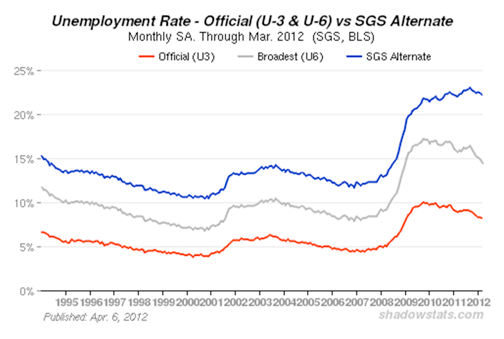
John Williams, of Shadowstats, notes that manipulated government statistics are not changing the fact that the true SGS Unemployment Measure now sits at a staggering 22.2%. Williams also demonstrates that despite the hype from Wall Street about a recovery, parts of the economy remain collapsed. Here is what Williams had to say about the situation: “Adding the SGS estimate of excluded long-term discouraged workers back into the total unemployed and labor force, unemployment—more in line with common experience as estimated by the SGS-Alternate Unemployment Measure—notched lower to 22.2% in March from 22.4% in February.”
Click on Image to Enlarge
John Williams continues:
“The SGS estimate generally is built on top of the official U.6 reporting, and tends to follow its relative monthly movements. Accordingly, the SGS measure will suffer some of the current seasonal-adjustment woes afflicting the base series, such as recent distortions in adjusted reporting of part-time employment for economic reasons. Nonetheless, there continues to be a noticeable divergence in the SGS series versus U.6. The reason for this is that U.6, again, only includes discouraged workers who have been discouraged for less than a year.
As the discouraged-worker status ages, those that go beyond one year, fall off the government counting, and new workers enter “discouraged” status. Accordingly, with the continual rollover, the headline workers flow into the short-term discouraged workers counted in U.6 continue, and from U.6 into long-term discouraged worker status (SGS Measure) at what appears to be an accelerating pace.
Join us in Washington, DC on April 28 and 29 for an “International Drone Summit: Killing and Spying by Remote Control” hosted by CODEPINK, Reprieve, and the Center for Constitutional Rights.
US drone strikes have killed an estimated 3,000 people around the world, including hundreds of civilians, without any judicial process or meaningful oversight, and without any transparency or accountability. The summit's dual objectives are to better inform the public about the reality and significance of the US government's expanding use of both killer and surveillance drones, and to facilitate networks and strategies to resist this expansion.
The Saturday, April 28 program is open to the public and brings together human rights advocates, robotics technology experts, activists, lawyers, scholars and journalists, and shares the stories of people whose families and lives have been directly impacted by remote-controlled drone strikes. This is an all day event with multiple panels beginning at 9am at Mount Vernon Place United Methodist Church, 900 Massachusetts Ave. NW, Washington, DC. See this site for updates on the program, and register here today!
The Sunday, April 29 program is a strategy session for organizations and individuals to network and plan advocacy efforts focused on various aspects of drones, targeted killings and expanding US covert wars. If you are interested in attending this session, please email Ramah Kudaimi at rkudaimi(@ symbol)gmail.com.
Cost growth in the last year in DOD's acquisition system was $74 billion, 34 percent more than the $55 billion presumed to occur in the sequester in January; while the time frames are different (see discussion below), so much for Secretary of Defense Panetta's asinine rhetoric that sequester would be a “Doomsday.”
Cost growth in the last year in DOD's acquisition system was $74 billion, 34 percent more than the $55 billion presumed to occur in the sequester in January; while the time frames are different (see discussion below), so much for Secretary of Defense Analysis of two recent acquisition reports is available at Time's Battleland blog at http://battleland.blogs.time.com/2012/04/09/lies-damn-lies-and-pentagon-budget-numbers/and below.
Lies, Damn Lies, and The Pentagon's Latest Budget Numbers
There's a pair of must-reads just out for anyone paying attention to the Pentagon's acquisition nightmare: one is a routinely scheduled, but important, report from the Defense Department; the other comes from one of the very few entities doing even minimal oversight of the Department of Defense these days, the Government Accountability Office.
Reviewing the reports separately results in a muddled picture of how the Pentagon buys its weapons. Happily, each report fills some of the data missing in the other. But, the two reports still leave some gaping holes, while providing a false impression of progress in the way the Defense Department buys weapons.
The two reports are GAO's annual review of major hardware acquisition, Defense Acquisitions: Assessments of Selected Weapon Programs, and DoD's new Selected Acquisition Report(SAR), both released March 30. What follows is my own After-Action Report – including the gaps, contradictions, and false assurances – after studying the data they do – and don't – contain.