While the US is distracted at home by warmongering politicians competing for the Republican nomination and Israeli-neocon warmongering for launching a new war against Iran, a crisis may be metastasizing in cancer that is Afghanistan.
Below is a report in the Pakistani newspaper Dawn that describes the logistics bottleneck in the port of Karachi caused by Pakistan's closure of the Nato's crucial southern supply route.
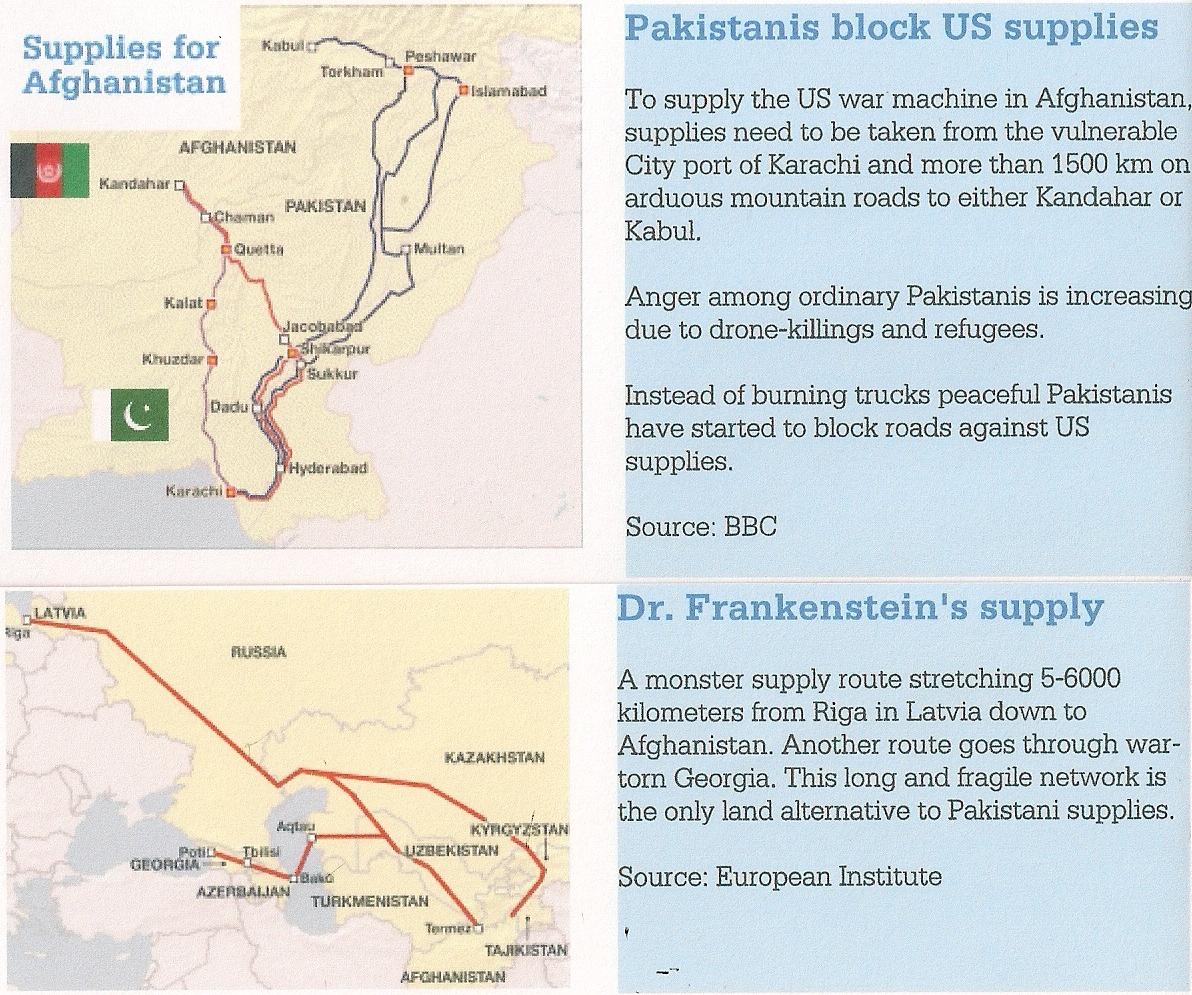
There are three logistics routes to sending supplies into Afghanistan: one by air and two by land. Air is too expensive and of limited carrying capacity. The least costly route is the long vulnerable highway net thru Pakistan — this is the southern route (top map) that has been shut down as described below. The northern route (lower map) is much longer going from either the Baltic or the Black Seas and is dependent on the good will of Russia, Kazakhstan, and Uzbekistan. According to the AP, The northern route at $104 million per month in total cost is at least six times as expensive as the southern route.
The AP report contained no information on the cost per ton, but that factor is likely to be much higher that six-to-one, because prior to the closure (as of last June), about 50% of Nato's total supply requirement was was flowing through the southern route, with the other 50% being divided between the norther route and the air route.]
Thousands of Nato trucks in Pakistan backlog
Dawn [Pk], 26 Jan 2012
KARACHI: Two months into Pakistan’s blockade on Nato supplies crossing into Afghanistan, thousands of trucks are crowding the port in Karachi where drivers, fed up with waiting, are starting to desert.
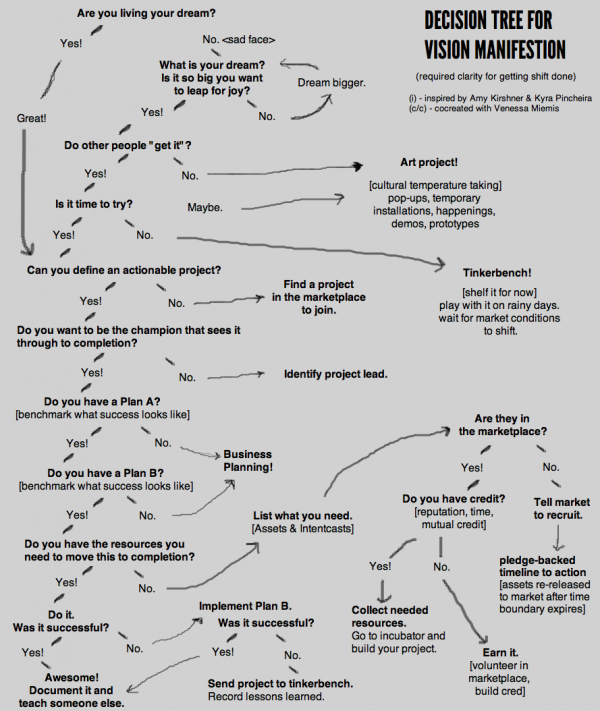
I just got back from a great trip to Burlington, VT, where I touched base with Amy Kirschner of the Vermont Sustainable Exchange. She and cocreator Kyra Pinchiera have been working on creating an inquiry process to assist people in making ideas happen.
Many of us have grand visions of the future, but to be able to tranform those into a “minimum viable product” – something tangible and actionable – can be a bit of an art.
She showed me her sketches for taking idea to action, and i made them into a little graphic. Enjoy!
Phi Beta Iota: Where this disappoints is in turning to art in the early stage when the marketplace does not “get it.” Some kind of mass educational shock appears called for–Shock Education. Revolutions start with violent shocks–no one has achieved a non-violent shock that leads to a non-violent revolution Of, By, and For We the People, that we know of.
From a perspective of elementary epistemology, the difference between practice of religion and practice of science is really quite simple: in religion, one changes one's observations about reality to fit one's conception or model of reality ; in science, one changes one's model of reality to fit one's observations about reality. At the heart of this distinction are the notions of incontrovertible truth on the one hand and conditional (or convertible) truth on the other. Each has its place in the human affairs, and differences in place implies acceptance of one does not necessarily mean rejection of the other.
Of course the real world is more complex than this simple distinction implies and the different notions of truth coexist and overlap. Indeed, notions of Truth revealed though religious study, for example, have in fact changed over the long term, often in unwilling response to the progress of science. The causes of thunderstorms in antiquity were in realm of religion and explained as acts of gods; today those causes can be explained by advancements in scientific knowledge. The Catholic church successfully suppressed the views of Galileo in the short term, but in the long term adapted its religious dogma to them, ditto for the ideas of Darwin. In contrast, the practice of science views “facts” in the context of a conception of truth, be it convenient or inconvenient, that is by definition conditional or controvertible in the short term and always subject to refutation. All scientific theories are conditional hypotheses about reality, and as the historian of science Thomas Kuhn has shown, these hypotheses may be accepted as truth during the normal practice of fleshing out scientific knowledge, but they are nevertheless alway subject to refutation. In fact, to be a valid hypothesis, a scientific theory must be stated in a form that can be falsified by logic or experiment or both — and while its truth may be accepted by the scientist, he recognizes that his/her acceptance is always conditional and subject to change. Indeed, many of the greatest experiments in science are those that falsify generally-accepted theories of reality, like Galileo's observations of Jupiter's moons or the Michelson-Morley experiment. The other necessary condition for the practice of science, namely that its efforts must be transparent and subject to replication by other scientists, flows naturally from the notion of conditional truth — hiding data, suppressing competing views, and political or hidden agendas have no place in the scientific ideal.
Now, I urge you read the attached letter by 16 scientist/engineers, and ask yourself if the theory and practice of the incontrovertible “truth” of global warming is evolving along a religious or scientific vector of knowledge creation? Are its practitioners treating it as as a theory — an hypothesis — subject to falsification or as a dogmatic truth that should not be questioned?*
——————–
* Of course, you can dismiss this letter. After all, it appeared in the Wall Street Journal, which is owned by the arch climate denier (itself a revealing epithet) Rupert Murdoch. On the other hand, if you are more openminded and want to determine for yourself if the anti-scientific behaviours alluded to in this letter are atypical isolated examples, I recommend you start by reading A.W. Montford's “The Hockey Stick Illusion,” which goes to the core of the question of whether or not it is an incontrovertible truth that the temperature increases since 1850 are unprecedented. But there is more — a lot more — readers interested in learning about alternative scientific hypotheses might explain the dynamics of climate change since 1850 can start their journey by reading Professor Akasofu's paper on the subject [here].
There's no compelling scientific argument for drastic action to ‘decarbonize' the world's economy.
Wall Street Journal [ op-ed], 27 January 2012
Note: The following has been signed by the 16 scientists listed below:
Claude Allegre, former director of the Institute for the Study of the Earth, University of Paris; J. Scott Armstrong, cofounder of the Journal of Forecasting and the International Journal of Forecasting; Jan Breslow, head of the Laboratory of Biochemical Genetics and Metabolism, Rockefeller University; Roger Cohen, fellow, American Physical Society; Edward David, member, National Academy of Engineering and National Academy of Sciences; William Happer, professor of physics, Princeton; Michael Kelly, professor of technology, University of Cambridge, U.K.; William Kininmonth, former head of climate research at the Australian Bureau of Meteorology; Richard Lindzen, professor of atmospheric sciences, MIT; James McGrath, professor of chemistry, Virginia Technical University; Rodney Nichols, former president and CEO of the New York Academy of Sciences; Burt Rutan, aerospace engineer, designer of Voyager and SpaceShipOne; Harrison H. Schmitt, Apollo 17 astronaut and former U.S. senator; Nir Shaviv, professor of astrophysics, Hebrew University, Jerusalem; Henk Tennekes, former director, Royal Dutch Meteorological Service; Antonio Zichichi, president of the World Federation of Scientists, Geneva.
A candidate for public office in any contemporary democracy may have to consider what, if anything, to do about “global warming.” Candidates should understand that the oft-repeated claim that nearly all scientists demand that something dramatic be done to stop global warming is not true. In fact, a large and growing number of distinguished scientists and engineers do not agree that drastic actions on global warming are needed.
Canadian researchers find a simple cure for cancer, but major pharmaceutical companies are not interested.
Researchers at the University of Alberta, in Edmonton, Canada have cured cancer last week, yet there is a little ripple in the news or in TV. It is a simple technique using very basic drug. The method employs dichloroacetate, which is currently used to treat metabolic disorders. So, there is no concern of side effects or about their long term effects.
This drug doesn’t require a patent, so anyone can employ it widely and cheaply compared to the costly cancer drugs produced by major pharmaceutical companies.
FBI wants an app to detect global and domestic threats
ThinkDigit, 27 January 2012
The FBI is in talks with developers to create an app that will notify them of suspicious behavior, combining information from Facebook, Twitter and Google Maps. The FBI has been monitoring user content on a lot of these sites for a while, and have lucked out in the past, catching many criminals who’ve unthinkingly revealed incriminating information.
“Social media has become a primary source of intelligence because it has become the premier first response to key events and the primal alert to possible developing situations.”
The app will work as an early-warning system, allowing the FBI be alerted of any threats or crimes, with location information displayed on maps. The FBI's Strategic Information and Operations Center (SOIC), had put out a market research request for a “Social Media Application,” last week, specifying the features required:
Collect open source information from across the web on domestic and global terror data
Automated search and scrape capability of social networks
Allow for users to create specific keyword searches.
Display levels of threats on maps, with colour coding, etc.
Google Maps 3D and Yahoo Maps the “preferred” mapping options.
Plot a wide range of domestic and global terror data.
Translate tweets into English
The FBI said the “Information posted to social media websites is publicly accessible and voluntarily generated. Thus the opportunity not to provide information exists prior to the informational post by the user.” Further assuaging privacy concerns, the bureau added that policy was in place to edit out any content that was not relevant of specific categories being researched for investigations. Sites it intends to monitor include YouTube, Flickr, Twitter, Facebook and Itstrending.com.
This paper investigates the similarities and differences between two important ideas in information processing and knowledge utilisation. Those ideas are [critical thinking] and [information literacy]. The two phrases are shown in brackets to indicate that the two words involved in each idea are not arbitrarily combined but have been coupled by authors to represent a single entity or a focus for development of concepts describing the characteristics involved. By exploring terms related to this couplet from the same sentence, the meaning of each of the central ideas can be expanded. The education, library science, and health science literature were used in this study, which analysed 8745 articles dealing with [critical thinking] and 8201 reports dealing with [information literacy] included in either ERIC or PubMed from 2000-2009.
The findings showed that combinations of terms (i.e. ideas) such as [information & literacy & related term] or [critical & thinking & related term], when organised based on Bloom’s Taxonomy of Learning (Bloom 1956), clarified the similarities and differences between the two central ideas. [Information literacy] was involved in all of the cognitive functions suggested by Bloom. This finding is consistent with the definitions of [information literacy] that relate it to lifelong learning and effective decision-making. In addition, the ideas describing [information literacy] were consistent with actions and perceptions that were more public and standardised than those associated with [critical thinking].
This suggests that [information literacy] and its associated procedures could significantly augment current instruction in [critical thinking] and indeed, the possibility has been explored by some authors in the current literature. A merging of the two ideas would involve [information literacy] providing tools and techniques in the processing and utilisation of knowledge and [critical thinking] supplying the particulars and interpretations associated with a specific discipline. This type of integration could lead to instructional programs similar in concept and application to those in research methodology where methods from statistics are integrated with the techniques and skills associated with a specific discipline. The development of a curriculum of this type would change functions and perceptions from private, individualised mentation, now associated with [critical thinking], to a more easily learned and practiced process suitable across the breadth of disciplines.
Keywords
critical thinking; information literacy; idea analysis
When I review these passages, my mind speaks back – “the machine is using us”.The goal of the enlightenment was to free our minds, by favoring ‘rationality’ over myth and mysticism. Nature became something that was to be controlled by us, quantified, compartmentalized, labeled, manipulated.
But, this new scientific way of looking at things changed the way we THINK… or perhaps limited our ability to think at all. Instead of looking for greater ‘Truth’ or deeper meaning in things, identifying the essence of a thing, giving it ‘value’, it becomes a mere definition. The framework of thoughts are based in a soul-deadening logic and mechanicality. Everything that can be named and described and explained away can be somehow controlled, and there’s a power in that, but at the same time, something sacred is lost.
Click on Image to Enlarge
The belief in positivism seems as irrational to me as mythology must have been for those that started the enlightenment movement. To place utmost value in what the senses can perceive, and call it Truth, is ridiculous. I think we’re finally coming around full circle, not to a return to mysticism, but at least allowing ourselves to say that there’s more to life than meets the eye. In some ways, science itself has pointed out its fallibility. The more we dive into quantum mechanics, the more incongruities and incompatibilities we find with what we think we know and what is. Perhaps there really is an unknowable universal. Is it really such a horrible thing to have a sense of awe of the world around us??
We become like slaves in invisible chains, our minds shaped into the pattern of a machine: efficient, mechanical, repetitive, causal, our thoughts on the conveyor belt of an assembly line – there are no alternative paths for them to take.
This machine-like way of thinking is tied directly to the division of labor – the mechanized process of thinking is merely a function of material production and the “all-encompassing economic apparatus”. By abandoning the cumbersomeness of formulating actual thoughts in favor of following a predetermined reified path, the greater machine/system of society can operate smoothly. At the same time, the smooth operation leads to a distillation of society, a loss of culture.
By treating nature as something outside of oneself, something that needs to be manipulated and controlled verse something with which to be in harmony, humans become isolated and estranged. Both the lowly worker and the ones in charge are victims – the dominated are resigned sheep, and the dominators are equally immobilized by their distance from the experience, the self imposed detachment and repression of novelty in favor of utility in order to ‘better’ perform their role of power.
(from the archives; friday february 6, 2009; media studies graduate paper)