Journal: Bound to Fail–The Inevitable Collapse of McChrystal’s Afghan War Plan

02 Diplomacy, 03 Economy, 08 Wild Cards, 10 Security
0Shares

The Inevitable Collapse of McChrystal's Afghan War Plan

Bound to Fail

By FRANKLIN C. SPINNEY

Nisos Kos, Greece

In the 11 May issue of CounterPunch, apparently based on White House and Pentagon sources, Gareth Porter, one of the most able journalists covering the Afghan debacle, reported that General McChrystal’s war plan is in the early stages of unravelling. To appreciate why this was entirely predictable, consider please, the following:

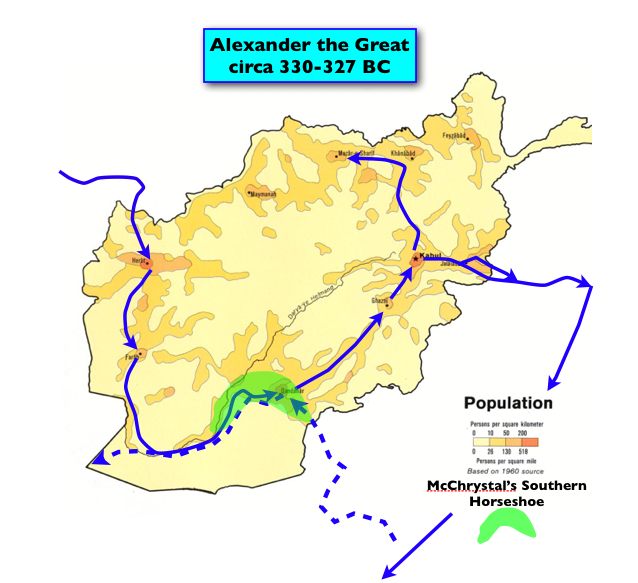
On January 2, during an interview with Drew Brown of Stars and Stripes, McChrystal described his plan to create an ‘arc of security’ in the most densely populated regions of Southern Afghanistan. The green shaded area in the following map of Afghanistan overlays McChystal’s arc on the distribution of population densities. I constructed it from the information contained in Brown’s interview. As you can see, McChrystal plan opens his biggest military campaign to date by invading a region that has seen many invasions and much fighting during the last two thousand years, including operations by Alexander the Great (also shown on the chart), both of the 19th Century Anglo-Afghan Wars, and the Soviet-Afghan War of the 1980s.
Original Story at CounterPunch


Historically minded tribal cultures, like the Pashtun, have had plenty of time to learn and remember the strengths and weaknesses of this terrain by resisting these invaders using the timeless arts of guerrilla war. Note, for example, the stunning similarity of Alexander the Great’s invasion route in the figure to that of the Soviet’s shown here.

McChrystal’s first move in implementing his pacification strategy was to invade Marjah (which is in the western part of the shaded area) in mid February. The aim of this operation was a variation of Marshall Lyautey’s ink spot theory: namely to clear the Taliban out of Marjah, secure the area, and prevent the return of the Taliban. Success in this operation would set the stage spreading the area of pacification by clearing the Taliban out of the more populated city of Qandahar. And so, moving from west to east along Alexander’s (and the Soviet’s) route, the ink spot would spread to Qandahar in the eastern part of the arc.

Without being critical, I note that neither Porter nor his sources mention the role of Afghan army and police forces in the unravelling of McChrystal’s plan. Porter is certainly aware of these limitations, having written several important reports on this subject. Nevertheless, the implication of the Taliban re-infiltration of the Marjah region is clear: the Afghan security forces in the region are either insufficient or ineffective (or both) to perform their job of protecting the people by permanently cleansing the area of Taliban.

The inability to spread the “ink spot” McChrystal tried to insert with the Marjah offensive has its roots in the central flaw highlighted last September in my critique of McChrystal’s escalation plan, which was submitted to President Obama last summer. This inability also means that US forces will be needed to provide security to the Marjah region, if McChrystal sticks to his strategic aim. This requirement, which would have been easily foreseen, had McChrystal presented Mr. Obama with a straightforward assessment of the very limited capabilities of the Afghan security forces, will now result in our forces being spread out to protect this region, assuming we want to protect the Marjah “ink spot.” The deployment of US pacification troops will probably take the form of an array of strong points and outposts, backed up with quick reaction reinforcements, kept on alert in nearby bases, together with airpower.

If our troops are being deployed this way, they will be unavailable for the upcoming Qandahar offensive. Moreover, they will become vulnerable to being attacked piecemeal in a series of irregular, but frequent hit and run attacks on bases and supply routes. This kind of rope-a-dope strategy will keep our troops on edge and put them under continual mental and physical stress — and they will be vulnerable to being ground down much like the British troops were last summer. The continuing pressure will naturally increase the jumpiness of our soldiers and marines and, if past is prologue, will likely increase their trigger-happiness, including more calls for artillery and air support. More firepower means more civilian deaths in the “pacified” region, and the rising bloodshed will play into the Taliban’s hands by alienating the hearts and minds of local population we claim to be protecting, a process which is already in progress.

This hydra of emerging pressures, which is probably just beginning to be appreciated, is probably why the looming offensive to secure Qandahar that McChrystal was broadcasting in April is now being scaled back in its aims.

Later this summer, as these problems become more apparent and American mid-term elections loom, we can expect to be subjected to a unseemly spectacle finger pointing and a search for scapegoats. In the end, the debacle will be fault of Obama and by extension the Democrat’s, because the President ignored Sun Tzu’s timeless wisdom, when he approved McChrystal’s fatally flawed plan, despite the cabled warnings of retired Army general Karl Eikenberry, his ambassador to Afghanistan.

Franklin “Chuck” Spinney is a former military analyst for the Pentagon. He currently lives on a sailboat in the Mediterranean and can be reached at chuck_spinney@mac.com
Journal: Euro’s Crisis Has American Fingerprints

03 Economy
0Shares
Chuck Spinney Recommends

Posted on May 11, 2010

By William Pfaff

The obituaries written of the European currency, the euro, have demonstrated divergences in national and cultural temperaments, the European funereal and laden with gloom about the future, but unyielding, and the American and British cheerfully and self-satisfiedly shoveling earth onto a casket of euros already six feet into the ground. Defy the markets, will they, these Europeans! Suddenly, the lid of the casket flew open early Monday morning, and the euro burst forth, bigger, better and brighter than before!

Sunday night, German Chancellor Angela Merkel was prudently off in Moscow to watch a V-E Day parade in Red Square, rather than witness electoral humiliation in North Rhine-Westphalia (where her party lost because of voter resentment of pleasure-loving Greeks squandering German wealth amidst permanent sunshine!). Britain was politically decapitated, without a functioning government.

Before Merkel was back, the German government had run up the white flag. The euro crisis was over. If any individual was a winner, it was temperamental and widely derided French President Nicolas Sarkozy, who has insisted since his election in 2007 that Europe (or the euro’s users) requires a politically sophisticated decision-making authority.

Continue reading “Journal: Euro’s Crisis Has American Fingerprints”

Supreme Court Nominee Elena Kagan & Her Actions to Protect Saudi Royal Family from 9/11 Lawsuits

09 Justice, 09 Terrorism, 10 Security, 9/11 research, Corruption, Government
0Shares
raw story link

(from Rawstory.com citing NY Times 2009 article) Elena Kagan, President Barack Obama's latest nominee to the Supreme Court, helped protect the Saudi royal family from lawsuits that sought to hold al Qaeda financiers responsible in the wake of the Sept. 11, 2001 attacks. The suits were filed by thousands family members and others affected by the Sept. 11 attacks. In court papers, they provided evidence that members of the Saudi royal family had channeled millions to al Qaeda prior to the bombings, often in contravention of direct guidance from the United States. But Kagan, acting as President Obama's Solicitor General, argued that the case should not be heard even if evidence proved that the Saudis helped underwrite al Qaeda, because it would interfere with US foreign policy with the oil-rich nation. She posited “that the princes are immune from petitioners’ claims” because of “the potentially significant foreign relations consequences of subjecting another sovereign state to suit.”

Related:
+ Secret Saudi Document Shows Kingdom Linked with Al-Qaeda Terror
+ OpenSecrets.org profile of Elena Kagan

profile link

Journal: Eurozone – The Kitchen Sink Goes In – Now It’s All About Solvency

03 Economy
0Shares


Chuck Spinney Recommends
 

EuroZone All In

By Peter Boone and Simon Johnson, Baseline Scenario, 10 May 2010


The eurozone self-rescue plan announced last night has three main elements:

At first pass this package might seem to be in with what we recommended

But the European central banks have come in very early – with government bond prices still high – and there is no sign yet of credible fiscal adjustment for Spain and Portugal. The eurozone apparently did not even discuss the situation in Ireland, which seems increasingly troubling.

This is a whole new level of global moral hazard – the result of an alliance of convenience between troubled governments in the south of Europe and the north European banks (and implicitly, north American banks) who enabled their debt habit. The Europeans promise to unveil a mechanism this week that will “prevent abuse” by borrowing countries, but it is hard to see how this would really work in Europe today.

Overall, this is our assessment:

The underlying problem in the euro zone is that Portugal, Ireland, Italy, Greece, and Spain are locked into a currency which means they are uncompetitive in trade terms while they are also running large budget deficits. To get out of this they need large wage and price cuts to restore competitiveness, and they need to make fiscal cuts to get budget balances back at sustainable levels.

Markets decided these adjustments were going to be difficult, so spreads on those countries’ debts widened (i.e., interest rates relative to German government bonds). As the rates go up, this causes local asset prices to fall, concerns over bank balance sheets increase, etc. This combination was causing an incipient run on banks. Any country with its own currency could reasonably devalue in such a situation, but this is not an option within the euro bloc.

All these problems were exacerbated by the appearance that the Germans were going to be unwilling to bail out troubled nations – and would eventually chose to bail out their own banks instead. It is this risk which is now resolved. The Germans have shown willingness to provide very large amounts of money (the 750bn euro support is probably just enough for Spain and Portugal if they got packages in line with that received by Greece) and they would obviously provide more if needed (e.g., for Italy). (Here again is the ready reckoning chart for


However, the solvency issue remains. The Spanish and Portuguese have said they will now cut their budgets further, but already their forecasts were optimistic, and neither has seemed willing to admit they have severe budget problems, so we will need to watch how they implement in the near term. Greece


750bn euros in a fiscal support program, with 1/3 coming from the IMF (although this was apparently news to the IMF).The European Central Bank promises to buy bonds in dysfunctional markets.Swap lines with the Federal Reserve, to provide dollars.a week ago and again on Thursday.interlinkages between indebted Europeans.)remains simply far too indebted.

READ MORE:

http://baselinescenario.com/2010/05/10/eurozone-the-kitchen-sink-goes-in-now-it%e2%80%99s-all-about-solvency/?utm_source=feedburner&utm_medium=feed&utm_campaign=Feed%3A+BaselineScenario+%28The+Baseline+Scenario%29

Review (DVD): Saving God (2008)

Culture, DVD - Light, Reviews (DVD Only)
0Shares

5.0 out of 5 stars “Ving” Rhames Phenomenal, Movie of Raw Life and Real Hope,


May 10, 2010

Ving Rhames

From Wikipedia in English: Irving Rameses “Ving” Rhames (born May 12, 1959) is an American actor best known for his work in Pulp Fiction, Don King: Only in America, and the Mission: Impossible film series.

I put that up there because for me he will always be one of the main actors in Entrapment (Special Edition) where he very strangely has not received the credit he deserves as a supporting actor.

I am glad that all the Christians like this movie, but for me is is not a Christian movie per se, but rather a movie about raw life, the contradictions and challenges, and more often than most people realize, the unexpected openings for salvation and a new direction. The end is gripping, it can inspire tears.

Ving Rhames is the lead actor here (as he was in the sequel to Kojak as a series) and I would very much like to see him featured in other movies. Solid as a rock and that refers to his mind and his presence, not his body.

Absolutely recommended for viewing by anyone, not just families, and especially anyone who thinks they are “stuck.” Taking a line from Human Target: The Complete First Season, “You're not as stuck as you think you are.” BRAVO.

As a gesture of respect, and with a tip of the hat to Wikipedia where his entry is one of the better ones on substance, here are the three Mission Impossible movies he appeared in, the only person besides Tom Cruise to have this honor:

Mission Impossible – Ultimate Missions Collection (Mission Impossible / Mission Impossible II / Mission Impossible III)

Also see him with John Travolta in Pulp Fiction.

Vote on Review

Review (DVD) Human Target–The Complete First Season (2010)

Culture, DVD - Light, Reviews (DVD Only)
0Shares
Amazon Page

5.0 out of 5 stars Male Star is Solid–Ready for Prime Time Movies, May 10, 2010

Mark Valley

I had no idea this was a television series when someone loaned me the DVD, nor am I completely used to the idea that I am seeing stuff before it gets released on Amazon–but glad that Amazon allows those of us so privileged to add comments now instead of waiting for the material to be shipped from what is obviously a delayed system.

The star of this TV series is every bit as good as the best of the James Bond actors, and I give him very high marks for combining a physical presence with a mental calmness and a human touch that is rare in this kind of setting. His two co-stars are superb as well, and I for one am absolutely ready to see his trio offered in a prime time movie and then some.

See also:
Quantum of Solace
From Paris With Love
XXX (Full Screen Special Edition)

Vote on Review

Event: 16-18 May, Chicago, 4th International Conference on Climate Change: Reconsidering the Science and Economics

Politics of Science & Science of Politics
0Shares

event info

Reconsidering the Science and Economics
The Fourth International Conference on Climate Change will be held in Chicago, Illinois on May 16-18, 2010 at the Chicago Marriott Magnificent Mile Hotel, 540 North Michigan Avenue, Chicago. It will call attention to new scientific research on the causes and consequences of climate change, and to economic analysis of the cost and effectiveness of proposals to reduce greenhouse gas emissions.

Related: