Review (Guest): Power Hungry–The Myths of “Green” Energy and the Real Fuels of the Future

5 Star, Capitalism (Good & Bad), Complexity & Catastrophe, Crime (Corporate), Crime (Government), Economics, Water, Energy, Oil, Scarcity
0Shares
Amazon Page

Author Robert Bryce

92 of 93 people found the following review helpful:
5.0 out of 5 stars Nutrition Action for Energy Appetites,
 April 16, 2010
By  Jon Boone (Oakland, MD USA) – See all my reviews
(REAL NAME)

With Power Hungry, energy journalist and Austin apiarist Robert Bryce marshals lots of accurate numbers in context to make plain how modern culture exacts power from energy to save time, increase wealth, and raise standards of living. He also dispenses common sense to citizens and policy makers for an improved environment, a better, more productive economy, and more enlightened civil society. Inspired by the environmental economics of Rockefeller University's Jesse Ausubel and the University of Manitoba's prolific Vaclav Smil, he makes the case for continuing down the path of de-carbonizing our machine fuels–a process begun two hundred years ago when we turned from wood to fossil fuels and huge reservoirs of impounded water. As the world's population continues to urbanize, people will inevitably demand cleaner, healthier, environmentally sensitive energy choices.

Today, the world uses hydrocarbons for 90 percent of its energy, getting a lot of bang for its buck. Bryce offers convincing evidence that, over the next several generations, particularly since broad energy transformations require much time and financial investment, relatively cleaner burning natural gas will provide a bridge to pervasive use of nuclear power–” the only always-on, no-carbon source than can replace significant amounts of coal in our electricity generation portfolio.” And if nuclear ultimately becomes the centerpiece for the electricity sector, which constitutes about 40 percent of our total energy use, this development would accelerate the de-carbonization of the transportation and heating sectors as well.

His narrative transcends the current climate change debate. He thinks the evidence on either side is equivocal, at best provisional, and, even if it could be proven conclusively that humans were responsible for precipitously warming the earth by producing a surfeit of carbon dioxide, there is little that could be done about the situation now that would be consequential or practical, except embrace imaginative adaptation approaches.

Bryce organizes his ideas around four interrelated “Imperatives” that serve as a prime motif for human history and explain much contemporary circumstance: power density, energy density, scale and cost. He shows that, although energy is the ability to do work, what people really crave is the ability to control the rate at which work gets done–power. Performing work faster means more time to do something else. This begets an appetitive feedback loop, where more power unleashes more time to produce more power. As the scale of this process increases, costs are reduced, making what power creates more affordable.

Continue reading “Review (Guest): Power Hungry–The Myths of “Green” Energy and the Real Fuels of the Future”

Review (Guest): Gusher of Lies–The Dangerous Delusions of Energy Independence

5 Star, Capitalism (Good & Bad), Complexity & Catastrophe, Crime (Corporate), Crime (Government), Economics, Water, Energy, Oil, Scarcity
0Shares
Amazon Page

Author Robert Bryce

25 of 26 people found the following review helpful:

5.0 out of 5 stars Energy Independence, Alchemy and Perpetual Motion, September 23, 2008
By  Scrutinizing Consumer (Los Angeles, CA) – See all my reviews
(VINE VOICE)   

“A Gusher of Lies” is a must-read for those wanting the cold, hard facts on the current state and future prospects of worldwide energy dynamics. Written by Robert Bryce, a fellow at the Institute for Energy Research and energy journalist and author for the past twenty years, “Gusher of Lies” is meticulously researched and footnoted (60+ pages of bibliography and references). It relies on numerical facts, realistic forecasts and opinions of key members of the scientific community to dispel any notion that the United States will ever achieve “energy independence” until another energy source/application, that does not currently exist, is invented. The alarming truth is the United States, along with every other developed country on the planet, are inexorably dependent on fossil fuels and will be for the foreseeable future.

While looking at the numbers, one should ask how “energy independence” has become such a dominant theme. Is it because the Middle East is evil and wants Westerners dead? Perhaps. Perhaps not. The oil behemoths of the Middle East need the West as much as, if not more than, we need them. Oil makes up ~7% of total U.S. imports but accounts for between 65 and 95 percent of Persian Gulf exports, depending on the nation. In the long term, economics tend to supplant all other factors. To claim energy independence will significantly reduce terrorism is a contrivance. While there is no denying that some Middle Eastern players have been linked to Islamic fundamentalists, most terrorist organizations are low-tech in nature and don't need oil dollars. Their financing has been found to come from drugs, human trafficking, weapons trading and other criminal activities. The cost to finance terrorist operations is a rounding error compared to the $5 trillion in annual energy revenues. Not to mention other, rapidly expanding economies will happily buy up much of what the U.S. doesn't in their laser-focused goal to enjoy what the U.S. has for many decades.

Why aren't politicians and special interests clamoring for semi-conductor independence? Semiconductors are also a vital commodity, yet the U.S. imports ~80% of its total semiconductor needs compared to ~60% for oil. The U.S. is also dependent on others for many other crucial commodities – manganese for making steel (100% imported), bauxite for making aluminum (100%), graphite (100%), platinum (91%), tin (88%), titanium (85%)… The list of dependencies goes on and on. So why have so many people latched on to “energy independence” when a brief examination of worldwide energy sources and demand would reveal the absurdity of such a goal in a globally interdependent world? The answer might be found in the term, “energy independence” itself. In the year 2000, a news data base, Factivia, that tracks the use of terms and phrases in major periodicals counted 449 total stories using the phrase. Since 9/11, the use of the term has risen exponentially. In 2006 the term was used in 8,069 stories. Power misers (no pun intended) and others seeking to influence behavior of the masses are always looking for issues that will appeal to, and even manipulate, people's emotions. It is worth mentioning that since “Gusher of Lies” was published in March 2008 the use of the phrase “Energy Independence” has dwindled and been altered. If one listens closely, phrases like “CLOSER to energy independence” and similar semantically adjusted phrases have become more common.

Continue reading “Review (Guest): Gusher of Lies–The Dangerous Delusions of Energy Independence”

Journal: Senators Kerry & Lieberman Fail the Smell Test

03 Economy, 05 Energy
0Shares

My good friend Robert Bryce tries to inject a little truth into a green technology known as Carbon Capture. He is author of several energy-related books, including the the book shown below.

May 12, 2010

A Bad Bet on Carbon

By ROBERT BRYCE

 On Wednesday John Kerry and Joseph Lieberman introduced their long-awaited Senate energy bill, which includes incentives of $2 billion per year for carbon capture and sequestration, the technology that removes carbon dioxide from the smokestack at power plants and forces it into underground storage. This significant allocation would come on top of the $2.4 billion for carbon capture projects that appeared in last year’s stimulus package.

Washington

Amazon Page

That’s a lot of money for a technology whose adoption faces three potentially insurmountable hurdles: it greatly reduces the output of power plants; pipeline capacity to move the newly captured carbon dioxide is woefully insufficient; and the volume of waste material is staggering. Lawmakers should stop perpetuating the hope that the technology can help make huge cuts in the United States’ carbon dioxide emissions.

 READ REST OF ARTICLE

http://www.nytimes.com/2010/05/13/opinion/13bryce.html

 See also, by the same author:

Amazon Page

Search: OSINT software

Analysis, Augmented Reality, Budgets & Funding, Collaboration Zones, Collective Intelligence, Communities of Practice, Computer/online security, Counter-Oppression/Counter-Dictatorship Practices, Cyberscams, malware, spam, Ethics, Geospatial, InfoOps (IO), International Aid, Key Players, Methods & Process, Policies, Searches, Strategy, Technologies, Threats, Tools, True Cost
0Shares

The search term brings up appropriate results, but the fact of the search gives us an opportunity to provide comment.

1)  Nothing now being used by governments, and certainly not iBase or Palantir, both aging technologies that do not scale and have too many fat-finger handicaps, fulfills the originial requirements documents crafted in the late 1980's.

Worth a Look: 1989 All-Source Fusion Analytic Workstation–The Four Requirements Documents

2)  The ONLY programs that have gotten anywhere close are COPERNICUS plus plus, and SILOBREAKER.  However, both of these have been slow to recognize the urgency of integrating–fully integrating–capabilities that address each of the eighteen functionalities.  Below is the list of softwares now in use by US Special Operations Command J-23 Open Source Intelligence Branch along with the STRONG ANGEL TOOZL and a couple of other things.

Memorandum: USSOCOM Software List and STRONG ANGEL TOOZL

See also:

Definitions: M4IS2 (Multinational, Multiagency, Multidisciplinary, Multidomain Information-Sharing & Sense-Making

Search: The Future of OSINT [is M4IS2-Multinational]

Worth a Look: Deep Web Multilingual Federated Search

1988-2009 OSINT-M4IS2 TECHINT Chronology

Worth a Look: Planetary Skin Data Sharing Initiative

Search: meta-tagging humint

Who’s Who in Librarian Intelligence: Arno Reuser

Who’s Who in Public Intelligence: Mats Bjore

Who’s Who in Collective Intelligence: Stephen E. Arnold

Journal: Dr. Dr. Dave Warner Shares…

Event Report CORRECTED LINKS: Responding to Real Time Information, Open Systems and the Obama IT Vision [Google-Microsoft Meld]

Review: The Starfish and the Spider–The Unstoppable Power of Leaderless Organizations

Review: Innovation Happens Elsewhere–Open Source as Business Strategy

Journal: Google, the Cloud, Microsoft, & World Brain

Worth a Look: GeoChat (SMS Plotted on Map)

2006 Yekelo (ZA) Continental Early Warning & Information Sharing: A Military Perspective on Deterring & Resolving Complex Emergencies

1998 Arnold (US) New Trends in Automated Intelligence Gathering Software

The global standard for multinational information-sharing and sense-making is in the process of being designed, funded, and distributed.  If you think you have something relevant to that, generally only open source software will be considered, get in touch with any of the individuals above.

Journal: Pentagon Intellectual Spaghetti…

02 Diplomacy, 08 Wild Cards, 10 Security
0Shares


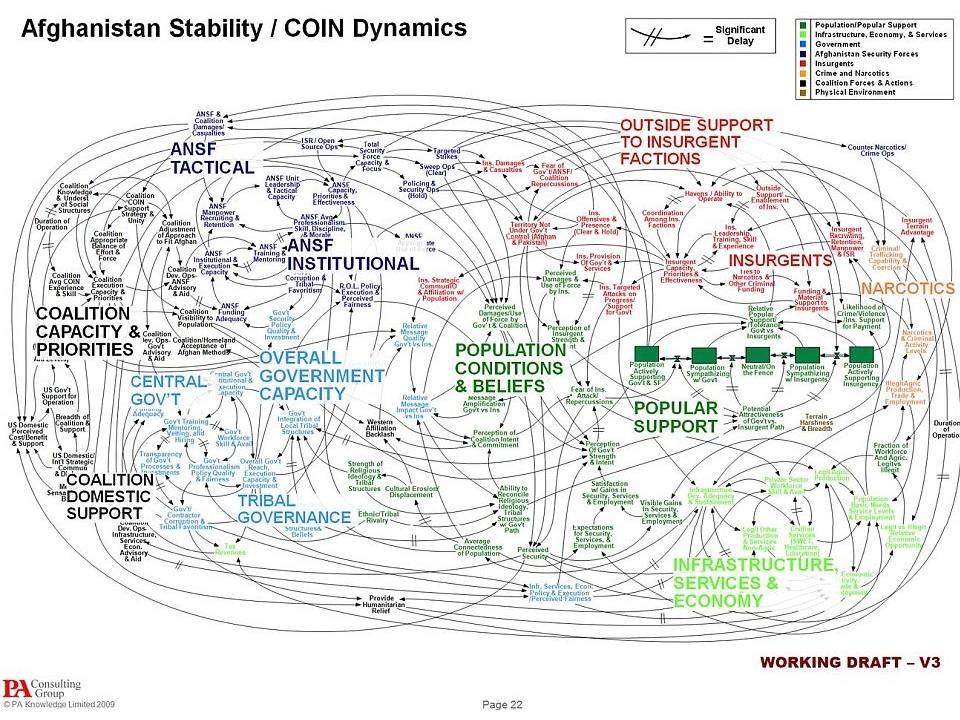
The following spaghetti diagram has been making the round of Versailles … it purports to summarize the strategy for winning the hearts and minds of the Afghans. But this is just the tip of the systems dynamics iceberg. This diagram is based on an attempt to model the non linear feedbacks implied in General Petraeus's Counter Insurgency Manual, FM 3-24. I do not know whether this is the product of a contractor or the military, the author of the technique was a Navy officer in 2008, but this is 2010 and the graphic has a contractor logo.


The author of the famous Afghan Spaghetti diagram is Navy Capt Brett Pierson, who worked on the JCS staff in the Pentagon. Pierson's bis is, reproduced below:


“Captain Brett Pierson is a 1987 graduate of the U.S. Naval Academy and was designated a Naval Aviator in 1989. Fleet assignments have included VS-38, VS-33, and a command tour as the Commanding Officer of VFA-147. He has been deployed in support of Operations SOUTHERN WATCH, RESTORE HOPE, and IRAQI FREEDOM. Brett is a graduate of the U.S. Naval Test Pilot School and was named the 1997 FORCE Test Pilot of the Year and 2002 USAF TPS Outstanding Flight Instructor. Captain Pierson has over 650 carrier arrested landings and 3,500 flight hours in 50 different aircraft. In December 2006 he reported to the Pentagon for duty on the Joint Staff where he currently serves in the Warfighting Analysis Division of J8. While on the Joint Staff, he was awarded the 2007 DoD Modeling and Simulation Award for Excellence for his work developing a system dynamics model of counterinsurgency based on the Army Field Manual FM 3-24.”

Reference A:  System Dynamics and Coin Modeling 2010

http://www.oss.net/dynamaster/file_archive/100513/f5ffe44103bf516a5191d460bc8b3d98/System_Dynamics_and_COIN_Modeling_v13.ppt.pdf

Reference B: Afghanistan Dynamic Planning

http://www.oss.net/dynamaster/file_archive/100513/73ba6c9145529b0fbe6a85319e5205cf/Afghanistan_Dynamic_Planning.pdf


The intellectual framework in the preceding briefing was then tailored specifically for Afghanistan in a the brief that culminated in the famous spaghetti Diagram. That brief is attached here. Note the explanatory comments are more in the manner of hypothecated assertions rather than empirically derived relationships.


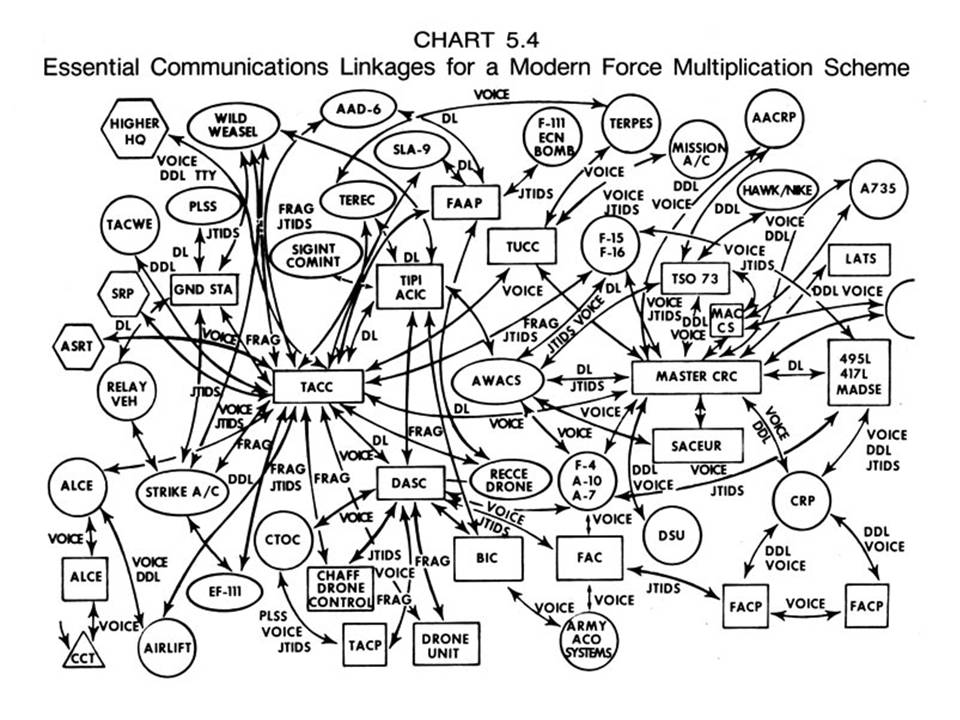
For those of you who think these spaghetti diagrams reflect a new or innovative way of thinking about systems I refer you to the following figure of the comm links in Europe that were being designed in the mid 1970s to deal with a Soviet led attack on the Nato countries in Western Europe — the chart was produce in the mid-to-late 1970s and reached the four star level in the Air Force. The figure was later reproduced in my book, Defense Facts of Life: The Plans Reality Mismatch (Westview 1985).

—————

CS comments:

This Powerpoint Briefing is the dynamics model of FM-24, the Counterinsurgency Manual for which Pierson one the award in 2007. It is converted into PDF format for easier access.

Phi Beta Iota: All of the above is earnest, well-intentioned, even brilliant in its conceptualization–like the movie Top Gun–it's wonderful right up to the point where it crashes and burns from its complete disconnect from reality.  USA does not have the collection, processing, analysis, or decision-making capacity to leverage any of these concepts.  The ONLY way to get this right is to start with integrity in the first place (don't send our troops in harm's way based on lies, ideology, and treasonous misappropriation of the public purse), and to have hundreds of thousands of human brains that are trained, equipped, and organized for multinational, multiagency, multidisciplinary, and multidomain information sharing and sense-making (M4IS2) without regard to secrecy, technology, or money.  The US Government is, in one word, stupid, at the same time that its leadership (both political and professional) is completely lacking in integrity.