Comments forthcoming.

The truth at any cost lowers all other costs — curated by former US spy Robert David Steele.
Comments forthcoming.
 Tour of the world in concise but precise terms,March 30, 2008
Parag Khanna
This is an extraordinary book, a tour of the “real” world where the future is being defined. While I respect the reviewer's that have difficulty with inaccuracies or inconsistencies, on balance, in all of my reading as reviewed on Amazon, I would rate this one of the top 20 books, perhaps even one of the top 10 (let's go with that, making it one of the top 10 on reality, while my other “top ten” would encompass world changing, social entrepreneurship, the Tao of democracy and other solution-oriented writings).
My notes must of necessity be cryptic. I will start with the bottom line and urge the Amazon reader to take my notes as a strong incentive to buy and read the book cover to cover.
Bottom line: US has screwed up big time, and is taking third place to China's achievement of globalization on its terms, using consultation, incentives, and efficient/effective agreements to propel itself past Europe, which has consensus model that has displaced the US but cannot compete with China's global juggernaut. The US is gently tarred with confusing “security” for prosperity or legitimacy, with preferring single-party strong-arm partners, and with being generally clumsy, inept, ignorant, and hence losing on all fronts.
+ Second World is internally divided between rich and poor sectors
+ Second World is the tipping point domain that will determine the tri-polar (China, Europe, US) outcome
+ Author covers five regions 1) east of Europe including Russia and Turkey; 2) Central Asia; 3) South America with little attention to Caribbean; 4) Middle East; and 5) Asia and the 4 Chinas.
Early on the author states that the Americas are terribly ignorant of both the old and new geography, and I would agree while emphasizing that the “expert” advisors to Presidential candidates are themselves as ignorant (or biased)–from those that are state-centric to those that are ideologically unbalanced to those that believe their ego and social network are sufficient in and of themselves. Not a single one of them knows how to lead a nation-wide conversation, much less a regional or international conversation–they are the “walking dead” of the pyramidal era, and any contender that listens to them and allows them to exclude the iconoclasts and the avant guarde is destined to be neutered, so to speak, before their time.
+ According to the author, America is now viewed as destabilize, in an era when the Second World judges legitimacy on the basis of proven effectiveness (one could also add: sustained effectiveness, not a US forte). Further on the author drives this point home by saying that success trumps ideology, and across the Second World, democracy is not considered practical (nor credible as a US claim for access).
+ European Union is the standard bearer for both technology and regulation (another book I have reviewed pointed out that USA has become a “dumping ground” for products from China Europe will not admit–thank you, Dick Cheney).
+ USA, EU, and China have no common culture, and (combined with the distinct cultures of the other four emergent regions), this is cause for concern about future misunderstandings and over-reactions.
+ The world is demographically blended and so increasingly inter-dependent that the day of major war is indeed likely to be a thing of the past.
+ In the early focus on Europe, the author quotes a European to the effect that Europe is expanding, each time getting poorer, but each time delivering and buying priceless stability. This is one reason why Eastern Europe is skyrocketing and at the same time, displacing the USA as a source for many exports to Europe.
+ He tells us that Europe is confident, incentivizes its partners, has a generation in charge that is transcendent, and is disdainful of the US for its ineptness.
+ Russia is described as a “Siberian Saudi Arabia” but with an insecure nuclear arsenal. ¾ of the wealth is centered in (controlled from) Moscow while 2/3 of Russians are living at the poverty line or below.
+ Russia is being emptied of Russians as they vote with their feet and move west, at the same time that Chinese are moving north into Siberia, which global warming is making more hospitable.
+ In the Balkans instability threatens Europe, but European agro-technology is making a huge difference, as is the European penchant to support multiple parties rather than any single dictator. Still, “lurking tribalization” is of concern.
+ Turkey is a key player in saving the Balkans, and in the author's view, is powerful, democratic, secular, and Muslim, and also responsible for ten times more trade with Europe than with the US.
+ Black Sea is creating its own unified region.
+ Georgia does not have a single decent road.
+ Caucasian Corridor is a Balkans waiting to happen.
+ While Brussels is central, London, Ankara, and Moscow each have their own key role in the region.
+ Central Asia benefits from the re-creation of the Silk Road for East-West trade, while also suffering from being the “laboratory” for imperial excess seeking to play the Great Game (not something the US is at all qualified to “play”)
+ The author points out Central Asia is at the intersection of Russia, China, Europe, and the US, to which I would add Iran as well.
+ Mongolia is militarily aligned with the US (and from my own knowledge, has one of the finer peace keeping training programs as well as an ideal pre-Afghanistan mobilization training environment)
+ According to the author, China, in sharp contrast to the US and Russia, is making huge gains in Central Asia because of “swift settlement” of all outstanding border issues, its promotion of shared development strategies, its “massive charm offensive” and its role as a “consultative leader,” and its being the “standard bearer for business practices” which is code for no-strings attached loans nearing one billion. The Shanghai Cooperation Organization (SCO) is now called the “NATO of the East.” China is winning Central Asia through strategy, trade, and co-development. [See also my online memorandum “Chinese Irregular Warfare oss.net”]
+ Kazakhstan has energy and retained its own language, shows promise.
+ Kyrgystan a mess, Tajikistan a bridge for revival of Sino-Iranian trade routes.
+ Uzbeckistan and Tajikistan are Islamic targets.
+ American failure to reconstruct Afghanistan has left Karzai neutered, perhaps soon to go.
+ South America has been suffocated by US hegemony, and US sponsorship of 30 years of “Dirty War” pitting authoritarian rightists against [liberation theology and populist] leftists.
+ Unlike other regions, South America simply wants US to live up to its rhetoric about free trade and democratization, “without exceptions.”
+ US threatened by crime, drugs, migration from the South, does not seem to appreciate the value of South American integration and self-sufficiency in energy and food sectors.
+ Four Mexico's–northern, central breadbasket, indigenous destitute isthmus, and very poor Mayan Yucatan.
+ Chaves in Venezuela is a spendthrift and has quadrupled Venezuela's debt, but he actually has a serious strategy that includes China to offset US, a pipeline to Argentina, state to state barter of commodities, modernizing Caribbean energy sector, and welcoming Iran and Europe.
+ Colombia is the key to the future of the region, unique for having Pacific and Caribbean coasts while also being the entry point for a Pan-American highway of greater potential.
+ US is losing the drug war and screwing up the alternatives of trade and economic accelerators.
+ Brazil is the USA of South America, and has formed a trade axis with China. It is multiracial, with the largest populations of Arabs outside Nigeria, Lebanese outside Lebanon, Italians and Japanese outside their own countries. Crime is the wild card, the Achilles' heel.
+ Argentina is a basket case (the author does not tell us that Argentine is also being seduced by Chinese men and is likely to be majority Chinese by 2025).
+ Chile, despite US mis-deeds, benefited from German farmers and is today's success story, focused on stability, pragmatism, and profit.
+ Arabs are redefining themselves in the Middle East in a manner not seen in the past 1000 years. They remain central, and the author anticipates Arab economics will triumph over Islamic radicalism. Later in the book he concludes that the Arabic opinion and sense of self is solidifying.
+ North Africa is Europe's southern shore, and part of the Mediterranean culture, but suffers a massive disconnect between unemployable poorly educated youth and jobs without qualified applicants.
+ Libya (I learn for the first time) is a huge success, with major gains in education, advancement of women, and per capita income over $7000 a year.
+ Egypt as the Arab cornerstone and the difficult blend of Arabia and Islam. This government, the author tells us , “provides neither moral leadership nor public services” and therefore is “a perfect target for Islamist groups well-equipped to provide both.” He believes an Iranian-style revolution is possible.
+ The Mashreq–Israel, Palestine, Jordan, Syria and Lebanon, he sums up as “Iranian interference, Syrian intransigence, Lebanese weakness, Israeli aggression, and Palestinian desperation.” I was surprised to not see “American idiocy” in there, since my taxpayer dollars are funding the Israeli genocide against the Palestinians.
+ He anticipates the death of Iraq and the emergence of Kurdistan, and here I quote two gifted turns of phrase: “Wars are like a geopolitical reset button.” and “The Iraq war exposed the United States as a superpower whose intelligence does not match its aspirations.” As an intelligence professional, I must clarify this: both the Army leadership and the CIA professionals, that is to say, Charlie Allen, got it exactly right–no weapons of mass destruction, kept the cook books, bluffing for regional sake. It was George Tenet who parked his integrity on the same shelf as Colin Powell and Mike Hayden, who allowed Dick Cheney to hijack the US Government and send the US military to war on the basis of 935 explicitly documented lies to the public and Congress and the UN, and 25 explicitly documented high crimes and misdemeanors.
+ Iran does not get enough coverage, but that is insufficient to undermine my very high regard for this book.
+ Gulf will provide 40% of the energy for the foreseeable future. Oil windfalls were mis-directed by the leaders, who funded luxuries for themselves, and militaries, rather than seeing to the public good.
+ Wahhabist reckoning is coming–they teach selected elements of the Koran by rote, not Islam. However, they correctly evaluate the Saudi Royals as the near enemy and the USA as the far enemy, joined at the hip.
+ United Arab Emirates is where Las Vegas meets Singapore, with Dubai as the icon. He notes with studied understatement that Chinese goods and Chinese whores are half price to any competing goods or whores, and the former “designed to disintegrate.”
+ Malaysia and Indonesia have huge Chinese Diasporas. Myanmar, Thailand, Vietnam not as well covered as I would have liked, especially Vietnam which is totally independent of China.
+ There are four Chinas–the southeast quadrant with Shanghai, Hong Kong, and Taiwan (I was surprised to see no mention of Macau, through which China is aggressively wooing all former Portuguese colonies including Brazil); the Beijing centered northeast, and the far edge of Tibet and Xinjiang, which the author tells us earlier in the book are as vital to China as the Rockies and West of the Rockies are to the US.
+ He says that China is “blending” Asia, and that from Malaysia and elsewhere there is broad recognition that a form of Chinese “Monroe Doctrine” is being established. He specifically points out that US offers of “security” are losing out to European offers of “capacity” that nurture prosperity (as well as Chinese offers of co-development).
+ I grew up in Singapore, finishing high school there, and I am in total agreement with the author's admiration for Lee Kuan Yew and the manner in which communitarian trumps democratic when it comes to producing more stability and prosperity. I recently learned from my step-mother, who just left Singapore after decades of being the leader of English education for the government (and Chinese teachers) that one cannot run for Parliament in Singapore without first earning a Masters in Business Administration.
+ Uniquely, Asians want to stay in Asia while visiting everywhere else.
+ He plays down India and I completely disagree with his dismissal of them. India has made more progress than China when one considers the totally divergent and conflictive situations they must handle across tribes, religions, classes, and environmental challenges.
In his conclusion, the author suggests that a tri-polar world now exists, but one read what can only be a list of indicators of USA suicidal tendencies: lousy education, no investment in technology, as many gang members as there are policemen (roughly 750,000 he tells us). The USA can learn to co-exist and co-develop with the rest of the world, and abandon its military “big stick” paradigm, or it can be relegated to third place forever, and gradually go down even further.
I am very worried. I see no one that has strategic perspective, a holistic understanding of the ten threats and twelve policies, nor an appreciation of the urgency of creating an alternative development model for Brazil, China, India, Indonesia, Iran, Russia, and Venezuela, among others.
See also:
A More Secure World: Our Shared Responsibility–Report of the Secretary-General's High-level Panel on Threats, Challenges and Change
High Noon 20 Global Problems, 20 Years to Solve Them
The Unconquerable World: Power, Nonviolence, and the Will of the People
The Fifty-Year Wound: How America's Cold War Victory Has Shaped Our World
War is a Racket: The Antiwar Classic by America's Most Decorated Soldier
The leadership of civilization building: Administrative and civilization theory, symbolic dialogue, and citizen skills for the 21st century
How to Change the World: Social Entrepreneurs and the Power of New Ideas, Updated Edition
Plan B 3.0: Mobilizing to Save Civilization, Third Edition
The Future of Life
Collective Intelligence: Creating a Prosperous World at Peace
 One Major Recommendation, March 30, 2008
Rupert Smith
Edit of 20 May 2007 to drop one link (reduntant to Master Gray) and add instead General Zinni's book on waging peace, our counterpart to the author of this book in terms of intellect, morality, and strategic gravitas.
I defer to the other reviewers on the bulk of the book. It can and should be required reading for some time to come.
Here is the one recommendation in the conclusion that really matters, and I paraphrase:
FROM THE BEGINNING, the national interests and desired outcomes must be considered by a fully integrated team of military and civilian experts with deep strategic, historical, cultural, geographic, and related knowledge, and the use of force must be planned in the context of the desired OUTCOME. The same and related teams must plan for the peace and see the entire program through to the desired END.
This is of course sensible, and not what the Americans did. General Shinseki's correct appreciation was over-turned by Paul Wolfowitz, a world-class liar living in a fantasy world. General Zinni was called a traitor. General Gavin was dismissed early because Haliburton was not done looting, and preppie Paul Bremer sent in to lose another $20 billion.
Here are other books I recommend, beginning with those from British authors that I consider as remarkable as this one:
Modern Strategy
The Battle for Peace: A Frontline Vision of America's Power and Purpose
Intelligence Power in Peace and War
Very Special Intelligence: The Story of the Admiralty's Operational Intelligence Centre 1939-1945
The Rules of the Game: Jutland and British Naval Command
A More Secure World: Our Shared Responsibility–Report of the Secretary-General's High-level Panel on Threats, Challenges and Change
High Noon 20 Global Problems, 20 Years to Solve Them
The Future of Life
Plan B 3.0: Mobilizing to Save Civilization, Third Edition
The leadership of civilization building: Administrative and civilization theory, symbolic dialogue, and citizen skills for the 21st century
I imagine General Patraeus will have his own book one day. It's a pity all the flag officers (both US and UK) drank the kool-aid and let Cheney and his merry band of liars and dim-wits destroy the US Army first–for the price of a good tea, any one of us could have told them the lesson the British Army and other Armies have learned since time immemorial: it takes a big war force two years (for slow learners, five years) to re-learn counter-insurgency–by the time they do so, they have been hollowed out and neither the force nor its equipment is suitable for big war absent a complete re-build–but then, that would be the logical “end state” for Dick Cheney and the military-industrial complex: the White House has gotten the outcome it wanted, never mind blood, treasure, and spirit nor international legitimacy, the insolvency of the nation, and the deepening recession. For those that “matter,” the profits have been properly banked in Dubai and elsewhere. So the final lesson from General Smith's book is this one: the planning must be open, public, and endorsed by national referendum. The utility of force, in my view, can no longer be entrusted to elites–the case must be made to the public, and only the public may validate the utlity of force. Mind the gap….

Co-author with David R. Schwinn and John Kesler, all three authors authors are associated with Ingenius, a Michigan-based consulting organization focusing on an integral community building approach to increasing civic intelligence. www.ingeniusonline.com
Civic intelligence and the security of the homeland

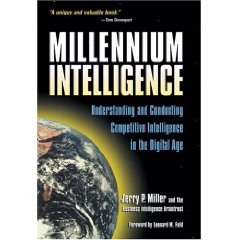
Michael Sandman is Senior Vice President of Fuld & Company. He has over twenty years of experience as a senior operations manager in companies. He joined Fuld & Company in 1991, where he is the managing partner. He also continues to do consulting for our clients. He has been a guest lecturer at Columbia University Business School's advanced management program for senior executives, the University of Wisconsin's Management Institute and at the Boston University School of Management. Mr. Sandman developed CI 101 and CI 202, the courses sponsored by the Society of Competitive Intelligence Professionals (SCIP), and he teaches those courses for SCIP. He has served on the peer review board of the Competitor Intelligence Review, and he wrote the chapter on computers and software for competitor intelligence applications published in Perfectly Legal Competitor Intelligence (Bernhardt, Pitman Publishing/Financial Times, London 1993). He is the author of the chapter on business intelligence analysis for Millennium Intelligence, edited by Professor Jerry Miller and published in 2000. He was elected to be a Fellow of the Society of Competitive Intelligence Professionals.
 Solid, Insightful, Relevant, Useful, Pointed, a Pleasure to Read,March 29, 2008
Ronald Dworkin
I bought this book on the basis of the title, with no idea of the author's deep history of accomplishments. This is a lovely book, largely an essay. The author opens by telling us he is concerned about the lack of political argument (dialog) in the USA, including substantive coherent dialog about core issues such as:
1. Nature and role of human rights in defining legitimate behavior by both individuals and governments
2. Role of religion in politics and governance
3. Distribution of community's economic wealth
I bring back from page 125 the following superb quote: “But our national politics fails the standard of even a decent junior high school debate.”
And on page 127: “So Americans are horribly misinformed and ignorant about the most important issues.” This is true. What he does not tell us, which we learn in the following book, is that all of our politicians and their so-called “advisors” are equally ignorant. See: Security Studies for the 21st Century
I was in error when I first thought the author was a conservative, forming that impression from the index and the endnotes, where I usually start a book. He is rather a very educated and philosophically well-grounded person of liberal to centrist perspective, and I found this book to be sensible, easy to read, and compelling.
The book could not be more timely for me (published in 2006) as I wathc Senators Clinton and Obama behave like children and avoid substantive policy backed up by a balanced budget they are both incapable of producing, while Senator McCain gets a “bye” and is not asked any tough questions at all (for 52 tough questions and transpartisan “starter” answers, visit the 501c3 Public Charity, Earth Intelligence Network).
The author, with a deep legal understanding and much work previous to this book, probes how character and forms of governance and politics shape the decisions we make.
He labels partisanship destructive, and puts forward his view that despite the superficial divide between “red” and “blue” he believes we can still come together at a deeper level of understanding such that we can overcome partisanship. I urge one and all to visit Reuniting America and especially their page on transpartisanship, it is consistent with what this author presents to all of us for consideration.
He specifically labels campaign rhetoric from 2004 to be shallow, as shallow as any since the last substantive debates in America, between Lincoln and Douglas (he says, I agree although Kennedy and Nixon I thought did well).
The author identifies his agenda in two parts: to explore how we might find shared principals, and to explore how such might lead to good outcomes for the Nation as a whole.
He puts forward three propositions early on:
1. Equal rights for all, meaning that both US citizens and foreigners (e.g. the ones in Guantanamo) should be treated equally, i.e. human rights should prevail here and both groups have equal right to dignity and justice and equality.
2. No television advertisements for political campaigns in the months leading up to an election.
3. Poor merit special protection and consideration as part of establishing the legitimacy of government and the equality of all (e.g. the poor cannot insure themselves the way the wealthy can). At a stratgeic level, there is no finer book than Max Manwaring (ed)'s The Search for Security: A U.S. Grand Strategy for the Twenty-First Century.
The author lists and discusses two dimensions of human dignity:
1. Human life as having special intrinsic value
2. Each person bears responsibility for themselves
He suggests that in discussion political versus human rights, the latter is the more stringent test, and I agree, as one of those who signed the letter to Senator McCain opposing torture by CIA or the US military. The author clearly states that to treat the “enemy combatants” as we have is to declare them to be less than human.
He places great emphasis on the importance of dignity for all, and I am reminded of the superb book, All Rise: Somebodies, Nobodies, and the Politics of Dignity (BK Currents)
He suggests that the religious clash in America is not about the more fundamental issue of faith and the value of faith, but rather about the role of religion in national life. The author leans toward the belief that we should (as the founding fathers intended, see Founding Faith: Providence, Politics, and the Birth of Religious Freedom in America, be tolerant with selected unitarian references to God (e.g. in the Pledge of Allegiance, in coin) but not–as most extreme right fundamentalists would have, as a “Christian Nation.” As the author of Founding Faith makes clear, the latter is simply not an option.
The author states that we need to have a faith-based dialog between left and right, and I agree, while also noting we need to do this at an international level, where we are long overdue for a global Truth and Reconciliation Commission on what damages America has wrought “in our name” but against our public moral faith. A couple books worth close scrutiny (or at least read my reviews:
God's Politics LP
Faith-Based Diplomacy: Trumping Realpolitik
The author addresses liberty as not just being freedom, and defines it rirectly as the right to do what you want with the resources that are rightfully yours. That last bit is of course subject to long discourse: is Exxon entitled to $40 billion in profit while externalizing $12 in costs to the planet and future generations? Is Wal-Mart entitled to profits and the abuse of most of its employees while destroying small busiunesses for 150 miles around each Wal-Mart, and destroying the South Pacific off the coast of Chile so as to produce cheap fish while killing all life on the ocean bottom there? See my many lists.
The author specifically confronts and rejects the “culture of life” as being a compulsory sort of paternalistic and judgemental intrusion into our liberty. He defends abortion by pointing out that the fetus, while undeniably alive (so is a cancer) has no mind and hence no intersts. I for one place higher status on the mother's desires and needs in the first tri-mester.
He strongly supports gay “marriage” as a loving contract, and demands scientific proof before being willing to consider “intelligent design” (in passing I note that Germany has declared Scientology to be a cult, and outlawed it. I am reminded of the excellent book, Forbidden Knowledge: From Prometheus to Pornography.
He provides an excellent discussion of how legitimacy in political authority stems from shared morality and balanced equality, and on this basis believes that the poor merit special consideration. He does not address how corporations should be deprived of their abuse of the personality privilege.
He tells us that a big reason the conservatives want to cut taxes is their desire to end the “welfare” state. From where I sit, we do need a smaller government but until labor unions are restored, and the Secretary of the Treasury starts to do his job instead of fronting for Wall Street against the public interest, I believe the author is on target and merits our respectful attention.
I completely agree with him on the indefensability of the gap between rich and poor in America, and elsewhere.
The book draws to a close with two contrasting views of what comprises a democracy, the one being majoritarian, the other in which We the People are full partners and the majority cannot impose its views on the minority, whose rights and views must be treated with respect and protectied. Here I point the reader to the formidably scathing Running On Empty: How The Democratic and Republican Parties Are Bankrupting Our Future and What Americans Can Do About It. BOTH parties are nothing more than two branches of a single organized-crime family, and both should be forced to pass the Electoral Reform Act before November 2008, or every incumbent dismissed and the two parties vanquished by Independents, Greens, Reforms, Libertarians, moderate Fiscal Conservatives, and conservative Southern Democrats.
He closes the book calling for equality for all, and dramatically increased self-government. He says we MUST do better in Education (I am reminded of Thomas Jefferson, “A Nation's best defense is an educated citizenry”), and calls for public election channels, the regulation of private networking (to which I would add Open Spectrum), the Right of Comment (e.g. on Jack Cafferty saying “Ralph Nader should be batted away like a fly”), and on term-limits for Supreme Court justices, he suggests 10 years.
As I contemplate the existence of 27 secessionist movements in the United States; the collapse of the Federal government whose ineptness is virtually complete, the criminality in the White House, hijacked by Dick Cheney, I have to come down strongly in favor of a public demand for a Constitutional Convention in 2009, making that the litmus test for any candidate. NONE of the three is qualified to govern in their present condition. We may yet need a third party candidate with a transpartisan cabinet, a balanced budget, a commitment to both Electoral Reform and a Consttutional Convention (see also Our Undemocratic Constitution: Where the Constitution Goes Wrong (And How We the People Can Correct It))
My review does not do this author justice. His book is elegant, thoughtful, philosophical, balanced, not at all confrontational, and the best thing I can say of this book is that I had to read it and think about it. This is a first-class piece of work, one the Founding Fathers would have found worthy.
See also The Future of Ideas: The Fate of the Commons in a Connected World and my many lists on the Earth Threats (10) Earth Policies (12) and Earth Challengers (8).
 Almost Did Not Buy, Reviews Too Negative–This Was Worth My Time, March 29, 2008
Dan Ariely
I almost did not buy this book as I sought to explore the new literature on behavioral and cognitive science. The negative review are too negative. You get from this book what you bring to it in open mindedness, in my opinion.
My truth-teller, off-setting the reality that this is a double-spaced book that inflates 120 pages of thought into 240 pages of easy to digest presentation, is the author's unique provision in the end-notes of both direct references to seminal works that each chapter is based on, with additional references suggested, AND his recognition of 17 collaborators, each with a long paragraph of biographic information. This is in short a worthy work, it was worthy of my time, and I do not agree with those who are dismissive or cavalier about this book.
As with Nudge: Improving Decisions About Health, Wealth, and Happiness and other works of this ilk, they seem to be blessed with an immaculate conception that fails to recognize the work of the 1960's and 1970's (e.g. Herbert Simon, “satisficing,” but I no longer mark this down–this is a new generation thinking new thoughts, and I have decided it is too much to expect them to go back more than 20 years.
The opening of the book is impressive. The author was burned on 70% of his body by a magnesium flare, and his probing of his own pain and how the nurse's had settled on fast painful ripping off of the bandages (with no medication.
Key point early in the book: most people don't know what they want until they see it in context. This is one reason I am planning an edited work in 2009 on Cultural Intelligence. As Howard Bloom teaches us in Global Brain: The Evolution of Mass Mind from the Big Bang to the 21st Century, we (and our policy makers) know nothing of “the other,” and I have concluded that peace starts in kindergarten and we have to separate the Israelis and the Palestians, and literally baby sit two new generations from birth to the age of 35.
The rest of the book is easy to read, has excellent real-world examples, and each chapter generally ends with a short appendix with real results. This is not a fluff book, it is a serious book that the light reader will mistake for fluff.
+ Relatively and “bracketing” matter (sell what you want by bracketing it with a more expensive option above and a trashy cheap thing below)
+ Decoys matter (e.g. a middle option that makes the “combined option” a “no brainer”)
+ Publishing salaries actually sets off ego wars at the top and churn at the bottom that leads to more turnover and more wasteful employees costs.
+ Imprinting is used by the author to explain “anchoring” (e.g. black pearls anchored in setting of most expensive diamonds, this is an example of how the SELLER is setting the price, not the buyer).
+ “Free” is never really free. It can blind rational choice and it can “cost” time, choice, and a higher value that is obscured (e.g. my cotton socks disintegrate within months, whereas the cotton socks I inherited from an earlier era are still lasting forever).
+ HOWEVER, I especially liked the way the author explored “free” as a device for policy furtherance, e.g. make vehicle registration “free” if you own a hybrid car.
+ Social versus market norms are discussed. The author does not discuss Open Money (see my comment for a link to my keytone at Gnomedex) or Yochai Benckler's [[ASIN:0300125771 The Wealth of Networks: How Social Production Transforms Markets and Freedom].
+ I especially like the way the author discussed how the poorly-paid border patrol and coast guard employees have made their own peace with the drug dealers–they have the same understanding the CIA clandestine service has with the KGB and local counter-intelligence services: we do not kill, kidnap, or even embarrass each other, we all just present to bedoing our job and the only people fooled are Congress and the taxpayers. Similar, the drug dealers understand that if they do not shoot to kill, neither will we….
+ One chapter offers a fascinating study on the impact of sexual arousal (a marker for passion). This quote from page 97 is priceless:
“Prevention, protection, conservatism, and morality disappeared completely from the radar screen. They were simply unable to predict the degree to which passion would change them.”
+ The author discusses Smart Cards and their ability to impose a restraining influence with emails, I urge one and all to dump their existing ursurous cards and turn to Interra and other similar community-based cards with high social value.
+ We over-value what we own or possess. (I would add, we also over-value credentialing and under-estimate how painfol our rote school system is, which kills creativity by the seventh grade in some of our brightest kids.)
+ Stereotypes influence behavior on both sides of the viewpoint.
+ Placebo effect is real, something the American Medical Association absolutely does not want you to know (see also Alternative Cures: The Most Effective Natural Home Remedies for 160 Health Problems among many excellent works in this area.
+ Options can confuse and divert.
+ There is a pricing effect (very high priced menu item drives folks toward the second most expensive, which they would not have chosen absent the “higher” bracket item)
+ Character costs. USA loses $525 million a year to robberies, and $600 BILLION a year to employee theft (this does not count procrastination and government issues, such as every second IRS employee a complete loser while the others do twice the work).
+ Harvard MBA students participated in a series of tests that conclusively demonstrated that people will cheat if given an opportunity to do so; they will cheat twice as much with “in kind” versus cash opportunities, but they will not cheat “wildly” even if assured of not being caught. See also The Cheating Culture: Why More Americans Are Doing Wrong to Get Ahead
+ Religion DOES have a good moral effect, as do honor codes and reminding people of the Ten Commandments from time to time. See Founding Faith: Providence, Politics, and the Birth of Religious Freedom in America for the Founding Father's deliberate mix of securlar tolerant government with a desire for a strong religious aspect to community for precisely this reason.
I can see how some might feel this book is less than they were expecting, but I do not agree. This book may be well-marketed and not the deep social science research that some buyers might have been hoping for, but I for one find it completely satisfactory and well worth my time. The author's crediting of 17 collaborators, and the unique goodness of the end-notes carry the day with me.
See also
The World Cafe: Shaping Our Futures Through Conversations That Matter
Society's Breakthrough!: Releasing Essential Wisdom and Virtue in All the People
Building a Knowledge-Driven Organization
Collective Intelligence: Creating a Prosperous World at Peace
My earlier lists (the first ten or so out of 70) focus on strategy, intelligence, information, and offer many other pointers to useful books somewhat related to the larger universe of cognitive science and decision support.
