Deciding what to do in Afghanistan requires a hard-nosed assessment of the
costs of the war,
the alleged benefits of victory
and the likelihood of success.
We know the price will be high. The United States has spent more than $223 billion on the Afghan war since 2001, and it now costs roughly $65 billion annually. The actual bill will be significantly higher, however, as these figures omit the replacement cost of military equipment, veterans' benefits and other war-related expenses. Most important, more than 850 US soldiers have already been killed and several thousand have been seriously wounded.
The disastrous mid-east strategy of Mad King George put the interests of Israel before all the interests of all others, including ourselves. It destroyed Iraq, alienated Turkey, countenanced the destruction of Gaza, placed Jordan in an impossible situation, and opened the door to the expansion of Iranian influence, among other things. One reaction to this policy may be that some of the countries in the region now feel it is necessary, or see new opening, for going their own way, evolving new regional policies. Yesterday, I discussed the emerging situation in Turkey (which has roots predating the the antics of the Bush Administration). The attached article describes how Syria is struggling with some success to reach out to other countries in the region.
Yoav Stern is Director, Business and economics department, Peres Center for Peace. Syria Comment is a very informative blogging website run by Professor Joshua Landis, Director of the Center for Middle East Studies at the University of Oklahoma.
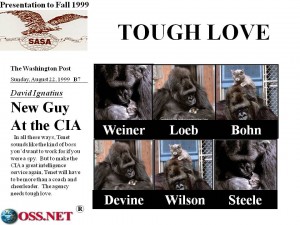
This was used for a panel in 1999 at the Defense Intelligence Agency (DIA) for the annual meeting of the Security Affairs Support Association (SASA), today called something else.
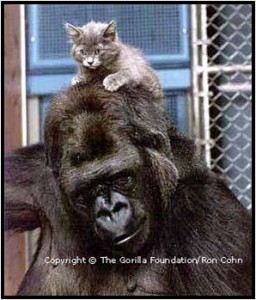
The photo of the Gorilla with Kitten links to The Gorilla Foundation that has nurtured Koko the Gorilla and others. Below from their site:
“During the course of the study, Koko has advanced further with language than any other non-human. Koko has a working vocabulary of over 1000 signs. Koko understands approximately 2,000 words of spoken English. Koko initiates the majority of conversations with her human companions and typically constructs statements averaging three to six words. Koko has a tested IQ of between 70 and 95 on a human scale, where 100 is considered “normal.” Michael, the male silverback gorilla who grew up with Koko, had a working vocabulary of over 600 signs.”
TOUGH LOVE SASA at DIA
The photo was also used, but since removed, with the announcement, now a record of the event (three slides shows posted):
Assuming there is no fraud among the buyers and sellers in a market exchange, Caveat Emptor — the principle that the buyer alone is responsible for determining the quality and suitablity of goods or services before a purchase is made — is the cornerstone of free market ideology. Implicit in this belief is the necessary albeit patently absurd condition in economic price theory that reliable information is freely available to the all the parties and potential parties to an economic exchange. After all, if information were truly free, the data processing and data-free manipulation industry of the post industrial society and its contemporary successor, the post-information era (an era synthesized by the petri dish of Pentagon, but now acculturated by the media and Wall Street), would be a non sequiturs. Today, for example, we have an economy where advertisers can profitably invest large sums of money in subliminally marketing their wares on reality TV, an invention to dumb down people, and make them more vulnerable to the subliminal marketing techniques they are being subjected to by conditioning viewers to substitute vicarious fantasy for realty. Continue reading “Journal: Why Bail-Out Has Not Reduced Foreclosures”