In American politics, the interests of two powerful factions are never questioned by an adoring, pusillanimous Congress: the US Military (really the political-economy of the Military – Industrial – Congressional Complex) and Israel (a foreign country represented by the Israeli lobby and its domestic allies). To date, the interests and welfare of these two factions have been in harmony, but what happens if those interests diverge?
Uri Avnery, a hero of the 1948 War and a prominent Israeli peace activist, explores the ramifications this question in the attached important opinion piece.
[Note: General Petraeus's statement to Senate Armed Services Committee, discussed by Avnery, can be downloaded.]
THIS WEEK, Petraeus conveyed an unequivocal message: after reviewing the problems in his AOR (Area Of Responsibility) – which includes, among others, Afghanistan, Pakistan, Iran, Iraq and Yemen – he turned to what he called the “root causes of instability” in the region. The list was topped by the Israeli-Palestinian conflict.
In his report to the Armed Services Committee he stated: “The enduring hostilities between Israel and some of its neighbors present distinct challenges to our ability to advance our interests in the AOR…The conflict foments anti-American sentiment, due to a perception of U.S. favoritism for Israel. Arab anger over the Palestinian question limits the strength and depth of U.S. partnerships with governments and peoples in the AOR and weakens the legitimacy of moderate regimes in the Arab world. Meanwhile, al-Qaeda and other militant groups exploit that anger to mobilize support. The conflict also gives Iran influence in the Arab world through its clients, Lebanese Hizballah and Hamas.”
Thanks to Steven Aftergood & Secrecy News for the heads up on the new book The Iraq Papers. Secrecy News' email newsletter describes it this way:
Book page
An extensive compilation of official documents, policy advocacy statements, and assorted commentary on the U.S. decision to go to war in Iraq in 2003 is presented in “The Iraq Papers,” a new book from Oxford University Press.Since it seems that there will be no new official reckoning of the Iraq war or other Bush Administration policy choices, it will be left to others to achieve their own understanding of the Bush era and its aftermath. “The Iraq Papers” provides one possible documentary starting point.”The decision to invade Iraq launched a new doctrine of preemptive war, mired the American military in an intractable armed conflict, disrupted world petroleum supplies, cost the United States billions of dollars, and damaged or ended the lives of hundreds of thousands of Americans and Iraqis,” the book states.The book editors are not overly perplexed by these events. Somewhat heavy-handedly, they offer their own interpretation of events involving the decisive influence of neo-conservatives, the unitary executive, and a U.S. drive to global hegemony, among other factors. Alternative explanations are not considered here.
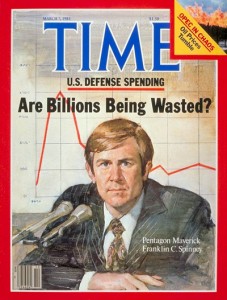
Phi Beta Iota: Chuck Spinney nailed it in the 1980's and before; Robert Steele and the USMC under Commandant Al Gray nailed it from 1988 onwards, and nothing has changed. Both the politics and programs of the US Government are corrupt and uninformed across the board, for one simple reason: US intelligence leaders lack the integrity to live up to their mission: to acquire the truth at any cost so as to reduce all other costs. Below are two stories highlighted by Chuck Spinney that represent the tragedy of a dishonest network of political, policy, and intelligence twits pretending to be leaders when all they are really doing is enabling the continuing looting of the public purse.
By Daniel Tencer, The Raw Story, March 19th, 2010 — 2:27 pm
Reps. Tom McClintock (R-CA) and Dana Rohrbacher (R-CA) made the comments at a discussion panel at the Cato Institute on Thursday.
Going into Iraq “was a mistake because I thought we had to finish the job in Afghanistan,” Rohrbacher told the panel, echoing a popular Democratic talking point at the time. “In retrospect, almost all of us think that was a horrible mistake,” Rohrbacher said. “Now that we know that it cost a trillion dollars, and all of these years, and all of these lives, and all of this blood … all I can say is everyone I know thinks it was a mistake to go in now.”
Asked by panel moderator Grover Norquist what percentage of Republican congressmen agree with that view, McClintock said, “I think everyone [in Congress] would agree that Iraq was a mistake.” McClintock added that he believed the Bush administration also made a mistake in the way it entered the Afghanistan war. “I think virtually everyone would agree going into Afghanistan the way we did was a mistake,” he said.
Chuck Spinney: … it is a shame that this kind of writing ends up being printed in a UK paper instead of a main stream US paper. The author, Avi Shlaim, is a native Israeli and one of the most prominent of the “new historians” of the 1980s. His book, “The Iron Wall,” which is based on meticulous research of Israeli archival data, is must reading for anyone trying to understand how the roots of zionist ideology set the stage for the emergence of permanent conflict in what is now clearly an apartheid state. Not surprisingly, he no longer resides in Israel and is now a professor at Oxford.
President Netanyahu is undermining US interests. The sooner President Obama makes his support conditional, the better
by Avi Shlaim, Independent, 21 March 2010
Israelis are not renowned for their good manners, but their treatment of Vice-President Joe Biden during his recent visit to their country went beyond chutzpah. Biden is one of Israel's staunchest supporters in Washington, and the purpose of his visit was to prepare the ground for the resumption of peace talks between Israel and the Palestinian Authority. An official announcement that Israel planned to build 1,600 new Jewish settler homes in East Jerusalem scuppered the talks, alienated the Palestinians, and infuriated Biden. It was a colossal blunder that is likely to have far-reaching consequences for the special relationship between the two countries.
America subsidises Israel to the tune of $3bn (around £2bn) a year. America is Israel's principal arms supplier, enabling it to retain the technological edge over all its enemies, near and far. In the diplomatic arena too, America extends to Israel virtually unqualified support, including the use of the veto in the UN Security Council to defeat resolutions critical of Israel. America condemns Iran for its nuclear ambitions, while turning a blind eye to Israel's possession of a large arsenal of nuclear weapons.
This unparalleled generosity towards a junior partner is largely the result of sentimental attachment and shared values. Israel used to present itself as an island of democracy in a sea of authoritarianism. But its own actions have shredded this image to pieces. It is now well on the way to becoming a pariah state. During the Cold War, Israel also used to promote itself as a “strategic asset” in helping to check Soviet advances in the Middle East. But since the end of the Cold War, Israel has become more of a liability than an asset.
America's most vital interests lie in the Persian Gulf; to ensure access to oil, the US needs Arab goodwill. Here Israel is a major liability, as a result of its occupation of Palestinian land and its brutal oppression of the Palestinian people.
“More than 100 foreign intelligence organizations are trying to hack into U.S. systems,” Deputy Defense Secretary William Lynn warned last month. “Some governments already have the capacity to disrupt elements of the U.S. information infrastructure.” So the Pentagon recently modified its regulations to allow military computer experts to be trained in computer hacking, gaining designation as “certified ethical hackers.” They'll join more than 20,000 such good-guy hackers around the world who have earned that recognition since 2003 from the private International Council of E-Commerce Consultants (also known as the EC-Council).
I am sure they do see a threat. If the Pentagon were not engaged in such a broad spectrum of illegal and corrupt practices wikileaks would not be seen as such a threat.
Phi Beta Iota: We ran this story earlier, but now that the New York Times is running it, it merits emphasis in conjunction with the other two “OUT OF CONTROL” posts. The Pentagon is nuts on the inside and criminal on the outside” They have lost sight of their mission, their roots within the Republic, and their responsibility to be responsible. Wikileaks, in sharp contrast, is an non-profit organization funded by human rights campaigners, investigative journalists, technologists and the general public.
WikiLeaks.org, a tiny online source of information that governments and corporations would prefer to keep secret, published an Army report about itself.
To the list of the enemies threatening the security of the United States, the Pentagon has added WikiLeaks.org, a tiny online source of information and documents that governments and corporations around the world would prefer to keep secret.
The Pentagon assessed the danger WikiLeaks.org posed to the Army in a report marked “unauthorized disclosure subject to criminal sanctions.” It concluded that “WikiLeaks.org represents a potential force protection, counterintelligence, OPSEC and INFOSEC threat to the U.S. Army” — or, in plain English, a threat to Army operations and information.
One of the simplest, most effective ways to strengthen congressional oversight of intelligence would be for Congress to make increased use of specially cleared investigators from the Government Accountability Office. This is such a straightforward step towards improving oversight that it was even championed by CIA Director Leon Panetta when he was a Congressman.
But the Obama Administration told Congress on Monday that new language to reinforce the GAO’s role in intelligence oversight was among several provisions in the pending FY2010 Intelligence Authorization Act that were objectionable to the White House and that might prompt a presidential veto of the bill.
When is intelligence really intelligence, and when is it merely “atmospherics”? It may sound abstract, but it goes to the heart of a New York Timesscoop about a defense official who apparently set up an off-the-books intelligence operation in Afghanistan.
In a column today, Ignatius distills the story. “Under the heading of ‘information operations’ or ‘force protection,’ he writes, “the military has launched intelligence activities that, were they conducted by the CIA, might require a presidential finding and notification of Congress. And by using contractors who operate ‘outside the wire’ in Afghanistan and Pakistan, the military has gotten information that is sometimes better than what the CIA is offering.”
Ignatius also unpacks some of the curious semantics around this, noting that reports by contractor (and CIA veteran) Duane “Dewey” Clarridge were labeled “force protection atmospherics,” not intelligence, and that sources were called “cooperators.” It’s a key distinction: By avoiding the vocabulary of intelligence collection, Clarridge’s network evidently tried to avoid crossing the line into Title 50 activities (i.e., covert action).



 Video from LinkTV.org's “Mosaic Intelligence Report” on Iraq elections and Iran & Saudi influence in elections