Caucus is an open-source, web-based eLearning and discussion platform. It is used in universities, non-profits, and companies wherever learning, conversation, and coordination must happen together.



The truth at any cost lowers all other costs — curated by former US spy Robert David Steele.
Caucus is an open-source, web-based eLearning and discussion platform. It is used in universities, non-profits, and companies wherever learning, conversation, and coordination must happen together.

The Media Equation
If you were going to pick an epicenter for mainstream media, The Washington Post’s Howard Kurtz would not be a bad place to land. With his running scorecard on Beltway journalists, his interviews of other scorekeepers on his “Reliable Sources” show on CNN, and his ceaseless fascination with network news, Mr. Kurtz embodied the folkways of the traditional press.
Until last week, when he announced he was leaving his privileged perch to become the Washington bureau chief for The Daily Beast, a two-year-old toddler of the new digital press conceived by Tina Brown and owned by IAC, run by Barry Diller. Mr. Kurtz’s lane change evinced gasps reminiscent of when Dylan went electric at the Newport Folk Festival in 1965.
On the heels of decisions by Howard Fineman of Newsweek and Peter Goodman of The New York Times to go to The Huffington Post, it would seem like a bit of a tipping point.
Read balance of this thorough article…
Phi Beta Iota: Robert has it half right–news you can use. The value has shifted from the T in IT to the I in IT. We told NSA this in Las Vegas in 2000, but the money is in the T not the I, so they ignored us. Public Intelligence about everything is about to emerge as the new arbiter of value. True cost will be known, transparency will expose corruption as well as waste, and there will be, as our friend and mentor Alvin Toffler has written, a PowerShift.

Beyond Left And Right: Arianna And Mike Huckabee On Fox News (VIDEO)
Arianna visited Mike Huckabee's eponymous show this weekend, finding plenty of common ground with the Fox News host and former Republican governor from Arkansas.
“Basically we went from a country that made things to a country that made things up: CDOs, credit default swaps, toxic derivatives,” said Arianna. “Wall Street became a casino. And we the taxpayers bailed them out. That's where you and I agree.”
The pair also agreed on the problems with Fannie and Freddie, the need to improve America's crumbling infrastructure, and even shared some quips about their accents.
Phi Beta Iota: This is the first sign we have seen of intelligent life in broadcasting–if these two decent people can extend the dialog and maintain the focus on reality-based affordable holistic policy, they could be game-changers.
 About 3 hours ago Sarah Kessler 9
The argument that social media fosters feel-good clicking rather than actual change, began long before Malcolm Gladwell brought it up in the New Yorker — long enough to generate its own derogatory term. “Slacktivism,” as defined by Urban Dictionary, is “the act of participating in obviously pointless activities as an expedient alternative to actually expending effort to fix a problem.”
If you only measure donations, social media is no champion. The national chapter of the Red Cross, for instance, has 208,500 “likes” on Facebook, more than 200,000 followers on Twitter, and a thriving blog. But according to the Chronicle of Philanthropy, online donations accounted for just 3.6% of private donations made to the organization in 2009.
But social good is a movement still in its infancy. Facebook launched in 2004, YouTube in 2005 and Twitter in 2006. Let’s give the tools a little while to grow up before we start judging them.
All of that virtual liking, following, joining, signing, forwarding, and, yes, clicking, has a lot of potential to grow into big change. Here’s why:
Phi Beta Iota: Complementary observations are made by Steven Denning in his featured post, Reference: The Revolution IS Being Tweeted.
See Also:
Continue reading “Journal: The Activist Power of the Internet”

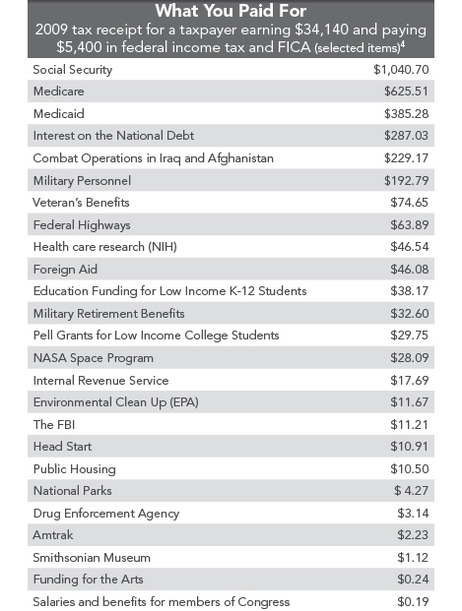
Taxpayers should get a receipt so they know what they're paying for, a think tank called Third Way argues in a new paper.
Here's a sample from the group. It includes federal income tax and FICA, which funds Medicare and Social Security. Details are here.

See Also:
Leif Utne's random rants, musings and meditations
 Recently, my dad proposed in his back-page column in the May/June Utne Reader, titled “An Open Letter to MoveOn,” that the nation’s premier progressive organization should go beyond issue-driven campaigns and “lead a community organizing movement across America.” (Yes, in case you’re wondering, my dad founded Utne Reader, and I worked there as a writer and editor for eight years.)
I couldn’t agree more. I especially like his suggestion that MoveOn stage a series of large revival-style cultural events designed to introduce members to each other:
MoveOn could kick off the movement by hosting stadium-sized events, harking back to 19th-century chautauquas and tent shows. Attendees would sit together according to particular affinities: parents of young children, schoolteachers, health care workers, clergy, small-business owners, elders. Like-minded participants could share their ideas about particular issues, like clean, green energy and single-payer health care. Or, if seating were assigned based on zip code and postal route, people would meet their neighbors in a positively charged environment.
Phi Beta Iota: We are hugely impressed by the combined convergence and emergence we see all around us. The Internet is moving into phase 3, where it optimizes human collaboration including face to face encounters. We will begin to follow Leif Utne.

Dear friends,
Do you live in Oregon? Do you have friends, associations, networks in Oregon? If you do, I'm urging you to spread the word on one of the most important developments toward a wiser democracy in the US.
Although most Oregonians don't know it — and you and I are going to change that — Oregon just held the first citizen deliberative councils ever to be officially authorized by a government in the US. Oregonians live in the first state to officially bring the “voice of the whole” — a legitimate, deliberative voice of We the People, above and beyond partisan debate — into public discourse, into the homes of voters, and into the official business of government.
Here's what happened: Two “Citizen Initiative Reviews” — panels of randomly selected ordinary Oregonian voters — have passed “informed public judgment” on two ballot initiatives Oregonians will be voting on this November. Authorized by the state legislature and the governor, their thorough study, expert interviews, and deliberations have clarified the issues and facts so Oregon's voters can more intelligently decide how to vote, to reflect their highest values. These ordinary citizens have cut right through the partisan noise and TV ads that muddy up the initiative process.
This innovation could revolutionize elections. The initiative form of direct democracy could once again become a tool of the popular will. Broader use of the Citizen Initiative Review process could overcome special interests bent on turning popular will against the common good.
The only thing needed now to turn this budding breakthrough into a full-fledged transformation is for Oregonians to read, think about, and talk about the Citizen Initiative Review statements in Oregon's Voter Information Booklets (see the links below). So we need to tell all our friends and associates in Oregon to do that. If enough people see these statements — and realize how incredibly valuable they are compared to the repetitive, manipulative partisan spin and mudslinging that usually fill the airwaves and Voter Information Booklets — they will demand more of this kind of We the People voice in more aspects of our political life and governance.
I want to stress how important this is: This initiative goes beyond surveys, because it is deliberative and it reveals common understandings, not just individual opinions. If this spreads, we'll find ourselves on a really different political playing field, with new rules of play. This is a potential game changer. We have a chance to make a difference with it RIGHT NOW, during this one month before elections.
Please do what you can.
Below is a message I received from Healthy Democracy Oregon who spearheaded this remarkable innovation:
Continue reading “Journal: Oregon First “Smart State?” Learn More…”
