Hearing a pattern of voices in the global wilderness
Contents:
Contrasting understandings of poetic discourse and dialogue between poets
Beyond complacency regarding existing modes of discourse?
Transcending the boundaries of conventional poetic discourse
Poetic improvisation in the moment vs. Prescripted unresponsive discourse
Multivocal poetic improvisation as an elusive phenomenon
Relevance of poetic debate to other arenas of discourse
Beyond diversality towards multiversality?
Embodying challenge and surprise into multivocal poetic improvisation
Relevant insights from the Poetist Manifesto
Emergent techniques in enactivating multiversal community
Poetry-making as a template for policy-making
Engaging imagination multiversally
In Future Perfect, bestselling author Steven Johnson (Everything Bad Is Good for You)declares himself a member of the new revolutionary party, the peer progressives. For the most part, it’s a quiet movement, steady, not inherently violent. The recent uprisings in Bahrain, Egypt, the Occupy Wall Street protests, and other well-covered clashes between Net-enabled citizens and truncheon-wielding cops do not embody this phenomenon, but are instead merely a symptom. Make no mistake, however: A revolution is afoot.
Peer progressivism is the social change that occurs outside of rigid government structures but in a way that isn’t guided by capitalistic self-interest, at least not exclusively. It’s spontaneous networks of free and equal agents, democratically intertwined. For instance, the crowdfunding site Kickstarter is nominally owned by a for-profit company but is powered by millions of selfless users seeking only to reward worthy creative projects. Wikipedia is peer progressive, as are employee-owned businesses.
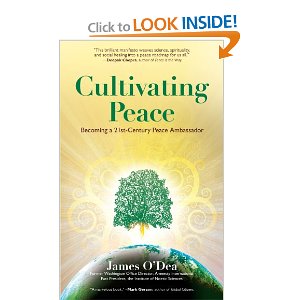
The world’s peace movements are undergoing a transition, according to James O’Dea, retired Amnesty International director. Whereas they once focused on simply opposing wars, peace organizations are now striving to actively build new social systems that embody justice and nonviolence, he writes in Cultivating Peace.
O’Dea calls on regular people everywhere to join in the shared effort by being “evolved peace leaders” in their own everyday lives. This type of peace leadership runs far deeper than protests and political campaigns: It involves a transformation of one’s own mind and heart.
Collective transformation toward more peaceable states of mind will come from thinking positively, learning to laugh, seeking wisdom, appropriately managing anger, and so on. We will not successfully stop violence, O’Dea concludes, unless we address the attitudes and patterns of thinking that give rise to it—and replace them with mind-sets conducive to shared understanding and affirmation of life.
O’Dea effectively melds social action and self-improvement into an inspiring clarion call for societal justice. At a time when mass movements are manifesting across the globe and swaying or even overthrowing whole governments, the author reminds readers of the transformative potential that concerned citizens of any country can yield when they work together. Activists and non-activists will find Cultivating Peace a worthy read.—Rick Docksai
The black race is gradually coming together. Where other world groupings are primarily motivated by strategic, security, political and economic interests, Africans wherever they are can count also on their common history of being black.
Haiti currently has the status of Member Observer with the African Union and submitted to that organization, a formal request for the status of full Associate Member of the Union of Heads of State and Government of Africa, a status that will be effective starting from January 2013.
In January 2011, the Libyan leader Muammar Kaddafi who was killed by NATO in October of the same year asked the following question to delegates who were attending an international conference for the African Diaspora from around the world that he had convened in Tripoli.
“Why shouldn’t people of black descent leaving outside the African mother continent be allowed to have a referendum to decide if they wanted to be part of Africa or not.”
As we know there are many countries out of Africa, particularly in the Caribbean’s Islands, where black people constitute the majority. Even Brazil itself is getting closer to such category.
The admission of Haiti to the African Union is a significant milestone of bringing together the black family of Africans as a people.
May this reunion of Haiti with the mother continent be a strong motivation for other nations with black majorities to see in such strong relationship a source for future prosperity of respective populations either in Africa or concerned countries?
People from the South – where most Blacks are – , have in the past strongly counted on their cooperation with the North for their development. Though the latter is still dominant, there are clear signs that the tides are shifting. The more the former will find in themselves the resources to uplift their populations the better.
In 1972, environmental guru Dennis Meadows predicted in his seminal study “The Limits to Growth” that the world was heading toward an economic collapse. Forty years on, he tells SPIEGEL ONLINE that nothing he has seen since has made him change his mind.
SPIEGEL ONLINE: Professor Meadows, 40 years ago you published “The Limits to Growth” together with your wife and colleagues, a book that made you the intellectual father of the environmental movement. The core message of the book remains valid today: Humanity is ruthlessly exploiting global resources and is on the way to destroying itself. Do you believe that the ultimate collapse of our economic system can still be avoided?
Meadows: The problem that faces our societies is that we have developed industries and policies that were appropriate at a certain moment, but now start to reduce human welfare, like for example the oil and car industry. Their political and financial power is so great and they can prevent change. It is my expectation that they will succeed. This means that we are going to evolve through crisis, not through proactive change.
An investigation into the relationship between environmental poisons and human health is riveting — and terrifying.
If horror is your genre, environmental writer Brita Belli’s The Autism Puzzle, is the book for you. Her terrifying look at the chemicals we eat, drink and breathe is guaranteed to make your hair stand on end.
We should thank her for it.
Statistics released earlier this spring by the Centers for Disease Control revealed that one in 88 U.S. born toddlers has an autism spectral disorder—from the less severe Asperger’s Syndrome to the so-called classical form of the ailment. Worse, it’s not just a North American phenomenon; Belli also reports a 57 percent spike in Asia and Europe.
Quick survey using DuckDuckGo in order as they appear — Trilogy does well — and no one else has the idea of “full-spectrum” HUMINT at the management level, Wikipedia gets it partly right at the source level.