New America Foundation blogged to CNN, November 21, 2012 |
A woman at the helm of the CIA wouldn't simply make another crack in the intelligence glass ceiling, it could effectively shatter it.
One of the most high-profile appointments President Obama will make in his second term is the director of the CIA. Here's a tip for the president: The time is ripe for the first woman to head the agency.
Choosing a woman isn't just about narrowing the intelligence community gender gap. It's also about drawing from the whole pool of talent to ensure the best national security apparatus and responding to Americans' apparent desire for more women in government. Here are the Top 10 reasons President Obama should name a woman as the next CIA director.
The Machine Grinds All of Us Up and Spits All of Us Out, No Exceptions
I keep returning to the idea that our collectives have come to rule us all, even those who seem to be captains at the wheel. If that's what they believe, they are wrong. The captain is the blind collective. And the blind collective is the sum of all the parts. They are just a part like the rest of us, albeit a part with more control that the rest of us have.
In that sense we have all become servants to the greater wholes: the blind collectives that drive us and that all of us serve. They are like giant machines.
One aspect of that machinery is cognitive and includes ideas as ancient as Aristotle. Yes, Aristotle's ideas have become part of the greater machine that drives us, as have other ideas that are thousands of years old, such as the idea that men should run everything.
And the machine requires us to play roles. It may seem like we invent our roles, but we don't. We select them from a limited number of stock of characters that are approved by the grand machine. We perform a function within that machine. And as soon as we no longer serve a purpose in the machine, we are ejected. Then we have to find a new machine-approved role. The blindness is contained within the roles. It's part of our wardrobe. It's contained within our lines and within the character traits of the role we are expected to inhabit. We are forced to follow the script. Very few ad libs are allowed.
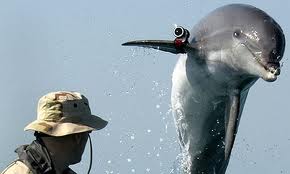
Some dolphins used by the Navy to track down mines will soon lose their jobs to robots – but they will be reassigned, not retired.
Starting in 2017, 24 of the Navy's 80 military-trained dolphins will be replaced by a 12-foot unmanned torpedo-shaped vehicle, according to the newspaper UT San Diego.
The military said the machines can do some of the same mine-hunting duties as the sea creatures. And they can be manufactured quickly, unlike the seven years it takes to train a dolphin.
But the dolphins will not be relieved of duty. They will be used along with sea lions for port security and retrieving objects from the sea floor, the newspaper reported.
I Spy Swimmer….
The Navy's 28 million US dollar marine-mammal program dates back to the late 1950s and once included killer whales and sharks. Based in San Diego, it currently uses 80 bottle-nosed dolphins and 40 California sea lions.
In recent years, dolphins have been deployed to Iraq and Bahrain to patrol for enemy divers and mark the locations of mines.
Using their innate sonar, the mammals find and mark mines in shallow water, in deep water when tethers are used, and on the bottom where sediment cover and plant growth can hide the devices.
Dolphins are carried aboard Navy ships in large movable pools, about 20 feet in diameter. Dolphins travelled on the amphibious ship Gunston Hall in 2003 for the Iraq war.
Most of the Navy's dolphins and sea lions are housed at Point Loma Naval Base, in pools sectioned off from the bay. Others guard Navy submarine bases in Georgia and Washington state, according to UT San Diego.
The military is responsible for the mammals' care throughout their lives, even after they are retired from active duty. Sometimes Navy dolphins are loaned to animal parks, such as Sea World, later in life.
The ten One Planet principles provide a framework that allows us to examine the sustainability challenges we face and develop action plans to live and work within a fair share of the earth’s resources.
The newly elected, 113th Congress includes the first Buddhist to serve in the Senate, the first Hindu to serve in either chamber and the first member of Congress to describe her religion as “none,” continuing a gradual increase in religious diversity that mirrors trends in the country as a whole. While Congress remains majority Protestant, the institution is far less so today than it was 50 years ago, when nearly three-quarters of the members belonged to Protestant denominations.
Catholics have seen the biggest gains among the 530 seats in the new Congress that have been decided as of Nov. 16. So far, Catholics have picked up five seats, for a total of 161, raising their share to just over 30%.1 The biggest decline is among Jews, who have been elected to 32 seats (6%), seven fewer than in the 112th Congress, where Jews held 39 seats (7%).2 Mormons continue to hold 15 seats (about 3%), the same as in the previous Congress.






 The ten One Planet principles provide a framework that allows us to examine the sustainability challenges we face and develop action plans to live and work within a fair share of the earth’s resources.