The myriad protests from Istanbul to São Paulo have one thing in common – growing dissent among the young, educated and better-off protesting against the very system that once enriched them. And therein lies the danger for governments
If the “new protest” can be summed up, it is not in specifics of the complaints but in a wider idea about organisation encapsulated on a banner spotted in Brazil last week: “We are the social network.”
. . . . . . .
What does ring true, however, is his assertion that a driving force from Tahrir Square to Occupy is a redefinition of notions of both what “freedom” means and its relationship to governments that seem ever more distant. It is significant, too, that many recent protests have taken place in the large cities that have been most transformed by neoliberal policies.
Pakistan: The Federal Investigation Agency (FIA) on Tuesday named former president Pervez Musharraf as the prime suspect in the December 2007 assassination of ex-prime minister Benazir Bhutto.
The head of the FIA's Joint Investigation Team, Deputy Director Khalid Rasool, told the Rawalpindi Anti-Terrorism Court that Musharraf “hatched” a criminal conspiracy to cause a breach in Bhutto's security detail that directly led to her murder. His motive was to secure his rule, Rasool's filing said.
The Anti-Terrorism Court Special Judge summoned Musharraf to appear for a hearing on 2 July.
Comment: Just before her assassination Bhutto expressed to friends her concern about an assassination plot involving Musharraf and three other senior officials at the time. They include former head of Pakistani intelligence, Hamid Gul. Eventually all those involved in the conspiracy are likely to be brought to trial.
This is the third active case against Musharraf that could lead to his execution. A fourth potential capital case is the treason accusation that Prime Minister Nawaz Sharif mentioned yesterday. That case has not yet begun.
OUR OBJECTIVE: Figure out how to take one million people out of a virtual hell and resettle them into a virtual heaven, using only $500 million ($500 per person), and three ingredients available in plentitude: sunlight, barren earth, and salt water. Begin within 90 days and finish within two years. In so doing, create the playbook for addressing the needs of the two billion extreme poor so as to end the migration pressures on Australia, Europe, Russia, Turkey, and the USA.*
* Three hard things in one package: # of people, fixed low-cost per person, and zero base start — in the middle of a moonscape with no supporting foundation. This is about speed & scale combined, and open source and low cost per person plus assured sustainability combined. A non-trivial challenge no one else has addressed.
INTRODUCTION:
Click on Image to Enlarge
Both human understanding and critical technologies have advanced far beyond the understanding of most academics, civil organizations including labor unions and religions, corporations, governments, law enforcement, media, the military, and non-government/non-profit organizations.
Hybrid public governance rooted in open-source decision-support — legal ethical evidence-based decision-support — is the wave of the future that we must all ride if we are to prosper.
My email is robert.david.steele.vivas [at] gmail [dot] com. I seek to attract ideas from those who believe, as I do, that there is plenty of money to create a prosperous world at peace — we simply lack applied intelligence with integrity across all traditional organizations. There are new leaders in place who appear disposed to listen. The time for Alternative C2, Open Source Everything (technical), and M4IS2 (human factor) has arrived.
Although the threats that organized crime pose to UN peace operations are increasing, most missions lack either the mandate or resources to deal with them effectively. By using case studies from Guinea-Bissau, Haiti, and Kosovo, this paper not only illustrates the nature of the problem, it provides recommendations on how peace agents can deal with it more effectively.
When NATO undertook the job of providing air support for Libyan rebels one of the actions they were tacitly supporting was the demolition of the Libyan state security apparatus. A hated tool of repression, those employed in it were slaughtered where ever they were found, offices were looted, files were burned, and systems destroyed. The effort to stabilize the country now involves their former colonial masters, the Italians, helping to rebuild this government function. Rebuilding the Libyan Intelligence provides a decent read with Italian to English translation.
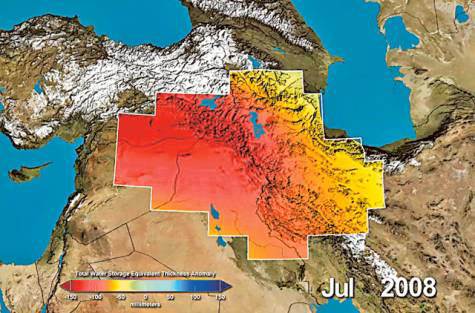
From the beginning of 2003 to the end of 2009, portions of Iran, Iraq, Turkey and Syria that lie within the Tigris and Euphrates river basins shed 117 million acre-feet of water. That’s roughly equivalent to the volume of the Dead Sea.
When the wealthy nations of the world meet as the G8 or in any other gathering, it's interesting to imagine what they would do if they followed the golden rule, valued grandchildren, disliked unnecessary suffering, or wished to outgrow ancient forms of barbarism, or any combination of those.
The United States alone is perfectly capable, if it chooses, of enacting a global marshall plan, or — better — a global rescue plan. Every year the United States spends, through various governmental departments, roughly $1.2 trillion on war and war preparations. Every year the United States foregoes well over $1 trillion in taxes that billionaires and centimillionaires and corporations should be paying.
If we understand that out-of-control military spending is making us less safe, rather than more — just as Eisenhower warned and so many current experts agree — it is clear that reducing military spending is a critical end in itself. If we add to that the understanding that military spending hurts, rather than helping, economic well-being, the imperative to reduce it is that much clearer.
If we understand that wealth in the United States is concentrated at medieval levels and that this concentration is destroying representative government, social cohesion, morality in our culture, and the pursuit of happiness for millions of people, it is clear that taxing extreme wealth and income are critical ends in themselves.
Still missing from our calculation is the unimaginably huge consideration of what we are not now doing but easily could do. It would cost us $30 billion per year to end hunger around the world. We just spent nearly $90 billion for another year of the “winding down” war on Afghanistan. Which would you rather have: three years of children not dying of hunger all over the earth, or year #13 of killing people in the mountains of central Asia? Which do you think would make the United States better liked around the world?