Leaving Afghanistan: Not With a Bang, But a Whimper
Stephen M. Walt, Foreign Policy, 28/10/13

Leaving Afghanistan: Not With a Bang, But a Whimper
Stephen M. Walt, Foreign Policy, 28/10/13

PDF (1 Page): (U) CSA Interview (Defense News, 28Oct13)-1
Interview
GEN. RAY ODIERNO
US Army Chief of Staff
Defense News 10/28/2013

At last week’s Association of the United States Army annual meeting and exposition in Washington, thousands gathered to hear senior leaders explain where the service is headed in this era of austerity. And the message from Gen. Ray Odierno, Army chief of staff, was one of frustration with uncertain budgets and automatic and inflexible defense cuts that are gutting readiness, with only two of his brigades ready for combat. The Army has been cutting personnel at a breakneck pace to save as much money as possible, given additional budget cuts are likely.
The Army is headed from a force of 570,000 soldiers, just a few years ago, down to 490,000. That number could get smaller, given sequestration is likely to continue and deeper reductions are expected over the coming months as part of a broader debt and spending deal.
Q. What is the real impact of past and future budget cuts on the force? Why are you so alarmed? And what is the way out of it?

1. Ricks fails to understand that military strategy and policy do not exist in a vacuum. The White House and Congress both have votes that can be decisive. Shinseki and Franks were closer to right w/r/t force requirements for Iraq than was Rumsfeld. Further, Jerry Bremer unbelievably complicated Iraq by de-Baathification and dissolutionn of the Iraqi army.
Continue reading “Marcus Aurelius: Can Military Learn From Its Mistakes?”

Privacy: This week, the European Parliament voted to immediately suspend the sharing of European financial tracking data with the United States in a 280-254 decision, as well as calling for criminal investigations of the NSA. This follows in the footsteps of mass surveillance revelations that the NSA has illegally hacked into the SWIFT financial data. This appears to be yet another public wake-up and backlash against the secretive wiretapping industry.
Continue reading “Rickard Falkvinge: Mass Surveillance Fallout — Europe Investigating NSA”
Hard National Security Choices
Dispatch from Berlin on a Diplomatic Disaster
Friday, October 25, 2013 at 7:00 AM
A diplomatic disaster for the United States is currently unfolding in Berlin. The revelation that the NSA may have monitored cell phone conversations and text messages of Chancellor Angela Merkel has led to popular outrage in Germany, as well as unusually pointed language from the Chancellor and other government officials. The U.S. Ambassador was not merely asked but summoned (“einbestellt”) to the German foreign office—a strong verb used until now (if at all) only for the Syrian and Iranian ambassadors. The Chancellor’s phone conversation with President Obama did nothing to ease the tension. Merkel declared such practices totally unacceptable: Between friends and partners such as the United States and Germany, the monitoring of communications by government leaders is a grave breach of trust, her press secretary emphasized. The Obama administration, other than saying the Chancellor’s phone is not now and will not in the future be monitored, has offered nothing: neither apology, nor explanation of what happened in the past, nor any sort of suggestion for future cooperation or discussion of a collective solution.
Continue reading “Berto Jongman: NSA A Diplomatic Disaster for USA”

From Gary Sycalik
Fellow earth-travelers,
An exceedingly important article / blog is copied below. It involves the War on Terror.
The very important rule rule is “Follow-the-Money.” So, when applied to the War on Terror what do we find? Perhaps, we find a tremendous strengthening of the Military-Industrial-Complex, a substantiation for unconscionable U.S. military budgets (to the determent of other budget areas such as education) and exceedingly huge profits of such corporate giants as Halliburton. According to a 2012 article in the Huffington Post, the U.S. spends more than China, Japan, UK, France, and Russia combined. More than all these added together. Russia spent 52.7 billion while the United States spent 695.7 billion (Not counting off the books stuff such as ‘black ops.”)
Could the War on Terror really be, substantially (and pivotally), about power and money? And until the majority of we, the people, become realistic about the ‘why’ of ‘things’, shine light into the shadows of secrecy, and demand appropriate responsible action from government and corporate leaders, the very few will control the many to the determent of the citizen-public. Consider this; existing corporate-government relationships are insidious in nature and dangerous in fact. President Eisenhower warned us about the this relationship (military-industrial complex) as he left office. Why do you think he waited to do so at the end of his presidency? Think about it. A more balanced relationship can be created. Actually, it must be if our country is to be sustainable and viable in the future. I want a sustainable and viable country. I assume that you do too.
Happy travels,
Gary
U.S. “War On Terror” Has INCREASED Terrorism
Posted onOctober 21, 2013
Charts Show that U.S. Policy Has Increased Terror Attacks
The National Consortium for the Study of Terrorism and Responses to Terrorism (START) Global Terrorism Database – part of a joint government-university program on terrorism – is hosted at the University of Maryland.
START is the most comprehensive open source terrorism database, which can be viewed by journalists and civilians lacking national security clearance.
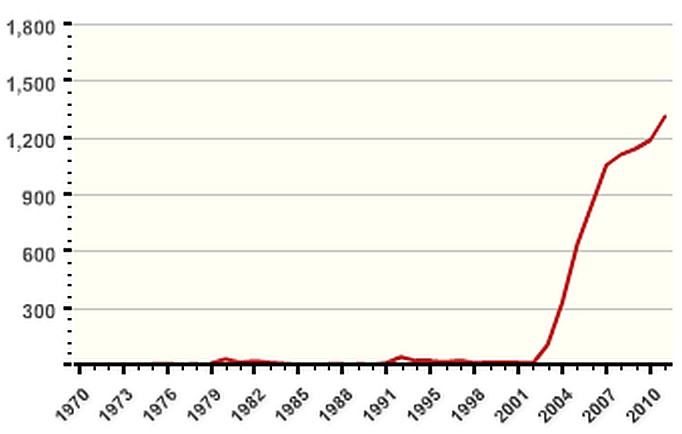
A quick review of charts from the START database show that terrorism has increased in the last 9 years since the U.S. started its “war on terror”.

This chart shows the number of terror attacks conducted in Iraq:
See compelling charts and rest of article.
Phi Beta Iota: The article and the charts do not address the financial terrorism of the City of London and Wall Street that have destroyed entire national economies, and particularly those of the USA, Spain, Portugal, Ireland, and Greece. Iceland, alone, had the integrity and intelligence to stuff the bankers into jail.

Algeria-Libya: Algerian soldiers found a large weapons cache on 24 October in Illizi in east central Algeria, near the border with Libya. The weapons included 100 anti-aircraft missiles, more than 500 MANPAD shoulder-launched anti-aircraft missiles and hundreds of rocket launchers, rifles, landmines and rocket-propelled grenades.
Comment: Algerian authorities have not commented about whom they suspect stored the weapons, except to suggest they came from Libya. Illizi is on the road several hundred kilometers southwest from Tripoli, Libya. This is one of the routes used to smuggle Libyan weapons to militants and terrorists in Mali.
The cache contents help confirm where some of Libya's large store of man-portable shoulder-fired anti-aircraft missiles (MANPADS) went after the weapons depots used by Qadhafi's forces were ransacked and their contents carried off. This is an important discovery, but only a portion of the weapons that are unaccounted.
Five hundred MANPADS would be more than enough to neutralize French air superiority in Mali, had they reached the militants there. Libya has become the arsenal of Muslim terrorists.