“The command centre has been good for us, it has helped a lot, but we’d like more commitment from them. They don’t really share intelligence information with us, they don’t give us enough weapons to do the job,” said an FSA commander.
“We all think they want to keep Assad stronger than us, they want to keep a balance – we get enough to keep going but not to win,” he said.
. . . . . . .
“It gets very complicated, everyone lies to each other, everyone is trying to control everyone else,” said an FSA commander.
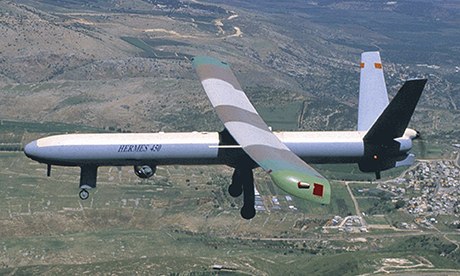
Heather Linebaugh's personal account of her work on the US drone program gives one set of reasons for why that program should be stopped immediately. Another reason was given by the Prime Minister of Pakistan two days ago: the use of drones in Pakistan violates the national sovereignty of that country and is protested by almost everyone there who learn to hate Americans for doing this to their country. A third reason: unless drones are banned by an international treaty with the same seriousness that chemical warfare was banned, we may live to see the day when powers hostile to the U.S. launch drones that kill or main you, your neighbors, your children, your friends. It could happen here–and sophisticated drones could be much harder to head off than other forms of attack. And the source of drone attacks may be hard to identify as drones start to become an accepted weapon by many countries, including small dictatorships that will eventually be ovethrown (some by people who wish to strike back at the US for supporting their repressive governments, as for example Egyptian Muslims watching as the US refuses to call the recent coup a coup so that we can still fund the military dictatorship which is every day proclaiming some new assault on freedm and democracy of the Egyptian people).
Few of the politicians who so brazenly proclaim the benefits of drones have a real clue how it actually works (and doesn't)
Heather Linebaugh
Guardian, U.K. Dec. 29th
Whenever I read comments by politicians defending the Unmanned Aerial Vehicle Predator and Reaper program – aka drones – I wish I could ask them some questions. I'd start with: “How many women and children have you seen incinerated by a Hellfire missile?” And: “How many men have you seen crawl across a field, trying to make it to the nearest compound for help while bleeding out from severed legs?” Or even more pointedly: “How many soldiers have you seen die on the side of a road in Afghanistan because our ever-so-accurate UAVs [unmanned aerial vehicle] were unable to detect an IED [improvised explosive device] that awaited their convoy?”
South Sudan is at the brink of civil war and societal collapse
History is just one of those hard things to ignore, especially in South Sudan.
In 2011, the U.S. midwifed the creation of a new nation, South Sudan. Though at the time Obama invoked the words of Dr. Martin Luther King speaking about Ghana (“I knew about all of the struggles, and all of the pain, and all of the agony that these people had gone through for this moment”) in officially recognizing the country, many were more focused on the underlying U.S. motives,
What sorts of threats will the US military face in the “deep future”?
That was the topic of a panel at the Association of the US Army (AUSA) conference this week, the heavily attended annual trade show that draws top Pentagon officials and defense contractors.
It's a tricky proposition for the Pentagon, since making the wrong predictions means squandering scarce funds in a time of intense budget pressure. The Pentagon was forced to cancel the Future Combat System in 2009, for example, when the military tried to predict where the future was headed “more than a few years out,” said Gen. Robert Cone, head of the US training and doctrine command. As a result, he told the panel, “We're a little gun-shy.”
Still, in a standing-room-only session, the discussion endeavored to come up with the most likely risks to the stability of the world – and most likely to challenge the US military – in 2030 and beyond. Here are their top three picks.
1. The growth of cities – and of slums
2. A ‘significant and lengthy' period of Sunni-Shiite violence in the Middle East
3. The revolution in personal communications, combined with cheap drones and robotics
We have big problems that are currently out of control and taking our nation careening towards a future that is dangerously out of control. We have, deeply ensconced within our power infrastructures, institutions, organizations and job categories where there are gross violations of the law, of the constitution, of the rights of citizens. These organizations and the people who operate freely as perpetrators of crimes and abuses of the constitution are protected by the power hierarchy that is supposed to supervise them and hold them accountable.
Let's take a look at some of the worse offenders. There's no new news here. But my hope is to frame this is a bigger problem that needs to be addressed by new responses– responses which I'll discuss shortly.
My goal in this article is to start a conversation that needs to be raised to a much higher level. So here are a few examples of the abusing entities.
Leaks from the former NSA contractor have been so illuminating that experts say they mark a turning point in U.S. intelligence operations.
By Ken Dilanian
Los Angeles Times, December 22, 2013
WASHINGTON — After news reports that the National Security Agency had secretly monitored German Chancellor Angela Merkel's cellphone calls, America's top intelligence official was asked why congressional oversight committees were kept in the dark.
Shouldn't Congress have been briefed, Rep. Adam B. Schiff (D-Burbank) asked James R. Clapper, the director of national intelligence, about a spying operation that would embarrass the U.S. government if exposed?
“Well, sir, there are many things we do in intelligence that, if revealed, would have the potential for all kinds of blowback,” Clapper replied at a House Intelligence Committee hearing in October. “The conduct of intelligence is premised on the notion that we can do it secretly, and we don't count on it being revealed in the newspaper.”

 Syrian Rebels Get Arms and Advice Through Secret Command Centre in Amman