Steve Aftergood: Pentagon Drone Program Cut in Half, New Military Doctrine

Military
Steven Aftergood
Steven Aftergood

PENTAGON DRONE PROGRAMS TAPER OFF, AND NEW MIL DOCTRINE

The Department of Defense budget for research and procurement of unmanned aerial systems (UAS), or drones, is on a distinctly downward slope.

The FY 2014 budget request included $2.3 billion for research, development, and procurement of unmanned aerial systems, a decrease of $1.1 billion from the request for the fiscal year 2013.

“Annual procurement of UAS has gone from 1,211 in fiscal 2012 to 288 last year to just 54 in the proposed FY14 budget,” according to a recently published congressional hearing volume.

See “Post Iraq and Afghanistan: Current and Future Roles for UAS and the Fiscal Year 2014 Budget Request,” hearing before the House Armed Services Committee, April 23, 2013.

Among the questions for the record published in the new hearing volume, DoD officials were asked: “Who is responsible for developing privacy protections for military UAV operations inside the United States?”

Some other noteworthy new doctrinal and congressional defense-related publications include the following.

Continue reading “Steve Aftergood: Pentagon Drone Program Cut in Half, New Military Doctrine”

Marcus Aurelius: SecDef Puts Humans on the Block

Ethics, Military
Marcus Aurelius
Marcus Aurelius

SECDEF speaks; see article below.  Key points:

  • First SOF Truth, equally applicable to every single element of the Joint Force, has been forgotten:  HUMANS ARE MORE IMPORTANT THAN HARDWARE.  First SOF Truth, repeat after me, Mr. Secretary:  HUMANS ARE MORE IMPORTANT THAN HARDWARE.
  • Troops and families — carriers of the rifles and the rucksacks and standers of the night watches — rather than contractors will bear the burden.

– – – – – – –

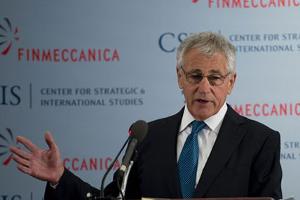
Defense Secretary Chuck Hagel warned Tuesday that troops and their families will be asked to sacrifice on pay and benefits to preserve readiness in an era of tighter budgets.

SecDef Chuck Hagel
SecDef Chuck Hagel

Hagel listed politically-charged changes to compensation and personnel policy as one of his top six priorities in reforming the military following the wars in Iraq and Afghanistan as the department gears up to meet new challenges.

“This may be the most difficult” to achieve among his six priorities, Hagel said of proposals to trim pay increases, overhaul TRICARE and review retirement benefits while adapting to cuts in personnel.

“Without serious attempts to achieve significant savings in this area, which consumes roughly half of the DoD budget and is increasing every year, we risk becoming an unbalanced force,” Hagel said.

The alternative was to have a military that is “well-compensated, but poorly trained and equipped, with limited readiness and capability,” Hagel said in a keynote address to a Global Security Forum 2013 sponsored by he Center for Strategic and International Studies.

Continue reading “Marcus Aurelius: SecDef Puts Humans on the Block”

Marcus Aurelius: WaPo (Carter/Barno) on Military Isolation

06 Family, 11 Society, Cultural Intelligence, Military
Marcus Aurelius
Marcus Aurelius

Invite your attention to following generally overstated (IMHO) article and my accompanying comments in yellow-highlighted red. 

Happy Veterans' Day

How the military isolates itself — and hurts veterans

By Phillip Carter and David Barno, Published: November 8

Phillip Carter and retired Lt. Gen. David Barno are veterans of Iraq and Afghanistan, respectively, and senior fellows at the Center for a New American Security.

In Afghanistan and Iraq, the wire ringing our bases divided two starkly different worlds. Inside the wire, life revolved around containerized housing units, cavernous dining facilities, well-appointed gyms and the distant but ever-present risk of a falling rocket or mortar round. Outside the wire, Afghans and Iraqis tried to live their lives amid relative chaos. They didn’t fully understand what we were doing there. And when we ventured out, we struggled to navigate their world.

Continue reading “Marcus Aurelius: WaPo (Carter/Barno) on Military Isolation”

Penguin: Stonewalling Fukushima – a Betrayal of the Public Trust

06 Family, 07 Health, 07 Other Atrocities, 08 Proliferation, 08 Wild Cards, 09 Justice, 11 Society, Corruption, Government, Officers Call
Who, Me?
Who, Me?

Think of the vastness of the evil of covering up this baby (headlines by country, plus streaming — truly shocking):

http://enenews.com/

Almost a complete blackout across the board when we there should be a national mobilization of state and local civil officialdom including schools to begin the measured precautions to protect our kids, particularly on the West Coast.

http://www.washingtonsblog.com/2013/10/how-to-protect-yourself-from-fukushima-radiation.html

See also:

http://www.globalresearch.ca/how-to-protect-yourself-from-fukushima-radiation/5356177

Spanish Dancer: Business Plans as Microsoft Fiction

Commerce, Commercial Intelligence, Ethics
Click on Image to Enlarge

Innosight

Business Plans and Other Works of Fiction

The purpose of a business, Peter Drucker famously said, is to create a customer. Yet, rather than creating customers, many innovators create a fantastical piece of what you might call Microsoft fiction.

This hit home for me during a recent client project. I was working with a team that had been tasked by the company’s CEO to develop a new venture in a promising market space. Its three members had been working for about six weeks. They’d conducted detailed research, talking both to prospective customers and numerous industry experts. And then they used Microsoft’s most popular products to produce what they thought was a business plan. But it actually was a kind of fiction built in three chapters: an Excel spreadsheet with sophisticated analyses showing breathtaking financial potential, a PowerPoint document blending facts and figures with compelling videos and pictures, and a Word document summarizing all of it in prose so lucid Malcolm Gladwell would shed a tear.

Still, it isn’t a business until you create a customer. After listening to the team describe its work, I asked a simple question: “Who is your first customer?”

The team turned to page 12 of chapter 2 of their Microsoft fiction, proudly displaying a PowerPoint slide citing detailed demographic figures. The slide said that 60% of the target market would be 18-to-34-year-old males with annual incomes within a certain range.

So I asked the question again. Instead of summary facts and figures, I wanted the team to be very precise. What is the customer’s name? Where does he live? What does he look like? What are his hopes, dreams, and aspirations? What does he love? What drives him crazy? How would the team’s idea fit into his life?

Read the rest at Harvard Business Review.

Scott Anthony is the managing partner of Innosight.

Penguin: Our Veterans, Our Blood, Our Soul

Ethics, Military
Who, Me?
Who, Me?

This captures my continuing anguish.

How American Troops in Afghanistan became Unreal (Jones)

Ann Jones writes at Tomdispath.com

Informed Comment

Posted on 11/08/2013 by Juan Cole

The last time I saw American soldiers in Afghanistan, they were silent. Knocked out by gunfire and explosions that left them grievously injured, as well as drugs administered by medics in the field, they were carried from medevac helicopters into a base hospital to be plugged into machines that would measure how much life they had left to save. They were bloody.  They were missing pieces of themselves. They were quiet.

It’s that silence I remember from the time I spent in trauma hospitals among the wounded and the dying and the dead. It was almost as if they had fled their own bodies, abandoning that bloodied flesh upon the gurneys to surgeons ready to have a go at salvation. Later, sometimes much later, they might return to inhabit whatever the doctors had managed to salvage.  They might take up those bodies or what was left of them and make them walk again, or run, or even ski.  They might dress themselves, get a job, or conceive a child. But what I remember is the first days when they were swept up and dropped into the hospital so deathly still.

Continue reading “Penguin: Our Veterans, Our Blood, Our Soul”

noble gold