The world we inhabit badly needs red lines, but “the right red lines”, writes Falk.
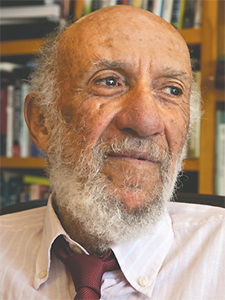
Richard Falk
Richard Falk is Albert G. Milbank Professor Emeritus of International Law at Princeton University and Visiting Distinguished Professor in Global and International Studies at the University of California, Santa Barbara. He is also the United Nations Special Rapporteur on Palestinian human rights.
EXTRACT
Debate on Syria: ‘Missing red line'
What is missing from the debate on Syria, and generally from the challenge to foreign policy, is a more fundamental red line that the US at another time and place took the lead in formulating – namely, the prohibition of the use of international force by states other than in cases of self-defence against a prior armed attack.
This prohibition was the core idea embodied in the United Nations Charter, and it was also consistent with the prosecution and punishment of surviving German and Japanese leaders after World War II for their role in “Crimes against Peace“, that is, aggressive warfare. The only lawful exception to this prohibition was use of force in accord with a prior authorisation given by the UN Security Council.
Conversations to Awaken your Soul. Live from the Hay House “I Can Do It” conference in Las Vegas. A conversation with Dr. Wayne Dyer and Bruce H. Lipton, PhD. Bottom line: DNA is fixed, but DNA read-out is infinitely variable and radically affected by your beliefs, consciousness, and mental focus. One third to two thirds of “medicine” is a placebo effect — this coincides with the documented view that half to two thirds of all surgical procedures are unnecessary and half to two thirds of pharmaceuticals are either ineffective or harmful. Less well understood is the negative effect of all of the medical programming on television telling people about diseases they do not have so that they will get them. In brief, television is making people ill.
A former FBI counterterrorism agent acknowledged this week on CNN that every telephone conversation that takes place on American soil “is being captured as we speak.”
3D printing technology is taking off in the medical science community, especially in emerging methods known as “bioprinting.” Instead of inks, plastics and other artificial materials, science and medical labs use a patient’s actual living human cells to replicate organs that the body can recognize and accept.
3D bioprinting has tremendous promise for medical professionals, but it could also forever change areas such as cosmetic surgery and food engineering (not to mention counterfeiting or spy disguises). Here are some of the latest innovations happening in 3D printing and 3D bioprinting.
WASHINGTON – Not long after Adm. William H. McRaven led the mission to kill Osama bin Laden, he was put in charge of the nation's entire contingent of Special Operations forces, and set to work revamping them to face a widening array of new threats as America's combat role in the Middle East and southwest Asia winds down.
His efforts to apply the lessons learned from more than a decade of fighting in the shadows of the larger wars in Iraq and Afghanistan have high-level support from a White House and Pentagon eager to avoid large-scale foreign interventions and to encourage allies to assume more of the burden of combating extremism and instability.
Admiral McRaven's goal is to recast the command from its popular image of commandos killing or capturing terrorists, and expand a force capable of carrying out a range of missions short of combat – including training foreign militaries to counter terrorists, drug traffickers and insurgents, gathering intelligence and assessing pending risk, and advising embassies on security.
But along the way, the ambitious Admiral McRaven has run into critics who say he is overreaching, or as one Congressional critic put it, “empire building” at a time when the military is shrinking its footprint in Afghanistan and refocusing on other hot spots around the world. Congress has blocked, at least temporarily, an idea to consolidate several hundred of the command's Washington-based staff members in a $10 million-a-year satellite office here, saying it would violate spending limits on such offices.
At the same time, Admiral McRaven has also faced criticism that he is encroaching on the turf of the military's traditionally powerful regional commanders.
Shortly before leaving the Pentagon, former Defense Secretary Leon E. Panetta granted Admiral McRaven new authority to make staffing decisions in the Special Operations units assigned to the regional commanders. While they will still have the final say on missions in their region, Admiral McRaven will now have the ability to allocate the much sought-after 11,000 deployed
Special Operations forces where he determines intelligence and world events indicate they are most needed.
Indeed, in the past year, the command has conducted three classified exercises to determine where it can expand Special Operations forces in regions where they have not operated in large numbers for the past decade, especially in Asia, Africa and Latin America.
Twitter has closed down Posterous.com, the former host of my blog “Random Communications from an Evolutionary Edge”.
We decided to make this problem into an opportunity. So Co-Intelligence Institute board member John Abbe and I have moved my blog to a new site where it has its own memorable domain name:
I really like the new look that we've created. You will see that more posts are now visible on the home page. There is also a tag cloud to make it easier to find what you are looking for and to give you an overview of the topics covered.
The new blog contains all the posts from the previous site at Posterous and all my new posts will be found at this new site.
Over 90% of my blog posts are also mailed to my list (the one you're getting this bulletin on) – and vice versa. So you can subscribe to the blog's RSS feed or simply continue to get my posts via this email list.