Howard Rheingold: Think-Know Tools Webinar, Registration Closes 12 June.

04 Education, Advanced Cyber/IO, Collective Intelligence, Cultural Intelligence, IO Sense-Making
Howard Rheingold
Howard Rheingold

I'm following up my infotention instruction that I presented in Introduction to Mind Amplifiers with a more advanced examination of both the ideas and the practices around intellectual augmentation and the extended mind — concept mapping, social bookmarking, personal knowledge management with tools like Personal Brain. June 19 – July 16. Limited to 30 co-learners. The class is half-filled and registration closes June 12.

Think-Know Tools

June 19 – July 26

A six week course using asynchronous forums, blogs, wikis, mindmaps, social bookmarks, concept maps, Personal Brain,  and synchronous audio, video, chat, and Twitter

Cost for individuals is 300 dollars US or 500 dollars if employer reimburses — via Paypal. 250 for graduates of Rheingold U courses ($200 if you've taken two courses, etc.)  Class cohort limited to 30 learners. If you are interested in signing up, contact howard@rheingold.com to reserve a spot.

Continue reading “Howard Rheingold: Think-Know Tools Webinar, Registration Closes 12 June.”

Olivier Zara: Free Online New Book (in French) on Paradoxical Management

Advanced Cyber/IO, Collective Intelligence, Commercial Intelligence, Communities of Practice, Cultural Intelligence, Ethics
Olivier Zara
Olivier Zara

Management de l'intelligence collective

Réseaux sociaux – Technologies 2.0

A l’évocation du mot “intelligence collective”, certains comprennent “perdre le contrôle”, anarchie, désordre,… ; d’autres comprennent innovation, résolution de problème, performance collective, valorisation des intelligences et des expertises pour mieux produire et mieux vendre.

Dans les entreprises, l’intelligence collective n’existe pas. Il faut la créer par la volonté des dirigeants (c’est une décision, une vision, un paradigme et non le constat résigné qu’on fait que cela existe ou que cela n’existe pas). Dire que l’intelligence collective n’existe pas est une vision du monde. Vouloir créer l’intelligence collective et la gérer est une autre vision du monde. Si vous lisez ce blog… vous connaissez la mienne 

Cliquez sur l'image pour agrandir

Mais, peut-on vouloir créer et gérer l’intelligence collective si on a peur de produire du désordre, de l’anarchie ? Depuis 10 ans que je travaille sur le sujet, j’ai toujours considéré que le simple fait de poser cette question était une forme de résistance au changement et que répondre à cette question était une perte de temps. Je pense aujourd’hui que je me suis trompé et, par ce billet, je vais donc réparer mon erreur.

Pour répondre à la question, je vous propose le concept de management paradoxal qui induit l’idée d’une organisation paradoxale. Le terme de  “management paradoxal” m’a été inspiré par Dee Hock, fondateur et ancien CEO de VISA via son livre Birth of the Chaordic Age. “Chaordic” est la contraction de chaos et d’ordre : http://en.wikipedia.org/wiki/Chaordic.

Voici une carte de l’organisation paradoxale montrant les 8 parties indispensables à la construction d’une entreprise performante :

Lire la présentation complète

English and Other Links Below the Line

Continue reading “Olivier Zara: Free Online New Book (in French) on Paradoxical Management”

Berto Jongman: McKinsey 12 Technologies Driving the Future — With Comment from Robert Steele

Advanced Cyber/IO, Civil Society, Collective Intelligence, Commerce, Commercial Intelligence, Earth Intelligence, Ethics
Berto Jongman
Berto Jongman

These 12 technologies will drive our economic future

Neil Irwin

Washington Post, 24 May 2013

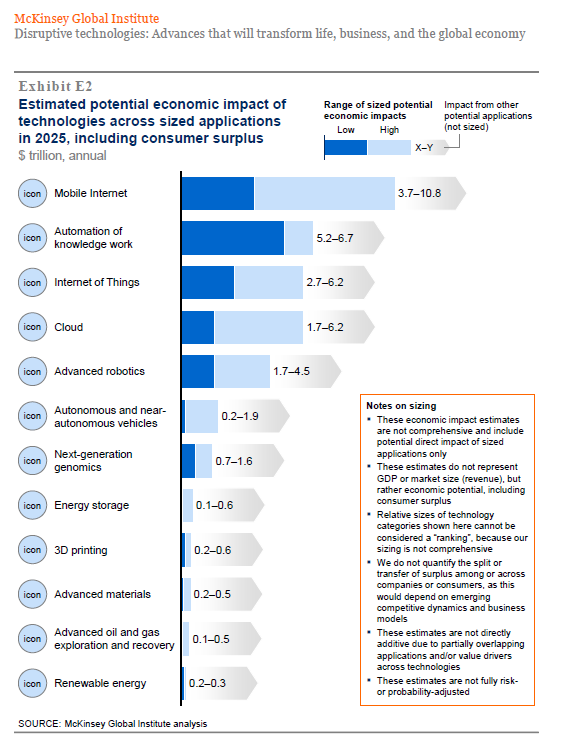
As the chart shows, the McKinsey folks believe that the most economically significant technologies over the next decade-plus will be those already well underway in their development — the mobile Internet, largely in place in the adv

Click on Image to Enlarge

Indeed, maybe the single biggest takeaway from the study is this: The things that will have the greatest impact on the economy in the medium term aren’t the ones that seem to most excite the imagination and public interest. Instead, the potentially powerful innovations are mostly those that have been evolving for many years in new ways.

. . . . . . . .

The real economic benefits of innovation, at least over the near term, come not from the flashy, mind-blowing ideas, but from clever combinations of technologies that are just maturing with those that have been around for ages.

Continue reading “Berto Jongman: McKinsey 12 Technologies Driving the Future — With Comment from Robert Steele”

29 May 2013 1000-1200 NDU DC Dr. Walter Dorn, Peacekeeping Technology for the Protection of Civilians

Advanced Cyber/IO, IO Deeds of War, Peace Intelligence
Dr. Walter Dorn
Dr. Walter Dorn

Peacekeeping Technology for the Protection of Civilians

The goal of the forum is to increase awareness of peacekeeping technologies and how they are being used in practice.  While much attention has been given to providing the UN with helicopters and unmanned aerial vehicles (UAVs), Dr. Dorn emphasizes the importance of basic tools such as smart phones, night vision goggles, video surveillance, and tethered balloons. The forum will include two panels  of experts to explore how the UN and African militaries might go about pilot projects to make use of these innovations.

Keynote Address by: Dr. Walter Dorn, Author of Keeping Watch: Monitoring Technology and Innovation in UN Peace Operations and editor of the forthcoming

Panelists Include:
Colonel Thomas Dempsey, African Center for Strategic Studies (ACSS)
Dwight Raymond, Peacekeeping and Stability Operations institute (PKSOI)
Sarah Williamson, Protect the People (PTP)
David Rogers, MobileGov
Alison Giffen, Stimson Center

Wednesday, May 29, 2013, Time: 10:00am-12:00pm
National Defense University, Lincoln Hall Room 3305, Ft. McNair, Washington, D.C.

This is a part of the TIDES Speaker Series.  Please RSVP to Nelly Mobula 202-685-1971 nelly.mobula@ndu.edu
or register online at: http://www.ndu.edu/CTNSP/Event_Registration/register.cfm

DOWNLOIAD PDF FLYER FOR LOCAL BULLETIN BOARD:
NDUMay29 PeacekeepingTechnology_29May2013

Stephen E. Arnold: Potentially New Web Page Data Mining Tool

Advanced Cyber/IO
Stephen E. Arnold
Stephen E. Arnold

Potentially New Web Page Data Mining Tool

Extracting content from a Web page can be a maddening process, requiring specialized scripts and time spent coding them. Taking a look at available tools, Softpedia touts “FMiner Pro 7.05.” FMiner Pro is advertised as a reliable application that allows users to easily handle Web content without scripts. The software can pull data from any page type, including https, plugins, JavaScript, and even complete data structures.

After the data is extracted much can be done with it:

“Extracted results can be saved to csv, Excel(xls), SQLite, Access, SQL Server, MySQL, PostgreSQL, and can specify the database fields’ types and attributes(eg, UNIQUE can avoid duplication of the extracted data). According to the setting, program can build, rebuild or load the database structure, and save the data to an existing database. Professional edition support incremental extraction, clear extraction and schedule extraction.”


FMiner Pro is available for a free fifteen-day trial to see how well it can perform. After viewing the specs, FMiner Pro is worth a shot. It can probably save coders hours by not having to write scripts and organizing Web content is a tedious job no one likes to do. Having a program to do it is much more preferable.

Whitney Grace, May 22, 2013

Sponsored by ArnoldIT.com, developer of Beyond Search

Neal Rauhauser: NDU Convergence Free Online Book

Advanced Cyber/IO
Neal Rauhauser
Neal Rauhauser

National Defense University’s Convergence

I have been writing on attention conservation for the last four years, having first heard of the concept within Bruce Sterling’s Viridian Design Notes. Sterling used this term as a label for an initial few lines of summary on each note, basically negative information regarding the content, permitting those who would not be interested to ‘conserve their attention’. I use the phrase more broadly, in the sense that we are overloaded by media, overloaded by data, and overloaded by a world that is about to change dramatically.

Part of my personal attention conservation this year has been an effort to take the time I used to spend on short, reactive social media – like Twitter – and redirect it into more weighty reading. I just finished the National Defense University’s Convergence: Illicit Networks and National Security in the Age of Globalization, and I strongly recommend this tome for anyone seeking to better understand the nature of conflict between hierarchies and networks.

Read full post.

Contents

Chapters (Links to Each):

Continue reading “Neal Rauhauser: NDU Convergence Free Online Book”

SmartPlanet: India Pioneering Web Search Via Text Message —

Advanced Cyber/IO

smartplanet logoIndia has 900 million mobile users, but only 8 percent of those enjoy mobile Internet access. Thanks to four college drop-outs, the other 92 percent can now search the Web, too–by text. Read on.

In India, browse the web through texts

By | May 20, 2013

DELHI — In 2009, four students dropped out of an engineering college in a small town in southern India to pursue their dream. They wanted to channel the vast sea of knowledge floating on the Internet through text messages to millions of people who don’t have access to the web.

Now their creation, called SMS Gyan (gyan means knowledge), a search engine available on mobile phones, has 120 million users in India, the Middle East and Africa submitting over five million queries every day. And their company Innoz Technologies has expanded to 45 employees, and it earned $2.5 million worth of revenue last year.

The company’s founders say that Innoz is set to become the world’s largest offline search engine in 2015, with projections of 10 million monthly unique users and more than 55 million searches per day.

. . . . . . . .

Air Tel made the service available to its users in India (it has total of 230 million in 19 countries) who can text questions to 55444 for one rupee, or two cents.

Mohammed Hisamuddin, 26, another co-founder, said that Innoz had designed a special algorithm that crawls their Internet partner sites like Wikipedia and Zomato for information, and then optimizes the most relevant bits into a text-response of 480-characters to make it user friendly.

Read full article.

noble gold