Neal Rauhauser: Plowing Up Astroturf (Outing Robo-Tweeters)

Advanced Cyber/IO, Crowd-Sourcing
Neal Rauhauser
Neal Rauhauser

Plowing Up Astroturf

I received an interesting bit of commission work earlier today – would I help someone plow up a bunch of astroturf. It sounded like an interesting test of my expanding social network analysis skills, so I agreed to take on the task.

I was given a list of six Twitter accounts. One had 2,000+ friends, two had 1,000+ friends, one had 500+ friends, and then there were two very small accounts that were suspected to be coordinators or handlers. Numbers like that are clearly beyond the query limits for Maltego, so the solution would have to be Gephi. I recently published my savetwit shell script, which exercises the python twitter package in order to collect as much information as possible on Twitter accounts. The process kicks out a couple of csv format files suitable for use as edge files in Gephi.

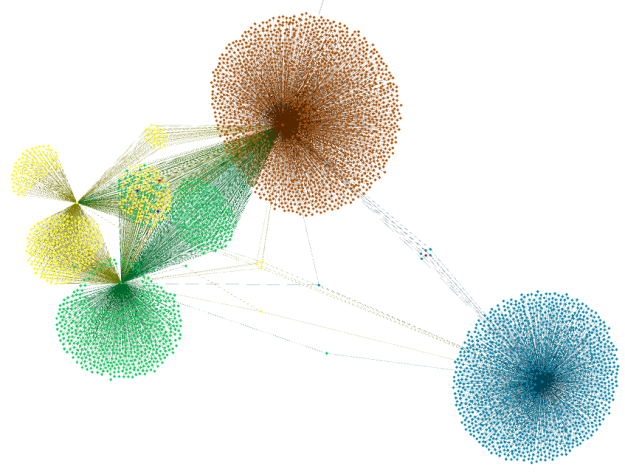
The accounts in question proved to have 4,300 friends and 5,200 links. This is labeled ‘anonymous’, it isn’t anything to do with Anonymous, it’s just a group that I don’t want to spook by mentioning their names.

. . . . . .
Click on Image to Enlarge

And here we have it – the tricolor battleground, with yellow/green on one side, and red on the other. The single red and two blue dots are what modularity shows us. I suspect that if these accounts were isolated, entered into Maltego, and manually colored for allegiance that this would be a three way tussle, and that the names in this portion of the graph are the ones that are lobbing verbal grenades at each other on a nightly basis.


Read full post with additional graphics.

Mary Ellen Bates: Top Gun Information Broker Presentations

Advanced Cyber/IO
Mary Ellen Bates
Mary Ellen Bates

A.I.M. Higher For Your Corporate and Hospital Researchers (pdf)

Mary Ellen brings her lively and practical approach to how info pros can most effectively support the research efforts within their organizations and best leverage their econtent. This webinar, sponsored by Springer, was presented on April 18, 2013.

Super Searcher Tips (pdf)

Mary Ellen presents her favorite super-searcher secrets and tips. This presentation was given at Computers in Libraries on April 8, 2013 in Washington, DC.

Searching the Social Web (pdf)

Mary Ellen shows how to get the most out of social media searching. This presentation was given at Computers in Libraries on April 7, 2013 in Washington, DC.

2011 Info-Entrepreneur Report: insights on information businesses (pdf)

Mary Ellen surveyed business owners in the Association of Independent Information Professionals about their businesses. How much do they make? How many hours do they work? What is their biggest challenge? This 60-page report provides insight into info-entrepreneurship, and offers a benchmarking tool for both new and long-time business owners.

Mini-Me: Google Died. Now What?

Advanced Cyber/IO, IO Impotency
Who?  Mini-Me?
Who? Mini-Me?

Huh?

Google Alerts May Be Dead, and You Don’t Even Know It

Posted by on Mar 22, 2013

Oh Google, you love to draw me in only to drop my favorite services. I have come to rely on Google Alterts to deliver relevant, timely content into my inbox on a broad array of subjects. Google Alerts may already be dead, and you don’t even know it. Especially, as I’ve been talking about content curation so much recently, Google Alerts is one of the top entry points into my content funnel.

The frequency and depth of my Google Alerts began to wane in December 2012, but in late January I noticed that the lag in reporting was far from “as it happens.” Ego alerts were taking 3-4 days to hit my inbox where they took minutes only months ago. So, when I saw Danny Sullivan’s post Dear Google Alerts: Why Aren’t You Working? I knew that I wasn’t alone:

One of Google’s oldest features is Google Alerts, where you can enter keywords you want to monitor and get an email report each day about any new search results that match those terms. It was awesome; but for several weeks, it’s become nearly useless. –

While Danny figures out the problem with Google, I thought I would do a quick roundup of Google Alerts Alternatives. Specifically, I am looking for the following criteria.

  • Price
  • Comprehensiveness – What networks does the service search?
  • Timeliness – How quickly does the service provide results after publication?
  • Email – Does the service deliver results by email?
  • RSS – Does the service provide an RSS feed of results?
  • Accuracy – Are the results that are being delivered accurate?
  • AI – Does the service learn from your input and improve results over time?

Table of Eight Alternatives:

Continue reading “Mini-Me: Google Died. Now What?”

John Robb: The Future of Food — Total Transparency & The Beginning of True Cost Economics

01 Agriculture, 03 Economy, 03 Environmental Degradation, 07 Health, 11 Society, Advanced Cyber/IO, Civil Society, Commerce, Commercial Intelligence, Ethics, Liberation Technology, True Cost Meme
John Robb
John Robb

Here's How to Build a More Resilient Food System…

By John Robb

Want to get a glimpse of the future of food?

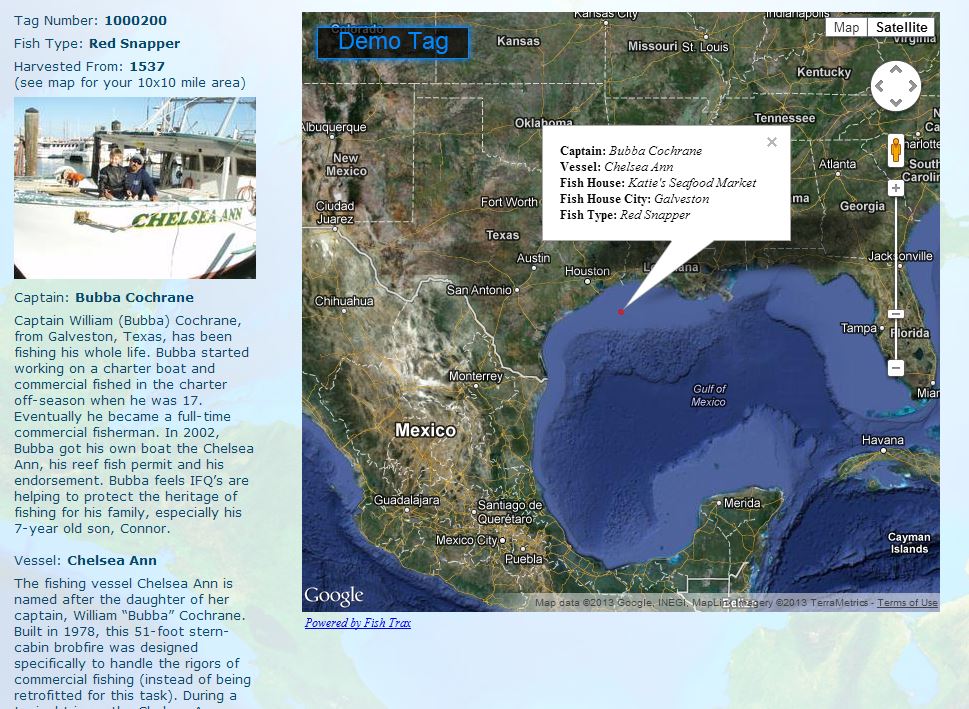
This is the page from Gulf Wild program. When you buy a fish that has a Gulf Wild ID number on it, you can find out everything about it.

Simply enter this ID number on their website or (cell phone) and it will provide you with:

Click on Image to Enlarge
  1. The bio and history of the fisherman who caught the fish.
  2. What the fish is, where the fish was caught (with a map) down to 10 miles, and when it was caught.
  3. Info on fishing practices (e.g. was it caught as part of a sustainable fisheries program?).

NOTE: Canada has a similar program called “This Fish

I believe we're going to see programs like this for all of the food (and an increasing number of products) we buy, from meats to vegetables.

Why? Info like this is addicting. Once you get it, you want it on everything.

Fortunately, it's also really easy to put a service like this together for local producers, and that's a good thing.

Here's why: This type of insight would positively differentiate fresh, high quality local produce from the generic products of indefinite age, quality, and origin we get from the global industrial system.

That would be a good thing, since it would help make local food more plentiful and that makes us ALL more resilient.

Resiliently Yours,
JOHN ROBB

Berto Jongman: Shodan – scariest search engine on the Internet — find one device with zero day crack, then find them all…

Advanced Cyber/IO
Berto Jongman
Berto Jongman

Shodan: The scariest search engine on the Internet

By David Goldman @CNNMoneyTech April 8, 2013: 1:41 PM ET

“When people don't see stuff on Google, they think no one can find it. That's not true.”

That's according to John Matherly, creator of Shodan, the scariest search engine on the Internet.

Shodan runs 24/7 and collects information on about 500 million connected devices and services each month.

It's stunning what can be found with a simple search on Shodan. Countless traffic lights, security cameras, home automation devices and heating systems are connected to the Internet and easy to spot.

Learn more.

Berto Jongman: New Technology and the Prevention of Violence and Conflict

Advanced Cyber/IO
Berto Jongman
Berto Jongman

New Technology and the Prevention of Violence and Conflict

CONTENTS

Executive Summary iii

Introduction 1 Francesco Mancini

Big Data for Conflict Prevention: New Oil and Old Fires 4 Emmanuel Letouzé, Patrick Meier, and Patrick Vinck

Using Information and Communication Technologies for Violence Prevention in Latin America 28 Robert Muggah and Gustavo Diniz

Early Warning and the Role of New Technologies in Kenya 42 Godfrey M. Musila

Conflict Cure or Curse? Information and Communication Technologies in Kyrgyzstan 56 Anna Matveeva

New Technologies and Conflict Prevention in Sudan and South Sudan 71 Helena Puig Larrauri

Conclusion: New Technology in Conflict Prevention 87 Francesco Mancini and Marie O’Reilly

Annex 93

Phi Beta Iota:  Bottom line:  Cell phones, bottom up, using free open source software at all levels.

See Also:

Patrick Meier Big Data for Conflict Prevention

Berto Jongman: Catching a Pandemic

02 Infectious Disease, 07 Health, Advanced Cyber/IO
Berto Jongman
Berto Jongman

Catching a Pandemic, Online

Researchers use an algorithm to diagnose infectious disease a continent away.

EXTRACT

“Real world information is often vague, minimal, and at times contradictory, so the challenge is to find ways to make good inferences (disease identifications) from such limited data,” says epidemiologist Stephen Morse of Columbia University, one of the paper’s co-authors and creator of the ProMED-mail site.

Click on Image to Enlarge

But the potential to detect outbreaks much faster through the use of statistical models applied to field reports is clear. These tools will find their greatest value in places where deadly pathogens are numerous, diagnostic equipment is hard to find, and time is short.

. . . . . . . .

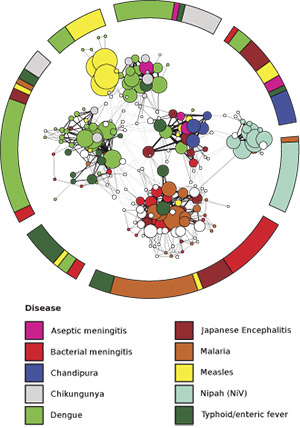
The network of diagnosed outbreaks of diseases with the potential to cause encephalitis (colored) and outbreaks of encephalitis where the cause was removed (white). The inner network describes the strength and relationship of individual outbreaks to each other. The outer ring gives the composition of the 7 communities of disease that were found by the detection algorithm. Each circle represents one outbreak report. Lines connecting two nodes indicate shared traits between two reports.

Learn more.

noble gold