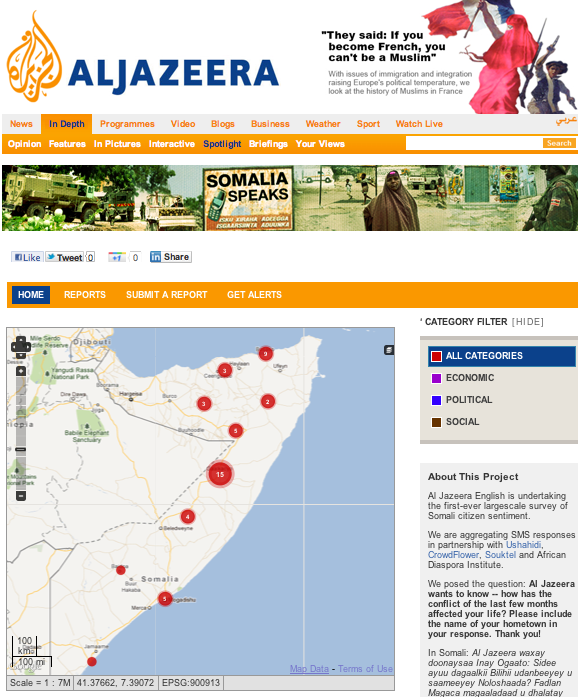
Somalia has been steadily slipping from global media attention over the past few months. The large scale crisis is no longer making headline news, which means that advocacy and lobbying groups are finding it increasingly difficult to place pressure on policymakers and humanitarian organizations to scale their intervention in the Horn of Africa. I recently discussed this issue with Al-jazeera’s Social Media Team whilst in Doha and pitched a project to them which has just gone live this hour.
The joint project combines the efforts of multiple partners including Al-Jazeera, Ushahidi, Souktel, Crowdflower, the African Diaspora Institute and the wider Somali Diaspora. The basis of my pitch to Al-jazeera was to let ordinary Somalis speak for themselves by using SMS to crowdsource their opinions on the unfolding crisis.
. . . . . . .
I am often reminded of what my friend Anand Giridharadasof the New York Times wrote last year vis-a-vis Ushahidi. To paraphrase:
They used to say that history is written by the victors. But today, before the victors win, if they win, there is a chance to scream out with a text message, a text message that will not vanish, a text message that will remain immortalized on a map for the world to bear witness. What would we know about what passed between Turks and Armenians, Germans and Jews, Hutus and Tutsis, if every one of them had had the chance, before the darkness, to declare for all time:
Just the other day, a colleague asked me whether I could suggest some examples of organizations that have been successful with “innovation initiatives” in a commercial setting? He said that he had a CEO who wanted to launch an “innovation initiative” that would provide a laboratory for experiments in-house, so that his firm could become known as an idea factory in their sector.
I replied that I didn’t know of any “innovation initiative” that was ultimately successful on a sustained basis. That’s because if an organization is looking at innovation as “an initiative”, and it introduces that initiative into a culture that doesn’t support innovation, then the culture will sooner or later crush the initiative—usually sooner. So you can have temporary “successes” as “initiatives” with a lot of flag waving and hoopla ceremonies and celebrations of victories, but they don’t last.
If the firm wants innovation, which they should, since innovation is an essential ingredient for survival in today’s marketplace, then they need to ask themselves why are they thinking of an innovation as “initiative”. They need to look more deeply at how the organization is being run and think through what would be needed to make innovation a central part of the organization’s culture.
The three phases of the 20th Century organization
In the 20th Century, organizations tended to go through three phases, as sketched by f Robert X. Cringely’s Accidental Empires, by analogy with a military operation.
In the first phase, you had startups run by commandos. They were unpredictable and uncontrollable yet remarkably productive. They worked hard and fast. They succeeded with surprise and teamwork, establishing a beachhead before the enemy is even aware they exist. They pushed the state of the art, ideally providing creative solutions to customer needs and making existing products irrelevant. However most startups fail because they don’t meet customer needs. Sometimes the product was close to meeting customer needs but it wasn’t ideal and had bugs or even major failings that need more work. However commandos were useless of this type of work: they got bored.
In the second phase, the infantry moved in, i.e. the obedient workers who followed orders and methodically grew a company from its IPO to market dominance. They exploited the opportunity created by the commandos. They took the prototype, tested it, refined it, made it manufacturable, wrote the manuals, marketed it and ideally produced a profit. This work was governed by rules and procedures—all the stuff that commandos hated. While the commandos make success possible, the infantry makes success happen.
In the third phase, the firm was run by police: the bureaucrats and middle managers who defend the entrenched position of an established market leader. The third phase was an occupying force intent on holding territory. A middle manager’s job was to say no to ideas that don’t originate from on high, preferably near the CEO, or which don’t improve the bottom line for the quarter.
In the 20th Century, “management” was seen as the set of bureaucratic practices designed to run the second and third phases. Management comprised hierarchy, command-and-control, tightly planned work, competition through economies of scale and cost reduction, impersonal top-down communications, all focused on making money for the shareholders.
These management practices were seen as timeless truths of the universe, so obvious that there was scarcely any need to articulate them, let alone re-examine them. They are still pervasive in large organizations, business schools and management textbooks. John Sculley tried to run Apple [AAPL] as a third-wave organization. Most big old mastodons today like GE [GE] or Walmart [WMT] are still third-wave organizations.
This way of managing systematically kills innovative activities in organizations. The phenomenon can be observed in:
The Internet isn’t really a technology. It’s a belief system, a philosophy about the effectiveness of decentralized, bottom-up innovation. And it’s a philosophy that has begun to change how we think about creativity itself.
. . . . . .
The ethos of the Internet is that everyone should have the freedom to connect, to innovate, to program, without asking permission. No one can know the whole of the network, and by design it cannot be centrally controlled. This network was intended to be decentralized, its assets widely distributed. Today most innovation springs from small groups at its “edges.”
. . . . . . .
I don’t think education is about centralized instruction anymore; rather, it is the process establishing oneself as a node in a broad network of distributed creativity.
I chose to focus my dissertation research on the impact of information and communication technologies (ICTs) during elections in repressive states. Why? Because the contentious relationship between state and society during elections is accentuated and the stakes are generally higher than periods in-between elections. To be sure, elections provide momentary opportunities for democratic change. Moreover, the impact of ICTs on competitive events such as contentious elections may be more observable than the impact on state-society relations during the regular calendar year. In other words, the use of ICTs during election periods may shed some light on whether said technologies empower coercive regimes at the expense of civil society or vice versa.
Full Blog with Three Major Graphics Below the Line
So, how does expertise affect these information access strategies? A study of professional athletes’ demonstrated the idea that experts use a “just-in-time” strategy, where information that is required to do well in their respective sports is accessed at the time it necessary. Such strategies also appear to be employed in everyday tasks such as making tea or a peanut butter sandwich (Hayhoe & Ballard, 2005). It seems that experts merely use the same strategies in their specific tasks to perform better. Through the acquisition of a “just-in-time” strategy experts are able to look at what they needed to, when they needed to, faster than novices (Land & McLeod, 2000).
It is no secret that big companies still uses email as their main collaborative tool. And this habit won’t change any time soon. Changing the office culture and the habits of maybe hundreds of employees may take years. But technology has moved on, and so should we. One step at a time. There are smarter and more time efficient technologies available today such as the enterprise wiki and we should all embrace it.
I strongly recommend watching the whole program, it’s an excellent discussion: “How does the Occupy Wall Street movement move from “the outrage phase” to the “hope phase,” and imagine a new economic model?




 ..
..  ..
..  .. even