2013 was the year that big data became big business, says Alex Handy in his San Diego Times article, “Big Data 2013: Another Big Year.” Handy explains that big data made the transformation when enterprises deployed Hadoop in production environments and NoSQL people spread data around on servers. These two combined situations resulted in disseminating massive amounts of data and employing enterprise systems to manage the information.
The future of search may not just be about Google and Bing. In the future of search, believe it or not, there are going to be a lot of people like you and me who will be providing much more helpful information guidance to specific requests than Google could ever do. I know this sounds probably unrealistic to you, but I think there are now many good indications that this likely going to happen much sooner than you expect. One of the key reasons why, human beings will start to reclaim this highly valuable search territory, is the fact that in the last few years we have slowly but deeply surrendered our ability to evaluate, decide and select what is “real” to Google's own algorithms, in ways that can only be detrimental to us.
We enjoy telling you about free resources, and here’s another one: Mining of Massive Datasets from Cambridge University Press. You can download the book without charge at the above link, or you can purchase a discounted hardcopy here, if you prefer. The book was developed by Anand Rajaraman and Jeff Ullman for their Stanford course unsurprisingly titled “Web Mining.” The material focuses on working with very large data sets and emphasizes an algorithmic approach.
Hmm, does this defy the easy-big-data narrative? VentureBeat warns us, “The Data Is Not Enough: Creative Data Scientists Make the Difference.” Not only is there a shortage of data scientists in general, we are now told firms would do well to find data scientists graced with creativity. How pesky. Writer Jordan Novet refers to a recent panel given at VentureBeat’s 2013 DataBeat/Data Science Summit headed by LinkedIn‘s former lead data scientist, Peter Skomoroch. The article relates:
“Skomoroch envisions a world not too far in the future where balance sheets will track companies’ data assets. But he and other panelists don’t just want more data to analyze. They discussed the importance of creativity as a key trait to look for in people who work with the data. That means relying on proven algorithms might not always cut it.”
Novet shares with us the perspectives of a few panel members. For example, former Kaggle president Jeremy Howard, apparently the creative type himself, described his process:
“Howard likes to just dive into data and start getting hunches about it, without knowing about the industry the data comes from and other context that others would find valuable. ‘That way, there’s no blinkers,’ he said. It might come across as a contrarian view, but Howard thinks his approach is one reason he did well in Kaggle competitions.”
Other panelists quoted in the article include Jawbone‘s VP of data, Monica Rogati and Pete Warden, CEO of Jetpac. See the story for their thoughts.
By 2020, the quantity of stored data could be 50 times greater than it was in 2010. Many pundits regard this massive explosion of data as the new oil, even a new asset class.
. . . . . . .
Tapping the potential of data analytics requires deep pools of advanced technical expertise. To be sure, workers skilled in data management and advanced analytics are in short supply, as are members of an emerging class of “translators” – those whose talents bridge IT and data, analytics, and business decision-making.
. . . . . . .
Few leaders have ever developed management muscle in completely new fields while assembling teams combining previously unknown types of talent. The strategic options confront equally fresh terrain, perhaps similar to when mass media opened a new era of marketing, or globalization required radical reshaping of organizational footprints.
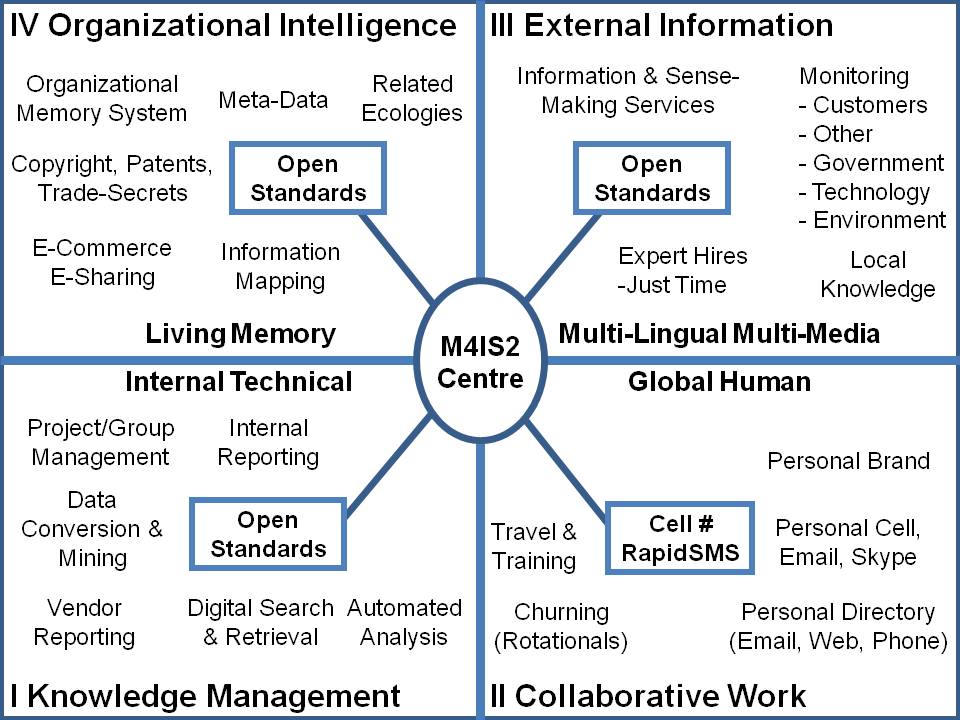
Phi Beta Iota: A very fine overview. Missing from the translators line-up are professional intelligence officers, collection managers, and strategists. Big data is found in the first two quadrants — absent the second two, it is not helpful.
A new book heralds the promise that big data will reveal more and more about how we live our lives and what we think, but is it really that useful?
EXTRACTS:
It’s easy to exaggerate the importance of what such a tool could discover. Sometimes it seems the only thing larger than big data is the hype that surrounds it. Within the first 30 pages of Uncharted: Big Data as a Lens on Human Culture, Erez Aiden and Jean-Baptiste Michel manage to compare themselves to Galileo and Darwin and suggest that they, too, are revolutionizing the world. The authors were instrumental in creating the Google Ngram viewer, which allows researchers or anyone else so inclined to explore the changing frequencies of words across time. Likening their creation to a cultural telescope, they proceed to share some of their ostensibly dazzling findings.
. . . . . . .
Ultimately, however, Aiden and Michel’s enthusiasm seems best explained by an Ngram that plots the relative frequency of the words “God” and “data.” Data eclipsed God in 1973, and its continuing ascendance suggests a culture that treats it as a surrogate divinity.
All is not well in the land of US spooks despite them having access to all the data on citizens that they can eat.
William Binney, creator of some of the computer code used by the National Security Agency to snoop on Internet traffic around the world, has warned that the agency knows too much.
According to the Wall Street Journal, the NSA can't understand the data it has because it has too much to do anything useful with it.
Binny said that the NSA's addiction to data had made it dysfunctional and the agency is drowning in useless data.
He described an agency where analysts are swamped with so much information that they can't do their jobs effectively, and the enormous stockpile is an irresistible temptation for misuse.
His warning mirrors concerns shown in the Snowden documents. An internal briefing document in 2012 about foreign mobile phone location tracking by the agency said the efforts were “outpacing our ability to ingest, process and store” data.
In March, some NSA analysts asked for permission to collect less data through a program called Muscular because the “relatively small intelligence value it contains does not justify the sheer volume of collection”.