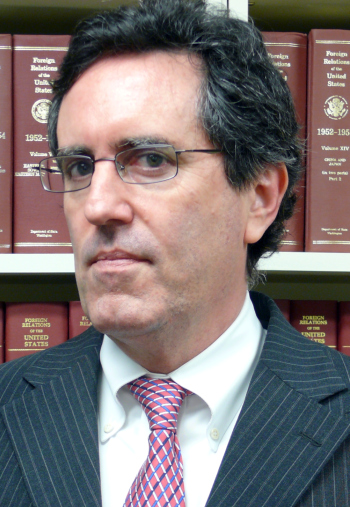
US Naval War College Professor Joshua Rovner discusses the misuse of intelligence by the US Government particularly during the Iraq and Vietnam Wars. Produced by Segal, K.
Phi Beta Iota: A useful benchmark on where the edge of conventional wisdom is within the US government. Goes in the wrong direction — more secrecy. Wants to remove intelligence from the public debate. Does not understand the reality that secret intelligence provides, at best, 4% of what major policymakers need, and nothing at all for everyone else.
FORT LAUDERDALE, Fla. — Data scientists are the most in demand job for the military, according to Reggie Brothers, the deputy assistant secretary of defense for Research.
The military has a problem with “big data” — the problem being that it collects too much of it. The infatuation with unmanned vehicles and the sensors mounted onto them has spurred a wave of data collected on the battlefield.
Using that data has caused military leaders headaches. Brothers said here at the Association of the U.S. Army’s Winter Symposium on Wednesday that the Army and the other services have placed their focus on PED, or processing, exploitation, and dissemination.
He used the ARGUS-IS as an example of the major advances being made in the world of intelligence sensors. The ARGUS-IS can stream up to a million terabytes of data and record 5,000 hours of high definition footage per day. It can do this with the 1.8 gigapixel camera and 368 different sensors all housed in the ARGUS-IS sensor that can fly on an MQ-9 Reaper.
Phi Beta Iota: The naive and the unscrupulous emphasis external threats and internal vulnerabilities while glossing over the FACT that this threat was clearly articulated by Winn Schwartau, among others, in 1990, and clearly articulated, in a letter delivered in 1994 to Marty Harris at the National Information Infratructure (NII) reporting to Al Gore, that put together in one place the best possible starting point for securing the entire US cyber-infrastructure with a starting budget of $1 billion a year.
CamOver: Counter Attack Against the Global Surveillance State
“It started in Berlin: Anarchists, donning black bloc attire, hit the streets at night in pairs, small groups or alone to smash and dismantle the CCTV surveillance cameras adorning the city streets. They posted videos and photos of their exploits online and called the guerrilla project Camover. The German collective gave a playful interview to Vice U.K. in which they explained that they are “a diverse group of people: Shoplifters eluding capitalism who don’t want to be monitored, passengers who don’t want to followed step by step and anarchists fighting everything that wants to control us.” Vice noted that the Berlin-based anarchists then laid down the gauntlet: Camover have also recently announced a competition encouraging others to get involved. All you have to do to enter is think of a name that begins with the words “Brigade…” or “Command…” and that ends with the name of a historical personality, recruit a mob and smash up cameras. Then you send pictures and video evidence to their website, and they declare the winning footage. The anti-surveillance project quickly spread throughout Germany, to Finland, Greece and hit the U.S. West Coast this month. A group identifying itself as “the Barefoot Bandit Brigade” released a statement claiming to have “removed and destroyed 17 security cameras throughout the Puget Sound region,” with ostensible photo evidence published alongside. “This act is concrete sabotage against the system of surveillance and control,” wrote the group’s statement, adding that the Camover contribution was also intended in solidarity with anarchists in the Pacific Northwest currently in federal custody without charges for refusing to cooperate with a federal grand jury.”
Dr. Edna Reid, intelligence analyst (IA) in the federal government, and Aileen Marshall will present an interactive session about emerging roles for librarians/information professionals as intelligence analysts (IAs), open source specialists, and cyber intelligence analysts. The workshop will involve dissecting job descriptions for IAs, comparing competencies of librarians and IAs, and exploring training opportunities such as the open source specialist certificate. Reforms in the intelligence community (IC) and enhanced recognition of the value of open source/unclassified information (OSINT) can provide new opportunities for you!
Objectives:
• Discover how librarians can make the transition to IAs in the intelligence community (IC).
• Analyze IA job announcements, outline differences between LIS and an IA resumes, and discuss analytical tradecraft associated with IAs. Tradecraft is a skill acquired through experience in a trade.
• Highlight opportunities for librarians/information professionals and the SLA.
Marshall McLuhan coined the phrase “the medium is the message” to draw attention to the heretofore underestimated importance of media. Trains can serve as a simple illustration of what he meant. It wasn't the cargo in the trains that was of prime significance to society. It was the fact of trains.
But now things have changed. Trains were the arteries of change at one time. But those arteries have grown in number and diameter. Now it's not just trains but TV, radio, internet, smart phones, and too many other examples of media to mention.
Media has become a jungle of arteries that are so thick that individuals can't negotiate them or penetrate them. We are hamstrung by media. And these media transmit useless mediocrity at best and toxic folly at worst.
Now media isn't just the message; media has become the aorta of survival. So now the idea that “the medium is the message” has become obsolete. Now the message that media transmits is all important!
So as innovative as Marshall McLuhan was as a thinker, this is something that I doubt he could understand to the degree you and I can understand it.
Of course I probably wouldn't understand it at all if not for Marshall McLuhan.
When government information is classified or otherwise withheld from release, the possibility of government accountability to the public is undermined. But when the executive branch withholds crucial information from Congress, that may pose an even more fundamental challenge to democratic governance.
In the absence of an official public account of post-9/11 U.S. counterterrorism programs, Americans (and others) must rely on unofficial accounts.
“Globalizing Torture” is a new report from the Open Society Justice Initiative, authored by Amrit Singh. It is said to provide “the most comprehensive account yet assembled of the human rights abuses associated with CIA secret detention and extraordinary rendition operations. It details for the first time what was done to the 136 known victims, and lists the 54 foreign governments that participated in these operations. It shows that responsibility for the abuses lies not only with the United States but with dozens of foreign governments that were complicit.”