Stuart Umpleby: Europeans Rocketing Past Americans in Cybernetics

Advanced Cyber/IO, IO Impotency
Stuart Umpleby
Stuart Umpleby

Americans are not inclined to create general theories.  Europeans are.

2009 CONVERGERS AND DIVERGERS: A Dimension of Cultural Difference between the United States and Europe

In 1988 the US was the leader in cybernetics.  Now we are tied for third with the Middle East, behind China and Europe.

2008 HOW RESEARCH IN CYBERNETICS IS MOVING FROM NORTH AMERICA TO EUROPE AND ASIA

However, the Chinese conception of “cybernetics” is technical, emphasizing subjects like OR.  The European conception is at the state-of-the-art.  Most Americans do not have any inkling about contemporary cybernetics while its popularity is growing in Europe as a standard business practice.  Like the earlier quality process improvement innovations of W., Edwards Deminig, whose ideas had to be shown to be revolutionary in Japan at great economic cost to the USA, before the USA would consider (very late in the game), so also with cybernetics and improvements to the crafts of intelligence (decision-support and the eradication of misinformation or information pathologies) and sustainabile business (green to gold).

Phi Beta Iota:  Cybernetics, put most simply, is about feedback loops and learning from tight transparent feedback loops.  Lies, secrecy, and all forms of misinformation corrupt the feedback loops and radically increase the true cost to society of misadventures by the few.

See Also:

Stuart Umpleby at Phi Beta Iota

Wikipedia / Cybernetics


Marcus Aurelius: Brookings 2013 Briefing Books for the President — Leans Left, Lacks Substance

02 Diplomacy, 03 Economy, 10 Security, 11 Society, Government, Ineptitude, IO Impotency, Military, Non-Governmental
Marcus Aurelius
Marcus Aurelius

There is no “out of the box” thinking here, just dabbling on the margins.

Phi Beta Iota:  We agree with Brother Marcus.  This was a very disappointing document and not at all presidential in utility.  There is no executive summary, no bullet points, no explicatory graphics, and no budgetary perspective (means to ways to ends).  The individual memorandums are too long, too bland, and not imaginative in the least.  Especially disappointing were the two pieces directly oriented on defense, the first by Peter Singer on drones, the second by Michael O'Hanlon on achieving defense budget efficiencies on the margins.  The individual authors are first rate across the board, but the editorial function and the leadership function are both absent from this work.  Singer plays it safe and calls for the establishment of protocols on drone use, avoiding the moral disengagement and extrajudicial assassination concepts that make the CIA drone program a crime against humanity; O Hanlon simply loses his excellent mind completely, and babbles about changes on the margin.  Below the line is the complete Table of Contents for the Brookings document, and relevant alternative perspectives by Robert Steele.

Continue reading “Marcus Aurelius: Brookings 2013 Briefing Books for the President — Leans Left, Lacks Substance”

Yoda: There Is No Publishing Industry [This Has HUGE Implications for Education, Intelligence & Research]

Commerce, Ineptitude, IO Impotency
Got Crowd? BE the Force!

In the tar pit, the mammoths are.

There Is No Publishing Industry

All models are wrong, some models are useful – statistician George Box

The mental model we share of this thing we call the publishing industry is no longer useful. Most of us think of the publishing industry’s product as “books”. That’s like thinking that Amazon sells two products, bits and cardboard boxes. Amazon ships stuff in cardboard boxes. It’s what’s inside the box that you are buying. Likewise, it’s the information contained in the bits that you are buying when you buy a digital product from Amazon.

Physical books were never really the publishing industry’s product. It was always the stories, ideas, and information contained in the books. Now that there are competing digital containers for almost everything that has traditionally been delivered via physical books, it is imperative that we take a hard look at the different industries which were hidden from view by our once-useful model of the publishing industry. Because these industries are moving to the digital world at vastly different rates and to very different digital containers: ebooks, apps, and the web. In my terminology, an app is a digital container that promotes user interaction with content rather than linear reading; an ebook is a self-contained reading unit mostly without external links; and the defining feature of the web is external linking. To understand the future of publishing, we have to let go of the idea of “the publishing industry” and look at its products based on the needs they fulfill.

The first [of four] industry to begin disappearing from the print world was the database packaging industry. Directories, encyclopedias, and dictionaries are well on their way to extinction in the print world. The mass-market products in this industry have moved almost entirely to the web. A few of the higher-end products have moved to specialized apps. Because this industry was always peripheral to the main business, many folks in publishing didn’t fully comprehend the implications of this change: some products that were previously only available as physical books had a natural affinity to a different form and business model.

Continue reading “Yoda: There Is No Publishing Industry [This Has HUGE Implications for Education, Intelligence & Research]”

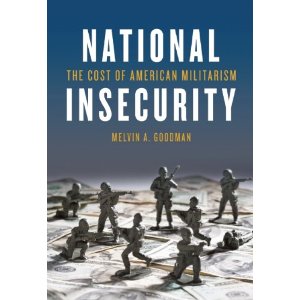
David Isenberg: Recommended Book, Mel Goodman on National Insecurity, The Cost of American Militarism

Corruption, Government, Idiocy, Ineptitude, IO Impotency
David Isenberg
David Isenberg

Recommended! Coming out 12 February 2013.

“Mel Goodman has spent the last few decades telling us what's gone wrong with American intelligence and the American military, and now, in National Insecurity, he tells us what we must do to change the way the system works, and how to fix it. Goodman is not only telling us how to save wasted billions–he is also telling us how to save ourselves.” — Seymour M. Hersh, The New Yorker

Upon leaving the White House in 1961, President Eisenhower famously warned Americans about the dangers of a “military industrial complex,” and was clearly worried about the destabilizing effects of a national economy based on outsized investments in military spending. As more and more Americans fall into poverty and the global economy spirals downward, the United States is spending more on the military than ever before. What are the consequences and what can be done?

Amazon Page
Amazon Page

Melvin A. Goodman, a twenty-four-year veteran of the CIA, brings peerless authority to his argument that US military spending is indeed making Americans poorer and less secure while undermining our political standing in the world. Drawing from his firsthand experience with war planners and intelligence strategists, Goodman offers an insider's critique of the US military economy from President's Eisenhower's farewell warning to Barack Obama's expansion of the military's power. He outlines a much needed vision for how to alter our military policy, practices, and spending in order to better position the United States globally and enhance prosperity and security at home.

Melvin A. Goodman is the Director of the National Security Project at the Center for International Policy. A former professor of international security at the National War College and an intelligence adviser to strategic disarmament talks in the 1970s, he is the author of several books, including the critically acclaimed The Failure of Intelligence.

See Also:

Goodman, Mel (2008), Failure of Intelligence: The Decline and Fall of the CIA (Rowman & Littlefield)

Steele, Robert (2000), ON INTELLIGENCE: Spies and Secrecy in an Open World (AFCEA 2000, OSS, 2001)

Worth a Look: Book Reviews on Intelligence (Most)

Stuart Umpleby: Limitations of Hand-Held Dashboards + Cyber-Brain RECAP

IO Impotency
Stuart Umpleby
Stuart Umpleby

Before Fruit Ninja, Cybernetics

By WILL WILES

New York Times, November 29, 2012

EXTRACT (Conclusion)

The No. 10 Dashboard taps into the same desire to master available information — a desire that has only grown as the amount of information in circulation has increased. Where Cybersyn needed dedicated national infrastructure and rooms full of equipment, the app runs on a hand-held device. And yet, the dashboard is actually less sophisticated.

It is not truly cybernetic because it lacks a mechanism to translate all that data into action. It can display information; it cannot consult and control. Less a driver’s dashboard, it is more a window out of which a passenger can observe the national scenery speeding past. Government might be given the illusion of hand-held, one-stop manageability, but no actual managing is going on.

The app could thus be an apt metaphor for politicians reduced to spectators by the surges and shocks of the globalized world. Mr. Cameron should remember that there’s at least one other instance of government-by-app: the team that worked on restructuring Greece’s debt used iPads too, equipped with an app purpose-built for the job.

However that turns out, we can at least say this: in terms of distractions, these apps are marginally more useful than Fruit Ninja.

Read full article.

Continue reading “Stuart Umpleby: Limitations of Hand-Held Dashboards + Cyber-Brain RECAP”

Mini-Me: Sandy Hook, Israel’s “Art Students” in Purple Van, Greenwich Safehouse, Nurse’s False Testimony — Four Competing Narratives

07 Other Atrocities, 11 Society, Corruption, Government, Idiocy, Ineptitude, IO Deeds of War, IO Impotency, Law Enforcement
Who?  Mini-Me?
Who? Mini-Me?

Huh?

Obama “Gun Address” Misses Real Terrorism Threat

by  Gordon Duff, Senior Editor

Despite attempts to blame a seemingly endless group of lunatic mass murderers for the equally endless number of devastating mass killings now plaguing the United States, our government, our “protectors” and, most damnably, our president, are failing to react to real terror attacks that are becoming an almost daily occurrence.

Ambassador Susan Rice was “sacrificed” for failing to cite the Benghazi attack as terrorism.

However, when something worse, when a dozen “somethings worse” happens, not in North Africa, but here at home, our schools, movie theatres, military bases, college campuses, the use of the term “terrorism” is forbidden.

Why?

. . . . . . . . .

The US Army has recognized a pattern of terrorist activity in several of the recent mass shootings, based on timing, type of target, control of media, lost evidence, poor investigations, a pattern that shows signs of the involvement of a military type operation against “soft targets” in the US.

Sandy Hook, we are told, is a total failure as an “false flag” terror attack, having left too many “loose threads.”  Some are listed in the video below.  In truth, there are hundreds:

Initial suspicions led investigators to extremist groups in the US, the National Socialist Movement, the US Border Patrol and the Hutarees.

However, investigations found these groups to be both almost entirely inactive or with a majority of members FBI informants.

Read full article with video and photos.

Continue reading “Mini-Me: Sandy Hook, Israel's “Art Students” in Purple Van, Greenwich Safehouse, Nurse's False Testimony — Four Competing Narratives”

Eagle: White House Petition Site a Joke — and the Future

Government, Ineptitude, IO Impotency
300 Million Talons...
300 Million Talons…

The White House Petition Site Is a Joke (and Also the Future of Democracy)

Megan Garber

The Atlantic, 16 January 2013

First of all, it should be said: Hahahahahahahaha. The White House — the seat of federal power in the United States, the infrastructure behind the leader of the free world, the place so powerful and notable that even Aaron Sorkin wrote about ithas been vanquished by a Death Star.

Well, pretty much. In September 2011, the White House launched “We the People,” an online initiative designed to bring a digital spin to citizens' right to petition the government. The site allowed citizens to start and spread petitions, promising that any entreaties that received more than 5,000 signatures would receive consideration — in the form of an “official response” — from the White House. And the site enjoyed steady growth — so much so that, in October 2011, the White House upped the number of signatures required to receive an official response from 5,000 to 25,000. In late 2012, however, the site — driven in part by petitions to allow a selection of states to secede from the Union and to, yep, construct an $850,000,000,000,000,000, Star Wars-style Death Star — saw a surge. Both in terms of the number of users it registered (2.4 million) and signatures it collected (4.9 million), but also in terms of the number of requests it generated. The last two months of 2012, apparently, saw some 73,000 new petitions.

Continue reading “Eagle: White House Petition Site a Joke — and the Future”

noble gold