Reference: National Intelligence Program (NIP)
Does not include the Military Intelligence Program (MIP) that is between $30 and $50 billion a year.
Continue reading “Reference: National Intelligence Program (NIP) – and Questions Not Asked”

The truth at any cost lowers all other costs — curated by former US spy Robert David Steele.
Reference: National Intelligence Program (NIP)
Does not include the Military Intelligence Program (MIP) that is between $30 and $50 billion a year.
Continue reading “Reference: National Intelligence Program (NIP) – and Questions Not Asked”
 Four reasons why meaningful, disruptive innovation fails
By Andrew Nusca | October 25, 2012
“Why can’t we solve big problems?” asks Jason Pontin in MIT’s Technology Review.
Technologist Paul Carr recently described the term disruption as “the faddish Silicon Valley concept which essentially boils down to, “let us do whatever we want, otherwise we’ll bully you on the Internet until you do.” (So, answer: we fail because we’re self-interested.)
“There is continual disruption in our industry,” Buzzfeed’s Jonah Peretti writes, “and you are likely to fail if you get complacent or stop evolving.” (So, answer: because we stop caring.)
The word is everywhere, but it means less with each passing minute. Is there anyone out there actually trying to, as they like to say in corporate boardrooms, move the needle?
Pontin explores the idea in his lengthy feature, citing four reasons why we fail to, as they like to say in baseball dugouts, swing for the fences. (Can you write about disruption without employing cliches? Certainly, but there are so many invented specifically to speak to this very concept.)
Those are:

With them, force is.
“Technology is not a substitute for thinking.”
Robert Steele
“Bandwidth is more expensive than pilots.”
Professor Robert Owen
Embry-Riddle Aeronautical University
The future is now: 10 startups leading the way in ‘big data’
VentureBeat, October 16, 2012
Police are mixing crime data and sociological information to anticipate incidences of crime. A small cadre of scientists in Silicon Valley is harnessing genetics data to detect early signs of disease. For business owners and harried IT executives, it’s easy feel overwhelmed with the flood of so-called big data options on the market. That is, if you buy into the trend at all.
We believe it’s time to cut through the hype and show you some cool companies that use big data to further research in the fields of healthcare, law, government, and education. To assemble our inaugural list of 10 standout companies, we spoke with investors, analysts, and experts.
We narrowed it down to some ground-breaking favorites who helped define the field. You’ll notice that the companies cover a lot of ground — we anointed a leader in every category, such as data science, business intelligence, data visualization and analytics. We also threw a few impressive newcomers into the mix as well.

Huh?
How a single DMCA notice took down 1.45 million education blogs
Web hosting firm ServerBeach recently received a Digital Millennium Copyright Act (DMCA) violation notice from Pearson, the well-known educational publishing company. The notice pertained to Edublogs, which hosts 1.45 million education-related blogs with ServerBeach, and it focused on a single Edublogs page from 2007 that contained a questionnaire copyrighted by Pearson. ServerBeach informed Edublogs about the alleged violation, and Edublogs says it quickly took down the allegedly infringing content.
Instead of calling the matter settled, though, ServerBeach took Edublogs' servers offline last Wednesday, temporarily shutting off all 1.45 million blogs, according to Edublogs. ServerBeach confirms taking all of the Edublogs offline, telling Ars that the outage lasted for “roughly 60 minutes before we brought them back online and confirmed their compliance with the DMCA takedown request.”
As you might expect, ServerBeach and Edublogs have slightly different accounts of how it all happened.
Phi Beta Iota: The criminal insanity of how ServerBeach handled this matter should be broadcast widely. We certainly would not trust any company so cavalier, so utterly oblivious to the unwarranted cost of their unbirdled actions. This specific instance should be the poster child for why an Autonomous Internet is needed with multiple backups such that no one unprincipled moron can wreak such havoc. ServerBeach – posterchild for how not to do business.
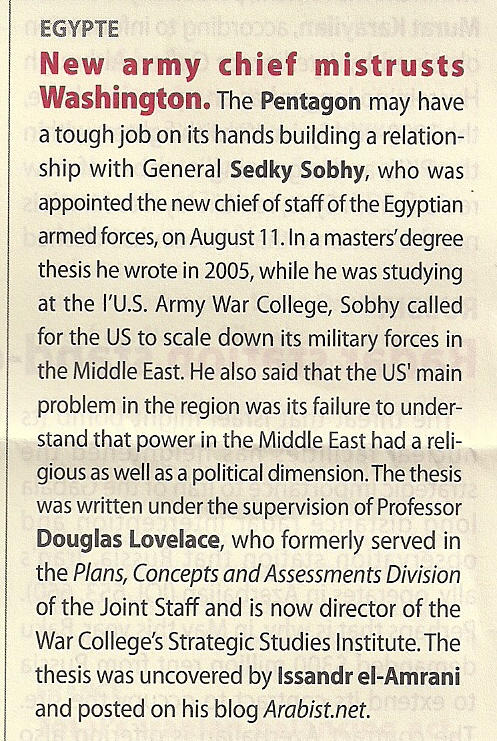
Sedky Sobhy's thesis makes the rounds
Glad to see that a bunch of news outlets picked up the thesis by Chief of Staff of the Egyptian Armed Forces Sedky Sobhy I highlighted a few days ago. Some wanted to interview me but unfortunately I was not available, but here's a couple of links.
Research paper offers insight into Egypt's new armed forces chief (McClatchy)
Professor Douglas Lovelace, the director of the Army War College's Strategic Studies Institute and Sobhy's adviser, remembered him as a “bold thinker,” charming and a “very impressive officer” who often offered thoughts counter to the conventional thinking at the time.
“I do recall he was provocative and an original thinker,” Lovelace said. “It was not surprising that he would either fail completely or rise to the top.”
Egypt general's paper offers insight into thinking (Reuters)

Julian ASSANGE probably is a bona fide “enemy of the State;” not sure that is actually an official US Government term. However, since the first hoopla about Bradley MANNING and Wiki-leaks came out a couple of years ago, I'm not sure the troops have been adequately warned that reading Wiki-leaks sites is proscribed. At that time, the orders were explicit. I'm not sure they were legal, particularly as they would apply to using privately owned equipment and internet accounts. Government is probably OK w/r/t USG equipment and accounts. In that regard, I suspect that US Cyber Command has every Wikileaks site it can find physically blocked from access from DoD computers or accounts.)
Melbourne Age (Australia), September 27, 2012, Pg. 1
US Calls Assange Enemy Of State
Extradition could end in military detention
By Philip Dorling
The US military has designated Julian Assange and WikiLeaks as enemies of the United States — the same legal category as the al-Qaeda terrorist network and the Taliban insurgency.
Declassified US Air Force counter-intelligence documents, released under US freedom-of-information laws, reveal that military personnel who contact WikiLeaks or WikiLeaks supporters may be at risk of being charged with “communicating with the enemy”, a military crime that carries a maximum sentence of death.


 Issandr El Amrani