Phi Beta Iota: Delusional fluff. The good news is that most of the stuff that is vulnerable to single point of failure interruptions is not all that important if you have a proper strategy that is based on reality and true cost information. What they do not get is the urgent need to create jobs that are directly related to resilience and sustainability from the local level up.
Economic imbalances and social inequality risk reversing the gains of globalization, warns the World Economic Forum in its report Global Risks 2012. These are the findings of a survey of 469 experts and industry leaders who worry that the world’s institutions are ill-equipped to cope with today’s interconnected, rapidly evolving risks. The findings of the survey fed into an analysis of three major risk cases: Seeds of Dystopia; Unsafe Safeguards and the Dark Side of Connectivity. Report also analyses the top 10 risks in five categories – economic, environmental, geopolitical, societal and technological.
Phi Beta Iota: The report fails to address the absence of both intelligence and integrity among all “institutions” be they public or private. This is the entire point of the global Occupy movement. This is also the entire point of this website, which predates Occupy by some time.
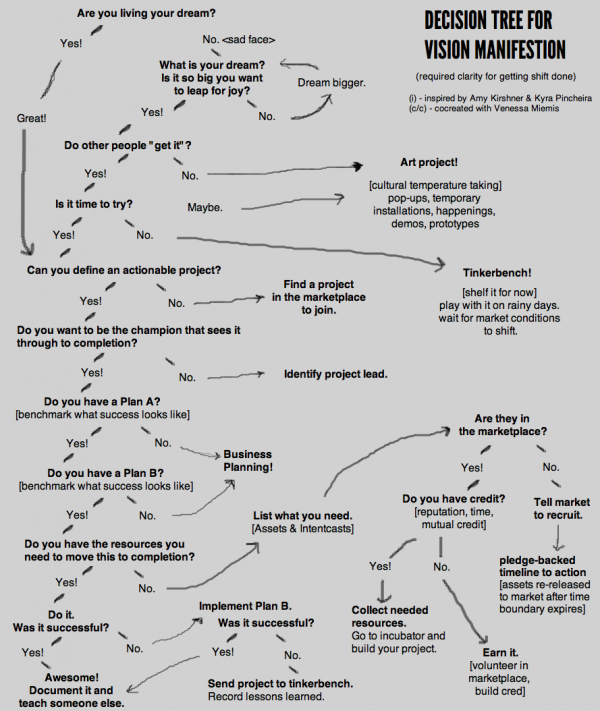
I just got back from a great trip to Burlington, VT, where I touched base with Amy Kirschner of the Vermont Sustainable Exchange. She and cocreator Kyra Pinchiera have been working on creating an inquiry process to assist people in making ideas happen.
Many of us have grand visions of the future, but to be able to tranform those into a “minimum viable product” – something tangible and actionable – can be a bit of an art.
She showed me her sketches for taking idea to action, and i made them into a little graphic. Enjoy!
Phi Beta Iota: Where this disappoints is in turning to art in the early stage when the marketplace does not “get it.” Some kind of mass educational shock appears called for–Shock Education. Revolutions start with violent shocks–no one has achieved a non-violent shock that leads to a non-violent revolution Of, By, and For We the People, that we know of.
FBI wants an app to detect global and domestic threats
ThinkDigit, 27 January 2012
The FBI is in talks with developers to create an app that will notify them of suspicious behavior, combining information from Facebook, Twitter and Google Maps. The FBI has been monitoring user content on a lot of these sites for a while, and have lucked out in the past, catching many criminals who’ve unthinkingly revealed incriminating information.
“Social media has become a primary source of intelligence because it has become the premier first response to key events and the primal alert to possible developing situations.”
The app will work as an early-warning system, allowing the FBI be alerted of any threats or crimes, with location information displayed on maps. The FBI's Strategic Information and Operations Center (SOIC), had put out a market research request for a “Social Media Application,” last week, specifying the features required:
Collect open source information from across the web on domestic and global terror data
Automated search and scrape capability of social networks
Allow for users to create specific keyword searches.
Display levels of threats on maps, with colour coding, etc.
Google Maps 3D and Yahoo Maps the “preferred” mapping options.
Plot a wide range of domestic and global terror data.
Translate tweets into English
The FBI said the “Information posted to social media websites is publicly accessible and voluntarily generated. Thus the opportunity not to provide information exists prior to the informational post by the user.” Further assuaging privacy concerns, the bureau added that policy was in place to edit out any content that was not relevant of specific categories being researched for investigations. Sites it intends to monitor include YouTube, Flickr, Twitter, Facebook and Itstrending.com.
Top Secret America: The Rise of the New American Security State
by Dana Priest and William M. Arkin
Little, Brown, 296 pp., $27.99
Intelligence and US Foreign Policy: Iraq, 9/11, and Misguided Reform
by Paul R. Pillar
Columbia University Press, 413 pp., $29.50
Counterstrike: The Untold Story of America’s Secret Campaign Against Al Qaeda
by Eric Schmitt and Thom Shanker
Times Books, 324 pp., $27.00
What is the American intelligence bureaucracy good for? The question is difficult to ask in a serious way in Washington because it risks raising the hackles of career intelligence professionals and their political sponsors at a time when spy agencies remain under pressure to combat resilient if diminished international terrorist groups and to monitor and check Iran’s nuclear program, among other challenges. Yet a serious, transparent review of the intelligence system’s strengths and limitations is overdue.
The past decade has witnessed one of the most egregious misuses of intelligence in American history—the Bush administration’s distortion of information about Saddam Hussein’s terrorist ties and unconventional weapons, in order to justify the invasion of Iraq. It has also seen a surge of paramilitary activity and covert action that has included the operation of secret prisons, the use of torture, and targeted killing. The Obama administration ended officially sanctioned torture, but it has refused to allow official inquiries into how it occurred, and the administration has increased the number of covert, unacknowledged targeted killings through the use of armed, unmanned aerial drones in Afghanistan, Pakistan, Yemen, and elsewhere.
In all, a president who might have challenged the American intelligence bureaucracy and given it a new direction has instead maintained and even expanded what he inherited. Nor has Congress reviewed the hasty organizational reforms it enacted after September 11 or reckoned in depth with the problems exposed by the Iraq disaster. The vital questions that seemed to be begged after the Bush era—about the intelligence system’s scope, effectiveness, costs, outsourcing, legal justifications, and vulnerability to politicization—have remained largely unaddressed.
. . . . . . .
After September 11, newspaper Op-Ed pages were full of recommendations for radical departures in American intelligence, changes that might place new emphasis on lean and adaptable operations. There was much talk of a long-term development of “human sources of information”; of the need for risk-taking and the bold penetration of what are known in the intelligence agencies as “denied areas,” such as Iran and North Korea. Some of that ambition has been fulfilled; it is difficult to measure how much, since so much of the detail of post–September 11 covert action and intelligence collection remains secret.
. . . . . .
What is plain, nonetheless, is that the larger story of the American intelligence system is one of continuity. The bureaucracy has defended itself from outside investigation and oversight and has followed many of the trajectories set during the Eisenhower years. The relative strengths of tactical American intelligence tradecraft today include innovative technology, vacuum cleaner–like collection of electronic data worldwide, computer algorithms that sort valuable information from noise, and the bludgeoning effects on adversaries of huge if wasteful spending. These methods look very similar to those of the anti-Soviet intelligence system. The bureaucracy’s weaknesses—inefficiency, ignorance of local cultures, revolving doors, self-perpetuation, vulnerability to political pressure, and an overall lack of accountability—are deeply familiar, too.
Phi Beta Iota: The New York Review of Books is retarded. Search for the article to read the full piece without their demand for registration. We note with interest that most of these themes were clearly addressed by Robert Steele in ON INTELLIGENCE: Spies and Secrecy in an Open World (AFCEA, 2000), but “blacked out” by the sycophantic media including Steve Coll and David Ignatius. It is a rare day when a mainstream media person gets this real–Mr. Coll now administers the New America Foundation, a front for the Obama Administration that receives taxpayer funding it has not earned. This sudden “conversion” by Mr. Coll may be a preamble to a very large but still insufficient and ineffective cut of secret intelligence just prior to the election. Neither Mr. Coll nor the Obama Administration are interested in intelligence with integrity–only profiteering from the commonwealth while flim-flaming the public with theatrics.
At no time has the U.S. based its foreign policies on facts — as opposed to its conceptions reliant on sheer wishes, interests, or pretensions, (its ambitions are often a mixture of all of these). Nor has it had fears that are warranted by reality. It has needs, whether economic or geopolitical. It has, however, often had the correct intelligence and the facts before it to warrant entirely different policies on its part. At the same time as it gets into tenuous military situations, situations it is often destined to lose and pay a great deal for while in the process of doing so, it employs people to produce rational analyses—which it then ignores. Why?
Phi Beta Iota: This is one of the longest, most cogent pieces we have seen on the internal and external contradictions inherent in the CIA archipelago of contrasting functions, values, and marginal outputs. It is totally consistent with the many books reviewed here on intelligence.