Stephen E. Arnold: Russia (BRICS?) Firewalling the Internet

IO Deeds of War, IO Impotency
Stephen E. Arnold
Stephen E. Arnold

Russian Content: Tough to Search If Russia Is Not on the Internet

Forget running queries on Yandex.ru if Russia disconnects from the Internet. Sure, there may be workarounds, but these might invite some additional scrutiny. Why am I suggesting that some Russian content becomes unsearchable. Well, I believed the story “Russia to Be Disconnected from the Internet.” Isn’t Pravda a go to source for accurate, objective information?

The story asserts:

This is not a question of disconnecting Russia from the international network, yet, Russian operators will need to set up their equipment in a way to be able to disconnect the Russian Internet from the global network quickly in case of emergency, the newspaper wrote. As for the state of emergency, it goes about both military actions and large-scale riots in the country. In addition, the government reportedly discusses a possibility to empower the state with the function to administer domains. Currently this is a function of a public organization – the Coordination Center for the National Domain of the Internet. The purpose of the possible measure is not to isolate Russia from the outside world, but to protect the country, should the USA, for example, decide to disconnect Russia from the system of IP-addresses. It will be possible to avoid this threat, if Russia has a local regulator to distribute IP-addresses inside the country, rather than the ICANN, controlled by the United States government. This requires operators to set up “mirrors” that will be able to receive user requests and forward them to specific domain names.

Interesting. Who is being kept in the information closet? I suppose it depends on one’s point of view. Need an update for Sphinx Search? There will be a solution because some folks will plan ahead.

Stephen E Arnold, September 20, 2014

See Also:

BRICS Internet @ Phi Beta Iota

Electronic Frontier Foundation: Human Rights Require a Secure Internet

Advanced Cyber/IO, Civil Society

effHuman Rights Require a Secure Internet

Between 15th-19th of September, in the week leading up the first year anniversary of the 13 Necessary and Proportionate Principles, EFF and the coalition behind the Principles will be conducting a Week of Action explaining some of the key guiding principles for surveillance law reform. Every day, we'll take on a different part of the principles, exploring what’s at stake and what we need to do to bring intelligence agencies and the police back under the rule of law. You can read the complete set of posts online. The Principles were first launched at the 24th Session of the United Nations Human Rights Council in Geneva on 20 September 2013. Let's send a message to Member States at the United Nations and wherever else folks are tackling surveillance law reform: surveillance law can no longer ignore our human rights. Follow our discussion on twitter with the hashtag: #privacyisaright

Human Rights Require a Secure Internet

The ease by which mass surveillance can be conducted is not a feature of digital networks; it's a bug in our current infrastructure caused by a lack of pervasive encryption. It's a bug we have to fix. Having the data of our lives sent across the world in such a way that distant strangers can (inexpensively and undetectably) collect, inspect and interfere with it, undermines the trust any of us can have in any of our communications. It breaks our faith not only with the organizations that carry that data for us, but the trust we have with each other. On a spied-upon network, we hold back from speaking, reading, trading and organizing together. The more we learn about the level of surveillance institutions like the NSA impose on the Net, the more we lose trust in the technology, protocols, institutions and opportunities of the Net.

Read full article.

2014 The National Intelligence Strategy of the USA — 3 Strikes and Out

Corruption, Director of National Intelligence et al (IC), Government, Ineptitude, IO Impotency
Click on Image to Enlarge

(U) 2014 US National Intelligence Strategy

STRIKE ONE: Refuses counterintelligence on domestic enemies.

STRIKE TWO: Refuses Whole of Government.

STRIKE THREE: Refuses Acquisition.

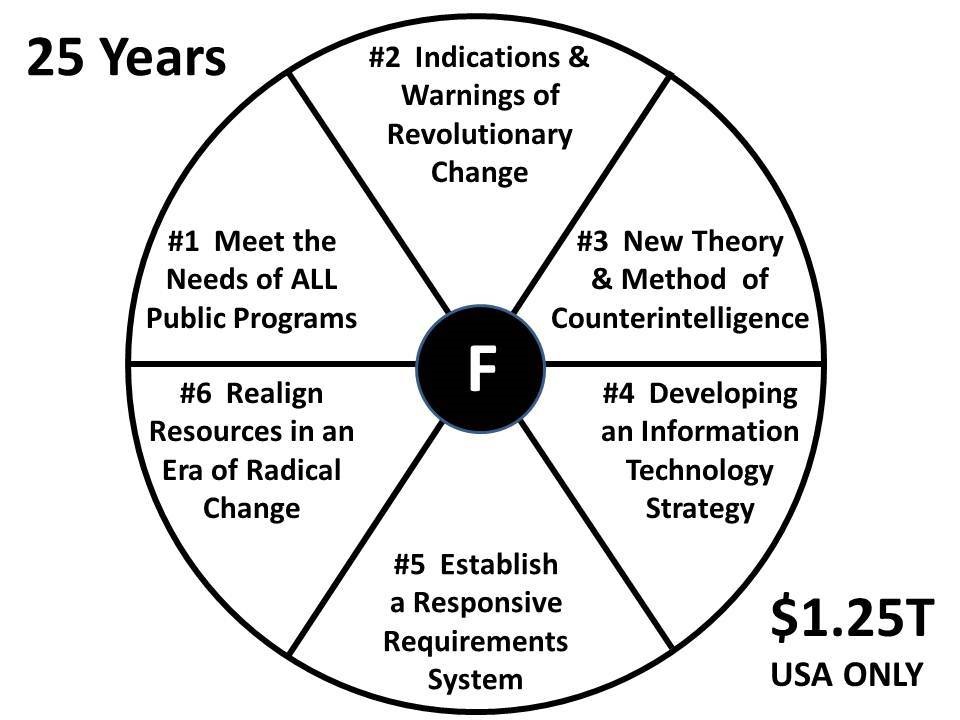
The six sucking chest wounds identified in 1990 continue. HUMINT/CI are dead in the water, followed by OSINT and mature holistic analytics integrating true cost economics. We continue to process 1% of what we collect by technical means, while being so far removed from human-centric ground truth about everything as to cause one to wonder, just who is the US IC supposed to be helping?

Keep the money moving, rah rah rah.

Click on Image to Enlarge

See Especially:

1989 Al Gray (US) on Global Intelligence Challenges

1990 Intelligence in the 1990′s – Six Challenges

See Also:

1989+ Intelligence Reform

1976+ Intelligence Models 2.1

1957+ Decision Support Story

Books By and With Robert Steele (includes Amazon links and free online links)

Worth a Look: Book Reviews on Intelligence (Most)


Stephen E. Arnold: Google as Architect of Cities?

IO Impotency
Stephen E. Arnold
Stephen E. Arnold

Google and Its Possible Really, Really Big Ambitions

I read “Looking Past the Search Results: Google 2.0 Will Build Airports and Cities Says Report.” The “report” appears to be the work of an outfit doing business as “The Information.” The founder of The Information is Jessica E. Lessin. She was a Wall Street Journal reporter. She morphed into a “reportrepreneur.” (See About the Information for more about the company.)

The “report” costs money. The Independent’s summary of the main idea reveals:

Larry Page has set up a ‘company within a company’ dubbed ‘Google 2.0’ that will look at the tech giant’s long-term future – presumably for when advertising revenue from search traffic (inevitably) dries up.

The “report” suggests that Google may build airports and cities. I assume these will complement the Loon, Glass, Death, and other moon shot projects.

Continue reading “Stephen E. Arnold: Google as Architect of Cities?”

Stephen E. Arnold: Palantir Funding + PBI Comment – Not Matched by Vision, Engineering, or Utility

Commerce, Ineptitude, IO Impotency
Stephen E. Arnold
Stephen E. Arnold

Palantir and Its Funding

I read “Palantir May Have Raised More Than We Thought, Perhaps $165 million.” The article presented a revisionist view of how much money is in the Palantir piggy bank. Here’s the number I circled: $165 million since February 2014. I also marked this paragraph:

The Palo Alto company led by CEO Alex Karp disclosed in a Securities and Exchange Commission filing on Friday that it had raised more than $440 million in a funding round that began last November.

The numbers add up. The write up asserted:

The company co-founded by Karp, Peter Thiel, Joe Lonsdale and others in 2004 has raised a total of about $1 billion, with some of that funding coming from In-Q-Tel, the venture arm of U.S. intelligence agencies.

This works out to a $9 billion valuation.

The question now becomes, “How long will it take Palantir to generate sufficient revenue to pay back the investors and turn a profit?” The reason I ask is that IBM is chasing this market along with a legion of other firms.

Continue reading “Stephen E. Arnold: Palantir Funding + PBI Comment – Not Matched by Vision, Engineering, or Utility”

Yoda: Big Data Potential — and Ignorance

IO Impotency
Got Crowd? BE the Force!

Baby steps…

What Big Data Can Mean for Sustainability

The first Industrial Revolution showed the world how much machines could accomplish. What GE calls the “Next Industrial Revolution” is now showing how much machines can accomplish when they communicate with each other. And just as steam — and later electricity — powered the first industrial revolution, Big Data is powering the second. Machine-to-machine communication (M2M) gave birth to the age of Big Data and advances in big data are expanding our sense of what the Internet of Things can accomplish in the coming years.

It’s too soon to know whether or not the promise of Big Data is being overstated. Google Trends shows that the number of news references for “Big Data” has increased ten-fold since 2011. Comparing that with the Gartner Hype Cycle suggests that the concept may be nearing its “Peak of Inflated Expectations” and will soon be sliding into a “Trough of Disillusionment” [see accompanying graph]. Still, if the Hype Cycle is an accurate forecast of the future, it seems reasonable to expect great things from Big Data once it reaches the “Plateau of Productivity.”

The Four V’s of Big Data

According to Wayne Balta, vice president of corporate environmental affairs and product safety at IBM, Big Data is defined by the four V’s: volume, velocity, variety and veracity.

Continue reading “Yoda: Big Data Potential — and Ignorance”

Hal Berghel: Big Data is Big Doo Doo

IO Impotency, IO Sense-Making, IO Tools
Hal Berghel
Hal Berghel

Spy the Lie‘s techniue and informal logic work together to help us disinfect our infospheres from crap, bilious bombast, media-babble, disinformation campaigns, pseudoevents, and bad information of every stripe. These days common sense itself doesn’t cut it. We need tools!

. . . . . . .

In fact, we computing professionals have unwittingly made infopollution much worse by increasing storage network capacity and bandwidth without a corresponding advance in filtering capability. We’ve turned big data into big dada.

Berghel Big Data as Big Doo Doo October 2014

Continue reading “Hal Berghel: Big Data is Big Doo Doo”

noble gold