
Patrick Meier: Using UAVs for Community Mapping & Disaster Risk Reduction — The Haiti Example

Crowd-Sourcing, Culture, Drones & UAVs, Geospatial, Governance
Patrick Meier
Patrick Meier

Using UAVs for Community Mapping and Disaster Risk Reduction in Haiti

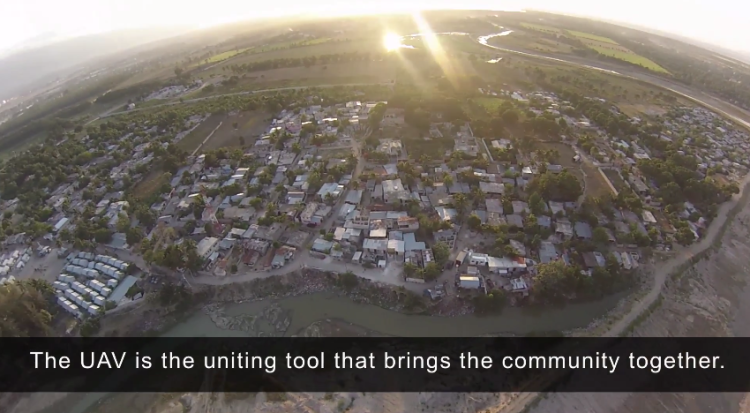
“What if, to solve our problems, we simply need to rise above them?” CartONG and France’s OpenStreetMap (OSM) community recently teamed up to support OSM Haiti’s disaster risk reduction efforts by deploying a small UAV, “which proved very useful for participatory mapping.” The video documentary below provides an excellent summary of this humanitarian UAV mission which took place just a few weeks ago.
Click on Image to Enlarge

As I noted in this earlier blog post on grassroots UAVs, the use of UAVs at the community level can be viewed as an extension of community and participatory mapping, which is why community engagement is pivotal for humanitarian UAV deployments. In many ways, a micro-UAV can actually bring a community together; can catalyze conversations & participation, which should be taken as more than simply a positive externality. Public Participatory GIS Projects (PPGIS) have long been used as a means to catalyze community conversations and even conflict resolution and mediation. So one should not overlook the positive uses of UAVs as a way to convene a community. Indeed, as CartONG and partners rightly note in the above video documentary, “The UAV is the uniting tool that brings the community together.”

Read full post with additional graphics & photos.

Stephen E. Arnold: Information Manipulation — Google Leads, All Others Guilty as Well

IO Impotency
Stephen E. Arnold
Stephen E. Arnold

Information Manipulation: Accountability Pipedream

I read an article with what I think is the original title: “What does the Facebook Experiment Teach us? Growing Anxiety About Data Manipulation.” I noted that the title presented on Techmeme was “We Need to Hold All Companies Accountable, Not Just Facebook, for How They Manipulate People.” In my view, this mismatch of titles is a great illustration of information manipulation. I doubt that the writer of the improved headline is aware of the irony.

The ubiquity of information manipulation is far broader than Facebook twirling the dials of its often breathless users. Navigate to Google and run this query:

Continue reading “Stephen E. Arnold: Information Manipulation — Google Leads, All Others Guilty as Well”

Sepp Hasslberger: Russian Li-Fi

Advanced Cyber/IO
Sepp Hasslberger
Sepp Hasslberger

A solution to the overload of microwave radiation from cell phones and WIFI?

Russian firm’s Li-Fi internet solution winning foreign clients

BeamCaster’s light module can transfer data at a speed of 1.25 gigabytes per second, which is the guaranteed speed for transferring data to each working unit.

In April 2014, the Russian company Stins Coman announced that it had developed a wireless local network called BeamCaster. This innovative solution transfers information to electronic devices with the help of light.

Continue reading “Sepp Hasslberger: Russian Li-Fi”

Stephen E. Arnold: Enterprise Social Software Dead on Arrival (DOA)

IO Impotency
Stephen E. Arnold
Stephen E. Arnold

Social Silliness: Search, Collaboration, Fear

July 5, 2014

I am not able to recall which conference featured a speaker who said, “Social search is the future of search.” At this same event, social was the solution to cost control, competitive intelligence, and silos of information. I napped through the first day’s events, delivered a keynote on the second day, and disappeared as quickly as my fat, flat feet could carry me. That was in 2005 or 2006.

Between World Cup games, I read a classic IDG “real” news story with the fetching headline “Many Employees Won’t Mingle with Enterprise Social Software.” My immediate reaction was, “Is this reporter just figuring this out?”

The write up wends its way across four pages of page view goodness. Here are the diamond like insights that I noted. But you need to read the article yourself. You may have a different view because you are unaware of the value of tracking and processing each and every social network click, mouse movement, and dwell time, among dozens and dozens of useful user activities.

Read full article.

Tom Atlee: Role of Collective Intelligence in Wise Democracy Needed for Humanity’s Survival

Advanced Cyber/IO, Collective Intelligence
Tom Atlee
Tom Atlee

TITLE: The role of collective intelligence in the wise democracy needed for humanity's survival

ABSTRACT: This article proposes that the primary function of intelligence is to sustain a dynamic system's balance between environmental control and adaptability.  A dynamic system needs to remain in tune with its changing environments so that its actions continue to be successful. It does this through impacting its environment and adapting itself to changing conditions.  Both strategies depend on awareness of environmental realities and their relevance to the success and survival of the intelligent system.

Human collective intelligence in technological, economic, and cultural realms has led to the rapid evolution of human civilization's capacity to impact its environment. Humanity's problem-solving capabilities have translated problematic circumstances into new forms of impact, a process known as progress.  However, this process has today projected extremes of actual and potential impact into unprecedented scales and realms which challenge not only our ability to respond but the very basis of our responsive capacities – the nature of our intelligence itself.

Continue reading “Tom Atlee: Role of Collective Intelligence in Wise Democracy Needed for Humanity's Survival”

Jean Lievens: Airbnb CEO on Sharing Economy – Starting with Education as a Global Traveling Experience

03 Economy, 04 Education, 11 Society, Advanced Cyber/IO, Commercial Intelligence, Cultural Intelligence

Jean LievensAirbnb does business in 34,000 cities, has a valuation of over 10 billion dollars, and in a very short time has disrupted the world of hospitality and travel. Its co-founder and CEO Brian Chesky envisions the future city as a place where sharing is front and center — where people become micro-entrepreneurs, the local mom and pops will flourish once again, where space isn't wasted, but shared, and more of almost everything is produced, except waste. But the journey from here to there won't be all smooth sailing. What are the ups and downs of the sharing economy, as businesses like Airbnb confront critiques about regulation, economic development, and fairness? What role might businesses play in creating more shareable, more livable cities? How will the sharing economy, with its de-emphasis on ownership, be a tool for addressing urban inequality?

Richard Stallman: Free Software Supporter Issue 75, June 2014

IO Newsletter Free Software
Richard Stallman
Richard Stallman

Free Software Supporter Issue 75, June 2014

TABLE OF CONTENTS

Reset the Net with our Email Self-Defense Guide
Join the FSF and allies: strengthen the Tor anti-surveillance network
US Supreme Court makes the right decision to nix Alice Corp. patent, but more work needed to end software patents for good
Recap of Friday Free Software Directory IRC meetup: June 6
“Active Management Technology”: The obscure remote control in some Intel hardware
Replicant at the 15th Libre Software Meeting in Montpellier, France this July
US Supreme Court reining in software patents
GCC 4.7.4 released
LibrePlanet featured resource: IBM Thinkpad X60
GNU Spotlight with Karl Berry: 23 new GNU releases!
GNU Toolchain Update
Richard Stallman's speaking schedule and other FSF events
Thank GNUs!
GNU copyright contributions
Take action with the FSF!

noble gold