John Danaher: Rule by Algorithm? Big Data and the Threat of Algocracy

Advanced Cyber/IO, Ethics
John Danaher
John Danaher

Rule by Algorithm? Big Data and the Threat of Algocracy

An increasing number of people are worried about the way in which our data is being mined by governments and corporations. One of these people is Evgeny Morozov. In an article that appeared in the MIT Technology Review back in October 2013, he argued that this trend poses a serious threat to democracy, one that should be resisted through political activism and “sabotage”. As it happens, I have written about similar threats to democracy myself in the past, so I was interested to see how Morozov defended his view.

Continue reading “John Danaher: Rule by Algorithm? Big Data and the Threat of Algocracy”

Stephen E. Arnold: IBM’s Flash Memory

Advanced Cyber/IO
Stephen E. Arnold
Stephen E. Arnold

Prediction for IBM January Announcement

Folks at the Register have been reading the signs and believe they know what big announcement IBM plans to make at its Infrastructure Matters virtual event on January 14th. “IBM Flashy January Announcement: Wanna Know What’s in It?” predicts the launch of data centers with all-flash memory. That would be one way to combat storage latency. What makes writer Chris Mellor so sure? Several clues led to the prediction. Continue reading “Stephen E. Arnold: IBM's Flash Memory”

Johan Galtung: Battle for the Globe — the Subsconcious Contest Between DMA & HDT

Advanced Cyber/IO, Cultural Intelligence, Peace Intelligence
Johan Galtung
Johan Galtung

Who runs the world? The Subconscious*)

Not one or a group of persons, not one or a group of countries. But they may serve as instruments for scripts engraved on the deeper recesses of their minds, not the conscious, easily retrievable ones. Scripts that are too trivial, obvious, too painful/shameful and hence repressed. Jung calls them archetypes; they often come in syndromes.

Imagine that deep down an actor–person, gender-generation-race-class, state-nation, region-civilization–is programmed for two forces in the world, one good the other evil, and sooner or later there will be a final battle for the victory of one over the other: the solution.

Continue reading “Johan Galtung: Battle for the Globe — the Subsconcious Contest Between DMA & HDT”

Robin Good: Curation Tools and Techniques for Journalists

IO Tools, Media
Robin Good
Robin Good

Paul Bradshaw, author, blogger and reference point for anyone doing online journalism, illustrates with a rich series of examples, the different types of content curation tools and techniques that can be effectively used by journalists today. The article covers basic curation principles and guidelines as well as offering a set of mini-tutorials on curating lists, playlists, image boards, maps and timelines, news magazines and more. Informative. Resourceful. Examples-rich. 9/10 Full guide: http://onlinejournalismblog.com/2013/09/30/curation-tools-tips-advice-journalism/

Journalism *is* curation: tips on curation tools and techniques

Amazon’s Jeff Bezos’ in his talk to employees at the Washington Post said: “People will buy a package … they will not pay for a story.” Previously that package was limited to what your staff produced, and wire copy. But as more content becomes digitised, it is possible to combine more content from a wider variety of sources in a range of media – and on any one of a number of platforms.

Read illustrated post with links.


Stephen E. Arnold: Free Big Data Mining Book — Mining of Massive Databases

IO Impotency
Stephen E. Arnold
Stephen E. Arnold

Free Data Mining Book

We enjoy telling you about free resources, and here’s another one: Mining of Massive Datasets from Cambridge University Press. You can download the book without charge at the above link, or you can purchase a discounted hardcopy here, if you prefer. The book was developed by Anand Rajaraman and Jeff Ullman for their Stanford course unsurprisingly titled “Web Mining.” The material focuses on working with very large data sets and emphasizes an algorithmic approach.

Continue reading “Stephen E. Arnold: Free Big Data Mining Book — Mining of Massive Databases”

Stephen E. Arnold: Human Creativity Key for Big Data Design & Exploitation

IO Impotency, IO Sense-Making
Stephen E. Arnold
Stephen E. Arnold

Creativity is Key for Data Scientists

Hmm, does this defy the easy-big-data narrative? VentureBeat warns us, “The Data Is Not Enough: Creative Data Scientists Make the Difference.” Not only is there a shortage of data scientists in general, we are now told firms would do well to find data scientists graced with creativity. How pesky.   Writer Jordan Novet refers to a recent panel given at VentureBeat’s 2013 DataBeat/Data Science Summit headed by LinkedIn‘s former lead data scientist, Peter Skomoroch.   The article relates:

“Skomoroch envisions a world not too far in the future where balance sheets will track companies’ data assets. But he and other panelists don’t just want more data to analyze. They discussed the importance of creativity as a key trait to look for in people who work with the data. That means relying on proven algorithms might not always cut it.”

Novet shares with us the perspectives of a few panel members. For example, former Kaggle president Jeremy Howard, apparently the creative type himself, described his process:

“Howard likes to just dive into data and start getting hunches about it, without knowing about the industry the data comes from and other context that others would find valuable. ‘That way, there’s no blinkers,’ he said. It might come across as a contrarian view, but Howard thinks his approach is one reason he did well in Kaggle competitions.”

Other panelists quoted in the article include Jawbone‘s VP of data, Monica Rogati and Pete Warden, CEO of Jetpac. See the story for their thoughts.

Cynthia Murrell, January 06, 2014

Sponsored by ArnoldIT.com, developer of Augmentext

See Also:

Arnold: Information Architects Offer Knowledge Management Solutions

Big Data @ Phi Beta Iota

Berto Jongman: Big Data – Lost in Translation

IO Impotency
Berto Jongman
Berto Jongman

Challenges are identified.

How will data change your boardroom?

EXTRACTS:

By 2020, the quantity of stored data could be 50 times greater than it was in 2010. Many pundits regard this massive explosion of data as the new oil, even a new asset class.

. . . . . . .

Tapping the potential of data analytics requires deep pools of advanced technical expertise. To be sure, workers skilled in data management and advanced analytics are in short supply, as are members of an emerging class of “translators” – those whose talents bridge IT and data, analytics, and business decision-making.

. . . . . . .

Few leaders have ever developed management muscle in completely new fields while assembling teams combining previously unknown types of talent. The strategic options confront equally fresh terrain, perhaps similar to when mass media opened a new era of marketing, or globalization required radical reshaping of organizational footprints.

Read full article.

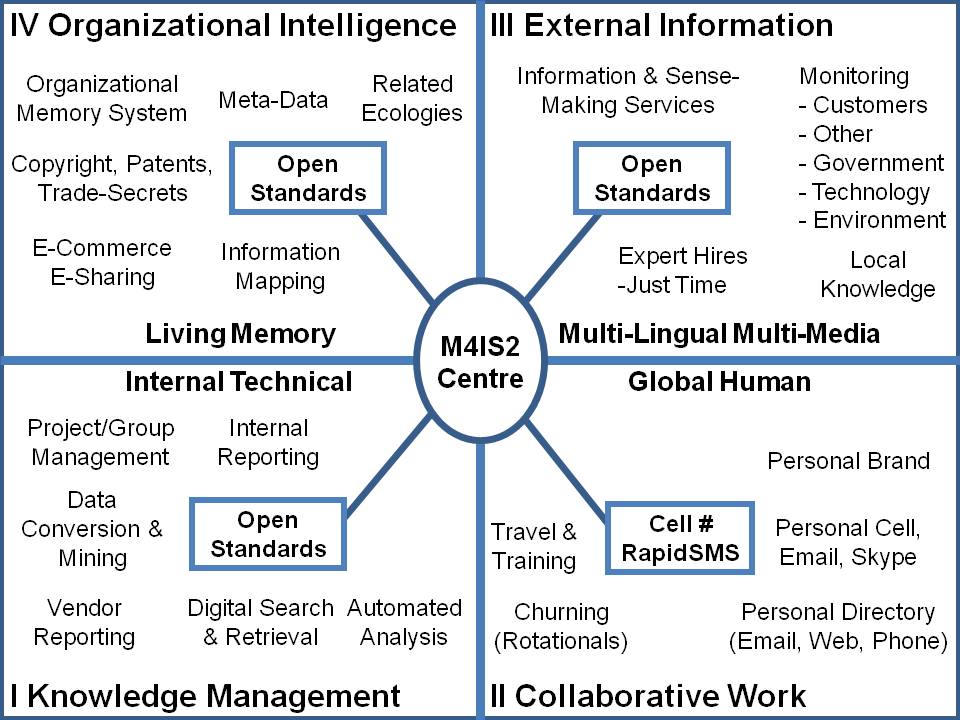
Click on Image to Enlarge

Phi Beta Iota: A very fine overview. Missing from the translators line-up are professional intelligence officers, collection managers, and strategists. Big data is found in the first two quadrants — absent the second two, it is not helpful.

See Also:

Big Data @ Phi Beta Iota

noble gold