John Robb: Disenfranchising the White Jewish Voice

Cultural Intelligence
John Robb
John Robb

“White Privilege” as the Neutron Bomb of Moral Warfare

The growing popularity of “check your privilege” and “white privilege” at Universities and in political debates is interesting.

Why is it interesting? It's not a force for progress or positive change, it's a form of moral warfare.   That means it's not a constructive remark that improves the debate, rather, it's an attack that does damage the target.  However, it doesn't damage the target directly.  Instead, the damage is done by weakening or breaking the moral bonds that allow the target to function in a social context.

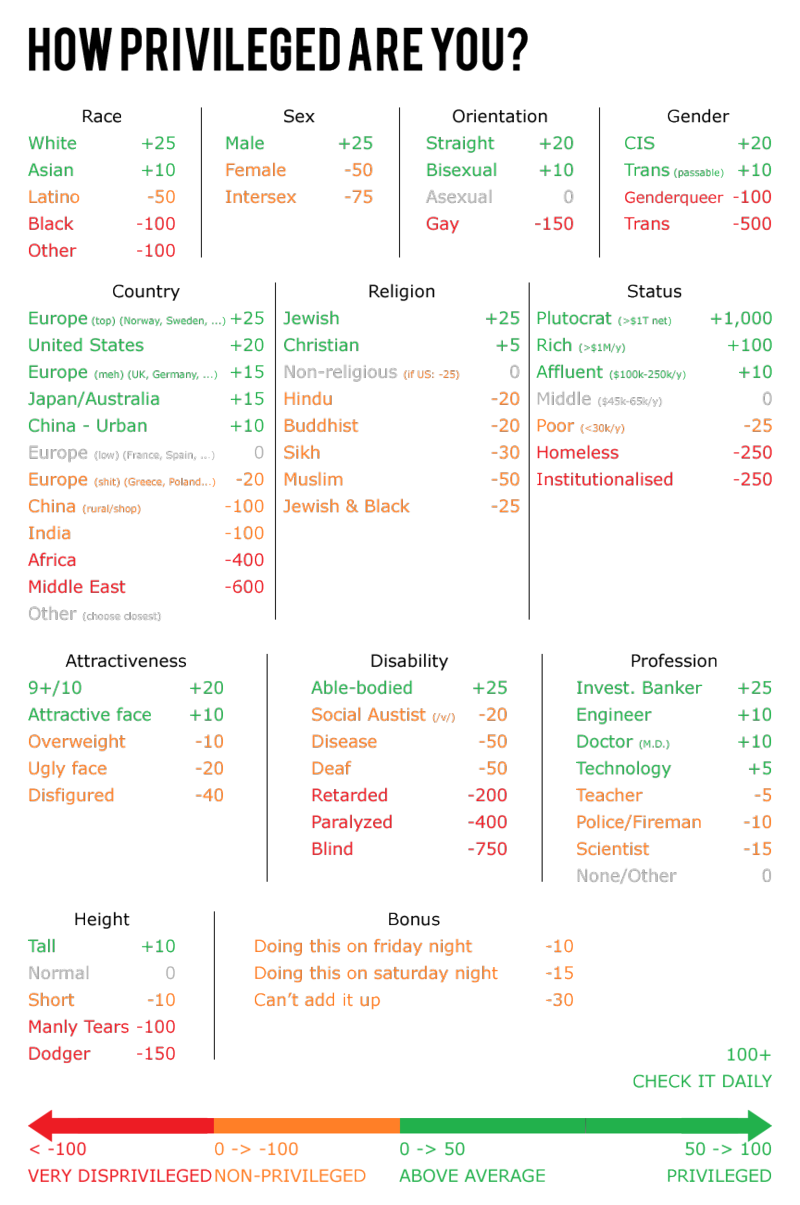
In other words, the attack disconnects the target from the moral support of others.  You can see that disconnection at work in how groups within the target group “white privilege” are fleeing from it, rather than rejecting the concept outright.  For example, I've seen “white male privilege” as a form of attack now.  I've also seen “white straight male privilege” being used.  This divisibility of the attack makes it the neutron bomb of moral warfare.  The kind of attack that's meant to surgically remove a specific target group from the debate without doing damage to your own group.
Click on Image to Enlarge

It's also interesting from the perspective of crowdsourcing social disruption, of the type we saw with Terry Jones and his “burn the Koran” campaign.  “Privilege” as a form of attack is going to generate an aggressive, non-violent counter response from those on the right, in the not too distant future.  A response that will only serve to increase divisions and make the possibility of any meaningful debate impossible.

Hope this was interesting,

JR

PS:  Here's “privilege” taken to an extreme.  It's a spoof, but it gives you an idea on how perniscious it can be (imagine your facebook profile being used to build your “privilege” score based on this nonsense).


SchwartzReport: Climate Change, Flood Plain, & Interactive Models

Cultural Intelligence, Earth Intelligence
Stephan A. Schwartz
Stephan A. Schwartz

It is impossible to have a rational conversation about climate change in the U.S. Congress or in Red value state legislatures, but in Blue value coastal states the implications of climate change and sea level rise are becoming a major issue, as this report explains.

84,000 Lives Threatened By Sea Level Rise In New England
JOANNA M. FOSTER – Think Progress

As New Jersey residents loft their rebuilt homes onto five foot pilings along the shore and NYC Mayor Bill de Blasio promises to get work started on 500 storm-demolished homes before Hurricane Sandy’s two year anniversary, a new sea level rise analysis has found that $32 billion in property and 84,000 people are at risk of extreme coastal flooding in five New England states.

As part of its Surging Seas initiative, Climate Central is using data from federal agencies like the National Oceanic and Atmospheric Administration, the Environmental Protection Agency and the U.S. Geological Survey, among many others, to map sea level rise by zip code in an interactive tool that also shows the number of people and the value of the property at risk.

The mapping tool was launched in 2012 for New York, New Jersey and Florida. Now, data on Massachusetts, Rhode Island, New Hampshire, Maine and Connecticut is also available. Of the states just added to the map, Connecticut has the highest value of property at risk from coastal flooding – $14.9 billion. For its part, Massachusetts has about 47,888 people who would be endangered by a four-foot flood. The odds of such a flood occurring in Boston in the next 15 years is 67 percent. Most at risk are the 17,662 people who are highly vulnerable to flooding because of their social and economic situations.

David Swanson: Olympic Capitalism – Brazil Does Great Wrong

Commerce, Commercial Intelligence, Cultural Intelligence, Government
David Swanson
David Swanson

Olympic Capitalism: Bread and Circuses Without the Bread

The author of Brazil's Dance With the Devil: The World Cup, The Olympics, and the Fight for Democracy, Dave Zirin, must love sports, as I do, as billions of us do, or he wouldn't keep writing about where sports have gone wrong.  But, wow, have they gone wrong!

Brazil is set to host the World Cup this year and the Olympics in 2016.  In preparation Brazil is evicting 200,000 people from their homes, eliminating poor neighborhoods, defunding public services, investing in a militarized police and surveillance state, using slave and prison labor to build outrageous stadiums unlikely to be filled more than once, and “improving” a famous old stadium (the world's largest for 50 years) by removing over half the capacity in favor of luxury seats.  Meanwhile, popular protests and graffiti carry the message: “We want ‘FIFA standard' hospitals and schools!” not to mention this one ((FIFA = Fédération Internationale de Football Association, aka Soccer Profiteers International):

Click on Image to Enlarge

Read full article.

Mini-Me: Google Hurting

Commerce, IO Impotency
Who?  Mini-Me?
Who? Mini-Me?

Huh?

A Personal Reflection On Google+

EXTRACT

The product that became Google+ developed over a lengthy gestation period. Key to its evolution was a model known as circles, which was popularized internally by Paul Adams and in a never published book called Social Circles. The idea as eventually implemented was simple: allow users to define how they relate to people by putting their contacts into different groups. That way, you could choose how you wanted your content to be shared, and complicate the limited sharing options offered by competitors like Facebook and Twitter.

In many key ways, Google+ was ahead of its time. Its internal product focus was on choice and privacy, which Google felt was the competitive advantage needed to beat the incumbents. It was reaching out to a demographic of users who had been turned off by the news about personal information leaking on Facebook, yet who were still interested in engaging socially online. The product leadership correctly predicted the trend in social that has made 2014 a banner for ephemeral communication.

What few understood, though, is that Google itself was part of the problem.

Continue reading “Mini-Me: Google Hurting”

Jean Lievens: Peer Production Based on Commons & Possession Vice Property

Commercial Intelligence, Cultural Intelligence
Jean Lievens
Jean Lievens

Christian Siefkes: Peer Production is based on Possession, not Property

“Peer production is based on commons and possession (not on property). Benkler talks about “commons-based peer production” to emphasize the important role of the commons (goods and resources without owners who can control how they can be used). Generally, commons such as free software and open knowledge play an important role as input or output (or both) of peer projects.

. . . . . . .

The key is that “possession” is rooted in the concept of “use rights” or “usufruct” while “private property” is rooted in a divorce between the users and ownership. For example, a house that one lives in is a possession, whereas if one rents it to someone else at a profit it becomes property. Similarly, if one uses a saw to make a living as a self-employed carpenter, the saw is a possession; whereas if one employs others at wages to use the saw for one's own profit, it is property. Needless to say, a capitalist workplace, where the workers are ordered about by a boss, is an example of “property” while a co-operative, where the workers manage their own work, is an example of “possession.”

Read full discussion.

Sepp Hasslberger: Nanoporous Material Combines the Best of Batteries and Supercapacitors

05 Energy
Sepp Hasslberger
Sepp Hasslberger

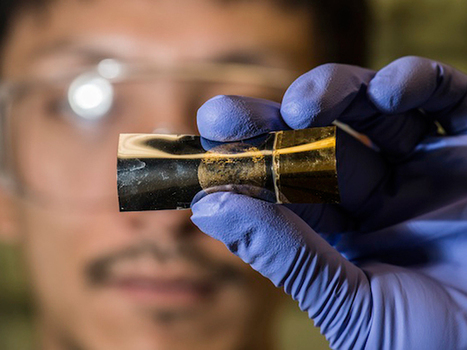
Storing electricity for later use is a factor that imposes limits on what we can do with our technological gadgets.  If this turns out to be commercially viable, the battery-supercapacitor hybrid being developed could improve things tremendously.

Nanoporous Material Combines the Best of Batteries and Supercapacitors

“Compared with a lithium-ion device, the structure is quite simple and safe,” said Yang Yang, lead author of the paper, in the press release.

“It behaves like a battery but the structure is that of a supercapacitor. If we use it as a supercapacitor, we can charge quickly at a high current rate and discharge it in a very short time. But for other applications, we find we can set it up to charge more slowly and to discharge slowly like a battery.”

Nanoporous material combines the best of batteries and supercapacitors | Cool Future Technologies | Scoop.itTo make the battery-supercapacitor hybrid, the Rice team deposited a nickel layer on a backing material. They then etched the nickel layer to create pores five nanometers in diameter. The result is high surface area for storing ions.

After removing the backing, the nickel-based electrode material is wrapped around a solid electrolyte of potassium hyrodroxide in polyvinyl alcohol.

In testing, the researchers found that there was no degradation of the pore structure after 10 000 charge-discharge cycles, or any significant degradation of the electrode-electrolyte interface.

noble gold