Anonymous Feedback on Robert Steele’s Appraisal of Analytic Foundations — Agreement & Extension

Corruption, Government, Ineptitude, IO Impotency, IO Sense-Making, Military, Officers Call
Got Crowd? BE the Force!

Robert,

I read your appraisal over several times. Essentially, in my opinion,  your understanding of the problems continues to be on the mark and remarkably consistent over the last twenty or so years.  Yet your work on both the process and products of intelligence is very high level and in this latest appraisal, as in your previous works, you leave it up to the imagination of the reader to figure out how to actually implement the ideas you so eloquently express. This I think is a mistake in that potential employers, impressed with you macro ideas, would be interested in how these ideas could be brought to the implementation stage. Attached is a supplement to your appraisal on collection and analysis.

In any event I hope that this finds you well and upbeat. You deserve a position that would reflect both your knowledge and your commitment to saving the IC from itself.

A Fan

Robert Steele
Robert Steele

ROBERT STEELE: The time has indeed come to create an alternative to the existing system. I have started to work with a select group across the emergent M4IS2/OSE network, on a firm geospatial foundation. While many of my ideas have been mis-appropriated and corrupted over the past 20 years, no one has actually attempted to implement the coherent vision — sources, softwares, and services all in one, and this time around, all open source, all multi-everything. The PhD thesis, the School of Future-Oriented Hybrid Governance, and the World Brain Institute — and perhaps even the Open Source Agency as a non-US international body — are the beginning of my final twenty-year run.  Intelligence with integrity. Something to contemplate.

Extention of Appraisal Details
Continue reading “Anonymous Feedback on Robert Steele's Appraisal of Analytic Foundations — Agreement & Extension”

Worth a Look: Whitebox Geospatial Analysis Tools — Open Source and Cross-Platform

Geospatial, IO Tools

Whitebox Geospatial Analysis Tools (GAT) is an open-source and cross-platform Geographic information system (GIS) and remote sensing software package that is distributed under the GNU General Public License. It has been developed by the members of the University of Guelph Centre for Hydrogeomatics and is intended for advanced geospatial analysis and data visualization in research and education settings. The package features a friendly graphical user interface (GUI) with help and documentation built into the dialog boxes for each of the more than 360 analysis tools. Users are also able to access extensive off-line and online help resources. The Whitebox GAT project started as a replacement for the Terrain Analysis System (TAS), a geospatial analysis software package written by John Lindsay. The current release support raster and vector (Shapefile) data structures.

Whitebox GAT is extendible. Users are able to create and add custom tools or plugins using any JVM language. The software also allows scripting using the Groovy, Python and JavaScript programming languages.

Whitebox Home Page

Worth a Look: Colin Gray on Stratey at US Army Strategic Studies Institute

Strategy, Worth A Look
Colin Gray
Colin Gray

Dr. Colin S. Gray

Dr. Colin S. Gray is Professor of International Politics and Strategic Studies at the University of Reading, England. He worked at the International Institute for Strategic Studies (London) and at the Hudson Institute (Croton-on-Hudson, NY) before founding the National Institute for Public Policy, a defense-oriented think tank in the Washington, DC, area. Dr. Gray served for 5 years in the Ronald Reagan administration on the President’s General Advisory Committee on Arms Control and Disarmament. He has served as an adviser to both the U.S. and British governments (he has dual citizenship). His government work has included studies of nuclear strategy, arms control, maritime strategy, space strategy, and the use of special forces. Dr. Gray has written 25 books, including: The Sheriff: America’s Defense of the New World Order (University Press of Kentucky, 2004); Another Bloody Century: Future Warfare (Weidenfeld and Nicolson, 2005); Strategy and History: Essays on Theory and Practice (Routledge, 2006); Fighting Talk: Forty Maxims on War, Peace and Strategy (Potomac Books, 2009); National Security Dilemmas: Challenges and Opportunities (Potomac Books, 2009); The Strategy Bridge: Theory for Practice (Oxford University Press, 2010); War, Peace and International Relations: An Introduction to Strategic History, 2nd Ed. (Routledge, 2011); Airpower for Strategic Effect (Air University Press, 2012); and Perspectives on Strategy (Oxford University Press, 2013), which is the follow-up to Strategy Bridge. Dr. Gray is a graduate of the Universities of Manchester and Oxford.

Titles Only:

Continue reading “Worth a Look: Colin Gray on Stratey at US Army Strategic Studies Institute”

Berto Jongman: Benghazi – Was Ambassador Steven Murdered to Cover Up CIA Arming of Al Qaeda?

04 Inter-State Conflict, 05 Civil War, 07 Other Atrocities, 09 Terrorism, 10 Transnational Crime, Government, Idiocy, Military, Peace Intelligence
Berto Jongman
Berto Jongman

CIA Pilot Bombshell!! Confirms Obama’s Gun Running Program To Al Qaeda

A very interesting interview over at InfoWars, which can be heard in part in the video below, with a former CIA gun runner, William Robert “Tosh” Plumlee, which confirmed that before the Benghazi attack which killed four Americans, including Ambassador John Stevens, the Ambassador had expresed concern over the illegal arms reaching Islamic radicals. Plumlee talks about the lack of information provided to the mother of one of an information officer killed that fateful day:

“I began to wonder ‘why won’t they tell her anything?’” He asked. “Then a contact of mine in the Middle East, a high-ranking NATO official, mentioned to me that he had reports that the ambassador [J. Christopher Stevens] had been complaining about the dispatches and cables that he had got from the State Department about the weapons being received and [Islamic] radicals armed, including Stinger missiles.”

According to Plumlee, Steven was ordered to stand down after he asked the State Dept. what he should do about the American arm shipments to al-Qaeda.

“The ambassador and his people had written a series of field reports and cable dispatches advising our State Department that the rebel factions had been armed with U.S. weapons,” he said. “Now my contention is this: if that is the case, why is that classified as a national security matter?”

Was Stevens and the other three Americans killed because of what they knew and expressed concern about? Is that why  the White House deliberately had officials providing false information to the public over the attack directly following it, which the latest Benghazi bombshell recently revealed? Is this also why the military was told to stand down and were not allowed to go in to save Ambassador Stevens and the others?

See Also:

Benghazi @ Phi Beta Iota

Sepp Hasslberger: Ocean Energy

05 Energy, Earth Intelligence
Sepp Hasslberger
Sepp Hasslberger

I like their design and the professional prototyping. The turbine can tap the huge energy potential of moving water in ocean currents without disturbing the marine eco-system. It can supply power constantly, 24/7/365

Crowd Energy seeks funding for vertical axis Ocean Energy Turbine – Renewable energy from ocean currents

The Ocean Energy Turbine is important because it  is the first renewable energy system designed to effectively harness ocean currents on a commercial scale. Globally, ocean currents can provide the power to completely replace the worlds dependance on fossil fuels and nuclear energy. The quantity of energy available from ocean energy greatly exceeds that of wind and solar. Ocean energy production is also a consistent reliable source of energy, whereas solar and wind power are limited by the availability of sun and wind.

Learning Options:

Fossil Fuel Pollution   Problems with Wind Energy   Problems with Solar Energy   Problems with Wave Energy   Problems with Nuclear Energy   Global Energy Use   Protect Our Future   Limitless Ocean Energy

Berto Jongman: USA #99 on Global Peace Index YouTube (2:41)

Peace Intelligence
Berto Jongman
Berto Jongman

Peace is quantifiable, based on measurable fundamentals.

One Of The Most Important Lists I've Ever Seen, And The United States Is In 99th Place. Yikes.

Gabe Stein, Upworthy

These fine folks had the brilliant idea to quantify peace and rank all the countries in the world. Unfortunately, the United States isn't doing so hot right now. We're — you guessed it — 99th out of the 162 countries on the list. How do we fix that? Take a look, and make sure to stick around until 2:01, when they explain why this list isn't just an exercise but could really change the way we think about minimizing conflict and achieving real world peace.

INTERACTIVE WEBSITE

Berto Jongman: Why “Big Data” Cannot Find Malaysian Airlines Aircraft

07 Other Atrocities, IO Impotency
Berto Jongman
Berto Jongman

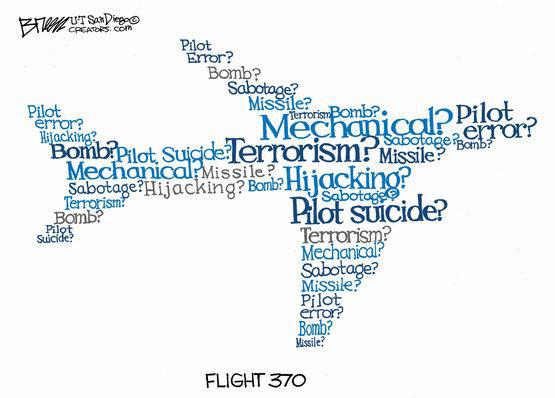
Why ‘Big Data' Can't Find the Missing Malaysian Plane

The ongoing search for Flight 370 exposes the world's serious information gaps.

Isaac R. Porche III

US News & World Report, 1 May 2014

How can a commercial airliner vanish and remain lost for weeks in an age in which data on virtually everything is collected and maintained either publicly or secretly? The answer is “quite easily.” It is one thing to collect huge amounts of information, but it is another to be able to fuse it quickly and meaningfully.

Click on Image to Enlarge

Much has been made about the reluctance of countries involved in the search for Malaysia Airlines Flight 370 to share sensitive aircraft tracking data that could help locate the doomed plane. But that is not the only issue.

The inability to quickly connect the dots is largely a technical problem. The sensed data of the world aren’t inherently organized or co-located or structured to be interoperable, semantically or otherwise. Even if all the data were being shared openly, it is simply not easy to marry disparate, dispersed data stores and perform timely searches to find connections, coincidences or errant commercial aircraft.

Read rest of article.

See Also:

Big Data @ Phi Beta Iota

Malaysian Airlines @ Phi Beta Iota

noble gold