The Department of Defense budget for research and procurement of unmanned aerial systems (UAS), or drones, is on a distinctly downward slope.
The FY 2014 budget request included $2.3 billion for research, development, and procurement of unmanned aerial systems, a decrease of $1.1 billion from the request for the fiscal year 2013.
“Annual procurement of UAS has gone from 1,211 in fiscal 2012 to 288 last year to just 54 in the proposed FY14 budget,” according to a recently published congressional hearing volume.
Among the questions for the record published in the new hearing volume, DoD officials were asked: “Who is responsible for developing privacy protections for military UAV operations inside the United States?”
Some other noteworthy new doctrinal and congressional defense-related publications include the following.
First SOF Truth, equally applicable to every single element of the Joint Force, has been forgotten: HUMANS ARE MORE IMPORTANT THAN HARDWARE. First SOF Truth, repeat after me, Mr. Secretary: HUMANS ARE MORE IMPORTANT THAN HARDWARE.
Troops and families — carriers of the rifles and the rucksacks and standers of the night watches — rather than contractors will bear the burden.
– – – – – – –
Defense Secretary Chuck Hagel warned Tuesday that troops and their families will be asked to sacrifice on pay and benefits to preserve readiness in an era of tighter budgets.
SecDef Chuck Hagel
Hagel listed politically-charged changes to compensation and personnel policy as one of his top six priorities in reforming the military following the wars in Iraq and Afghanistan as the department gears up to meet new challenges.
“This may be the most difficult” to achieve among his six priorities, Hagel said of proposals to trim pay increases, overhaul TRICARE and review retirement benefits while adapting to cuts in personnel.
“Without serious attempts to achieve significant savings in this area, which consumes roughly half of the DoD budget and is increasing every year, we risk becoming an unbalanced force,” Hagel said.
The alternative was to have a military that is “well-compensated, but poorly trained and equipped, with limited readiness and capability,” Hagel said in a keynote address to a Global Security Forum 2013 sponsored by he Center for Strategic and International Studies.
Interview with Moray B. King. Moray has been working as an electrical and systems engineer for over 30 years. During that time, in parallel, he has done extensive independent research into the standard physics literature concerning both zero point physics and self-organizing systems. He has also conducted extensive research into the patents and experiments of inventors who have reported anomalous energy gains over the decades. He is considered one of the leading authorities on the subject of Zero Point Energy, and has written two books on the topic titled: Tapping the Zero Point Energy, and Quest for Zero Point Energy. Most recently Moray gave a presentation titled “Water, Plasmoids, and Zero Point Energy” at this year's Breakthrough Energy Movement Conference.
How do you grow vegetables in arid areas? Reverse the trend of desertification, the Sahara Forest Project proposes.
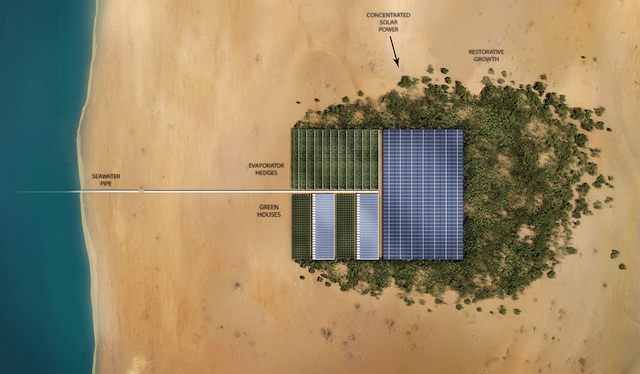
The project combines existing technologies — such as the evaporation of saltwater to create fresh water along with solar thermal energy tech — to utilize what we have (saltwater, CO2) to produce what we need (food, fresh water and energy).
This week, the project, which is supported by fertilizer companies, reached a milestone. Its Qatar pilot plant produced 75 kilograms of crops (like cucumbers) per square meter annually while consuming only sunlight and seawater, Science reports. That’s comparable to commercial farms in Europe.
At the center of the project is a saltwater-cooled greenhouse, Science explains:
At one end, salt water is trickled over a gridlike curtain so that the prevailing wind blows the resulting cool, moist air over the plants inside. This cooling effect allowed the Qatar facility to grow three crops per year, even in the scorching summer. At the other end of the greenhouse is a network of pipes with cold seawater running through them. Some of the moisture in the air condenses on the pipes and is collected, providing a source of fresh water.
One surprising side effect is how the cool, moist air that was leaking out encouraged plants to grow spontaneously outside. By reducing exterior air temperatures with “evaporator hedges” (pictured), the plant was able to grow crops like barley and salad rocket (arugula), along with useful desert plants around the seawater greenhouse.
Another key element of the facility is the concentrated solar power plant:
This uses mirrors in the shape of a parabolic trough to heat a fluid flowing through a pipe at its focus. The heated fluid then boils water, and the steam drives a turbine to generate power. Hence, the plant has electricity to run its control systems and pumps and can use any excess to desalinate water for irrigating the plants.
The project has also experimented with culturing heat-tolerant algae, growing salt-tolerant grasses for fodder or biofuel, and evaporating the concentrated saline the plant emits to produce salt, Science reports.
The Qatar plant is 1 hectare with 600 square meters of growing area inside. Next up: a 20-hectare test facility near Aqaba, Jordan.
Freedom of Speech – Zacqary Adam Green: “What is everyone complaining about? This is a free service, and [large corporation] can do whatever they want with it!” That’s true. Also wrong. Please stop saying it.
There’s always outrage whenever a popular online service like YouTube, Google, Facebook, Twitter, Tumblr, Flickr, or Whatevr makes some kind of unpopular change, or when unscrupulous business practices come to light. And in return, there’s always outrage at the outrage. “The service is free,” they say, “and it’s owned by a private company. Go use something else if you don’t like it.”
This is usually code for “I disagree with your complaint, and I get insecure and anxious when people have opinions that aren’t mine, because it reminds me of how alone I am in the universe. Therefore I am lashing out rather than attempting to explore my capacity for empathy.” It’s also a pretty weak argument.