Congressmen and others are suggesting that, because it was a contractor who leaked information about NSA’s surveillance activities, that the number of contractors in intelligence should be reduced. Is it true that reducing contractors will reduce leaks?
Leaks can be measured in several different ways — by number of leaks, importance of the material, by motivation, number of pages, signals versus other types, or weighted toward the present. Yet in all categories,
contractors have proven to be no more likely to leak compared to direct hires, including especially executives.
That’s not surprising because there is little difference between the two types of employees. In the latest census of those cleared at the Top Secret level, the employment status could not be determined for over 7% (or 100,000). Many contractors are former direct hires, and vice versa; a worker might change status without even changing his desk or assignment. Direct hires and contractors are vetted exactly the same way, except that contractors undergo even longer delays and more inconvenience. Contractors tend to change assignments more often – that is their main benefit – but the pace of reassignment has quickened among direct hires as well. Both types tend to remain employed within the intelligence community, often within one or two agencies.
Edward Snowden had been a CIA employee. He underwent extensive vetting, then extensive training and acculturation prior to stationing overseas. He was committed to a career in intelligence, as much as any 29-year-old unmarried techie can be said to be committed. Booz Allen, his employer for 3 months, was a convenient administrative apparatus for positioning him where his computer skills were needed within the NSA universe.
There is no evidence to suggest that contractors are more likely to leak, therefore an increase in the proportion of direct hires would not reduce leaks. One might claim instead that an overall reduction of the
intelligence workforce would reduce leaks. There is no evidence to substantiate that claim either, but the larger point is that we are creating a hash out of two separate issues. There are legitimate questions
about how to shape the intelligence workforce, and leaks have little to do with it. There are legitimate questions about how to prevent leaks, and shaping the workforce has little to do with it.
The case of Edward Snowden is well worth pondering for what is says about leaks, but not for what is says about contractors. Leaking is a very big discussion that should not be hijacked by another agenda that needs to stand on its own. If Congressmen want to reduce contracting, they need to make the case fairly and dispassionately. This is rarely attempted, including by the Post, perhaps because it is so much easier to excite
emotions and prejudices against contractors. Yet contractors are, for the most part, hardly different from direct hires. They are just doing the job that Congress asked for and paid for.
Leaked notes from private meeting show pontiff speaking about a ‘stream of corruption'
The pope has admitted the existence of a network of gay prelates in the Vatican, reports published on Tuesday said.
According to leaked notes of a private conversation with Catholic officials at the Latin American Conference of Religious (Clar), Francis was asked about being in charge of the Roman curia, the Chilean website Reflexión y Liberación reported. According to site, the Argentinian pontiff, speaking in his native Spanish, said the task was difficult as, alongside “holy people”, there was also “a stream of corruption”. He was then quoted as adding: “The ‘gay lobby' is mentioned, and it is true, it is there … We need to see what we can do.”
Click on Image to Enlarge
Clar later confirmed its leaders had written a synopsis of the pope's remarks and said it was greatly distressed that the document had been published. Vatican spokesman Federico Lombardi said he had no comment to make on the remarks made in “a private meeting”. The text follows repeated claims that there are a significant number of influential gay clerics within the Vatican.
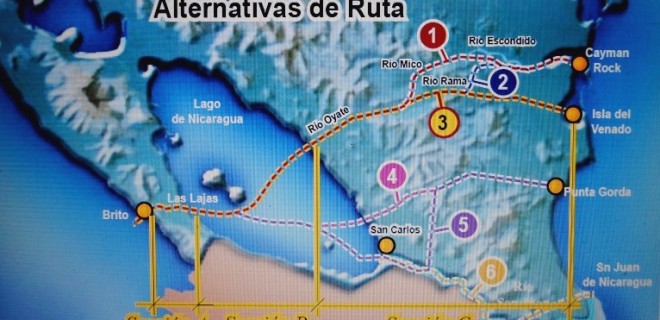
MANAGUA, Nicaragua – Fast-tracking a proposal through the ruling party-controlled Congress despite a lack of details about the $40 billion project, Nicaragua is moving ahead with a plan to dig a Chinese-funded rival to the Panama Canal across the midriff of the country.
A China-based consortium says it will finance the project and turn over control of the infrastructure to Nicaragua in exchange for a majority of the earnings, which it would share with the Nicaraguan government.
Click on Image to Enlarge
Proponents have said the project could capture 4.5 percent of world maritime freight traffic and double the per-capita gross domestic product of Nicaragua, one of the poorest countries in Latin America. The canal has won the enthusiastic backing of President Daniel Ortega, whose Sandinista Front controls the national legislature with 63 out of 92 lawmakers.
FinFisher, also known as FinSpy, is surveillance software marketed by Gamma International, a software firm with a UK-based branch Gamma International Ltd in Andover, United Kingdom, and a Germany-based branch Gamma International GmbH in Munich[2][3] which markets the spyware through law enforcement channels.[1] Gamma International is a subsidiary of the Gamma Group, specializing in surveillance and monitoring, including equipment, software and training services, reportedly owned by William Louthean Nelson through a shell corporation in the British Virgin Islands.
Blue Coat got in the news when the Hacktivist cluster Telecomix released a 54GB censorship log that had been found on the Syrian domain. The data was collected from seven of 15 Bluecoat SG-9000 HTTP proxies used by Syrian government telco and ISP STE in #opSyria. This is not the first time that government tools end up in environments where the regime has the last word.
Citizinlab had a nice research done about the Blue Coat software that you can find here.
Since retiring from a three-decade career at the NSA in 2001, a mathematician named William Binney has been telling anyone who will listen about a vast data-gathering operation being conducted by his former employers. “Here’s the grand design,” he told filmmaker Laura Poitras last year. “You build social networks for everybody. That then turns into the graph, and then you index all that data to that graph, which means you can pull out a community. That gives you an outline of everybody in that community. And if you carry that out from 2001 up, you have 10 years of their life that you can then lay out in a timeline that involves anybody in the country. Even Senators and Representatives—all of them.”