When government information is classified or otherwise withheld from release, the possibility of government accountability to the public is undermined. But when the executive branch withholds crucial information from Congress, that may pose an even more fundamental challenge to democratic governance.
In the absence of an official public account of post-9/11 U.S. counterterrorism programs, Americans (and others) must rely on unofficial accounts.
“Globalizing Torture” is a new report from the Open Society Justice Initiative, authored by Amrit Singh. It is said to provide “the most comprehensive account yet assembled of the human rights abuses associated with CIA secret detention and extraordinary rendition operations. It details for the first time what was done to the 136 known victims, and lists the 54 foreign governments that participated in these operations. It shows that responsibility for the abuses lies not only with the United States but with dozens of foreign governments that were complicit.”
Press TV's documentary program “Untold Truths” is a revealing documentary film about the life and experiences of former White House Middle East policy adviser, Gwenyth Todd, who has escaped to Australia to keep safe from FBI prosecution.
Phi Beta Iota: RIVETING. From Larry Franklin to Admiral Cosgrove. Traitors working for Israel and handled by AIPAC. Includes murder on the street of the Turkish billionaire paying her bills in exile, ruled a “suicide.” This entire video-tape consists of one US citizen talking. We pray she is heard. The arrogance and impunity of those who are behind this exceeds that of all other dictators combined (40 of them!). We pray that one day the USA gets an honest counterintelligence service that can flush traitors out of the Pentagon and keep it focused on legitimate US interests and US needs.
Right after the assassination of Osama bin Laden, amid all the cheers and applause, there were a few critical comments questioning the legality of the act. Centuries ago, there used to be something called presumption of innocence. If you apprehend a suspect, he’s a suspect until proven guilty. He should be brought to trial. It’s a core part of American law. You can trace it back to Magna Carta. So there were a couple of voices saying maybe we shouldn’t throw out the whole basis of Anglo-American law. That led to a lot of very angry and infuriated reactions, but the most interesting ones were, as usual, on the left liberal end of the spectrum. Matthew Yglesias, a well-known and highly respected left liberal commentator, wrote an article in which he ridiculed these views. He said they’re “amazingly naive,” silly. Then he expressed the reason.
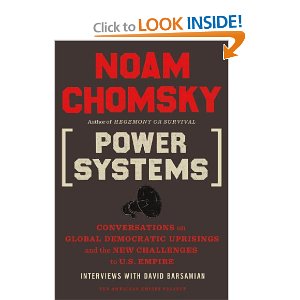
Amazon Page
He said that “one of the main functions of the international institutional order is precisely to legitimate the use of deadly military force by western powers.” Of course, he didn’t mean Norway. He meant the United States. So the principle on which the international system is based is that the United States is entitled to use force at will. To talk about the United States violating international law or something like that is amazingly naive, completely silly. Incidentally, I was the target of those remarks, and I’m happy to confess my guilt. I do think that Magna Carta and international law are worth paying some attention to.
I merely mention that to illustrate that in the intellectual culture, even at what’s called the left liberal end of the political spectrum, the core principles haven’t changed very much. But the capacity to implement them has been sharply reduced. That’s why you get all this talk about American decline. Take a look at the year-end issue of Foreign Affairs, the main establishment journal. Its big front-page cover asks, in bold face, “Is America Over?” It’s a standard complaint of those who believe they should have everything. If you believe you should have everything and anything gets away from you, it’s a tragedy, the world is collapsing. So is America over? A long time ago we “lost” China, we’ve lost Southeast Asia, we’ve lost South America. Maybe we’ll lose the Middle East and North African countries. Is America over? It’s a kind of paranoia, but it’s the paranoia of the superrich and the superpowerful. If you don’t have everything, it’s a disaster.
A brief article Bring on the Drones! offers a wonderfully hopeful and positive view of open-sourced drone technology that will be available to the 99%.
Here's the key take-away quote from it:
“Imagine, if you will, a world in which drones are cheap and widely available. Then stop and think about the target profile of the Empire and the corporate interests it serves. Imagine how easy it would be to get targeting information on the homes, churches and country clubs of the senior management and directors of the aerospace companies that make American drones. The Boardrooms and C-Suites themselves. The factories. The whole South Asian chain of command, from CINC CENTCOM down to battalion and flight headquarters. The logistical tail of the drones, including the control centers at every airbase from which drones are staged. Begin to get the picture? Even as it is, the current American advantage in drones is just an outlier in the general trend toward cheap area-denial technologies (carrier-killing Sunburn missiles, mines, etc.). In fact the panic in U.S. ruling circles is so extreme that the latest U.S. Defense Guidance document was centered on the need to prevent the United States losing its regional power projection capabilities to such technologies — the 21st century equivalent of the most powerful army in the world being defeated by a guerrilla army using punji sticks and a bicycle-borne logistical tail.”
Targeting drones at the homes and country clubs of senior defense managers is similar to some plot elements of Daniel Suarez's remarkable novel about drones, which is highly recommended novel, Kill Decision
But why stop at defense executives? Why not add to the list the bankers, lawyers, corrupt politicians, bad cops. Open source drone technology will become the great “equalizer,” just as handguns were in the 19th century wild west and many other more recent contexts:
1. 10th Annual Army Global Information Operations Conference
2. China's Space Activities Raising U.S. Satellite Security Concerns
3. ‘Red October' Cyber-Attack Found By Russian Researchers
4. Influence Operations and the Internet: A 21st Century Issue
5. When the Network Dies
6. Cyber Operations: Bridging from Concept to Cyber Superiority
7. Army Electronic Warfare Goes On The Offensive: New Tech Awaits Approval
8. Army Manual Highlights Role of “Inform and Influence Activities”
9. DoD Looking to ‘Jump the Gap' Into Adversaries' Closed Networks
10. President Putin orders FSB to protect media sites from cyber attack
Over time I’ve grown more and more suspicious of stories about breakthrough technologies. I always think back to those heady days of EEStor, the guys who were going to make a battery that would revolutionize grid storage and electric cars alike. “EEStor CEO says game-changing energy storage device coming by 2010”! As you may have noticed, 2010 came and went and the game remains unchanged.
All of which is to say, regarding the post to follow: caveat lector. Still, this looks very, very cool.
CleanTechnica has an exclusive on a new solar technology that claims to be able to produce power with a levelized cost of energy (LCOE) of 8¢/kWh. That is mind-boggling, “two-thirds the price of retail electricity and over 3 times cheaper than current solar technology.” If the claim proves to be true (and a lot can happen between prototype and mass manufacturing), it could revolutionize the solar industry.
The company is called V3Solar (formerly Solarphasec) and its product, the Spin Cell, ingeniously solves two big problems facing solar PV. First, most solar panels are flat, which means they miss most of the sunlight most of the time. They only briefly face direct sunlight, unless expensive tracking systems are added. The Spin Cell is a cone.
The conical shape catches the sun over the course of its entire arc through the sky, along every axis. It’s built-in tracking. The second problem: Solar panels produce much more energy if sunlight is concentrated by a lens before it hits the solar cell; however, concentrating the light also creates immense amounts of heat, which means that concentrating solar panels (CPV) require expensive, specialized, heat-resistant solar cell materials. The Spin Cell concentrates sunlight on plain old (cheap) silicon PV, but keeps it cool by spinning it. It’s just so damn clever.






 All of which is to say, regarding the post to follow: caveat lector. Still, this looks very, very cool.