
Worth a Look: WorldOMeters
Worth A Look
The truth at any cost lowers all other costs — curated by former US spy Robert David Steele.
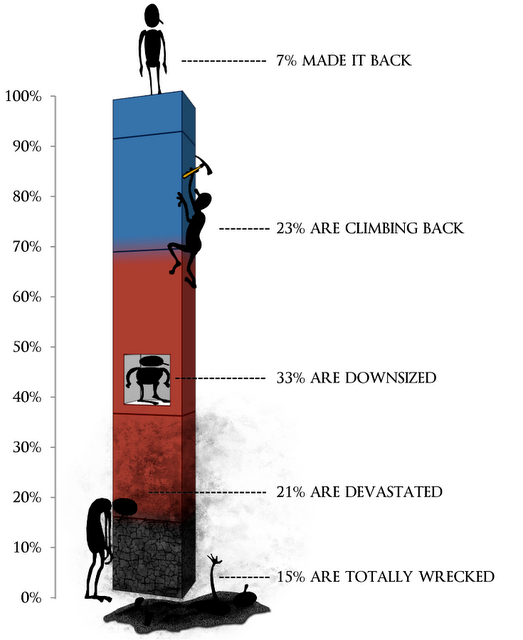
Categorizing the Unemployed by the Impact of the Recession
By Dr. Cliff Zukin, Dr. Carl E. Van Horn, and Charley Stone
Rutgers University Working Paper, 5 December 2011
Words like ‘shameful' and ‘national disgrace' do come to mind.
In August 2009, the John J. Heldrich Center for Workforce Development at Rutgers, The State University of New Jersey began following a nationally representative sample of American workers who lost a job during the height of the Great Recession.
The research began with a cross-sectional sample of 1,202 who had said they had lost a job at some point in the preceding 12 months (between August 2008 and 2009). They were resurveyed in March 2010, again in November 2010, and then in August 2011.
A total of 3,972 individual surveys were completed over the two years. Well over half of the original respondents participated in all four waves of the project, meaning they spent, on average, 50 minutes of their time responding to roughly 200 questionnaire items.
This resulting measure combines an assessment of the respondent/family’s current economic status with the magnitude of change in the quality of daily life, with an assessment of whether this change represents a new normal or is a temporary stay in limbo. Combining answers to these three questions result in a typology with five groups, defined as follows:
� Workers who have MADE IT BACK consider themselves in excellent, good, or fair financial shape and have experienced no change in their standard of living due to the recession.
� People ON THEIR WAY BACK have largely experienced a minor change to their standard of living, but say the change is temporary. They also consider themselves in excellent, good, or fair financial shape.
�� Workers who have been DOWNSIZED meet one of three conditions; they have experienced: a minor change that is permanent; a minor change that is temporary, but they are in poor financial shape; or a major change in their standard of living that is temporary and they are in at least fair financial shape.
� Workers classified as DEVASTATED have experienced a major change to their lifestyle due to the recession. They can be either in poor financial shape and think the change is temporary, or in fair financial shape but think this change is permanent.
� Workers that have been TOTALLY WRECKED by this recession have experienced a major change to their lifestyle that is permanent and are in poor financial shape.
Read the rest of this working paper here.

Alternative for more mature audiences:
YouTube Sex with Pilots vs. Intelligence Officers
And for the really thoughtful:
LINKS now has two columns, one for Righteous Sites of Note, the other for Professional Sites of Note.
Nominations are sought for both. In the case of Professional Sites of Note, the avant guarde is observing the death of Competitive Intelligence and the emergence of public intelligence and commercial intelligence as more holistic approaches to the art and science of intelligence as decision-support. Both public and commercial intelligence have multi-national, multi-agency (or multi-sector) evoluations.

VIDEO (8:19) Applying Scenarios, Wargames and Advanced Intelligence Analytics (Part 1 of 2)
Generic is worthless–focus on real specific threats and opportunities. Do the collection rather than just speculating without data. Do not extrapolate from the past — instead intuit and shape the future.
VIDEO (7:12) Applying Scenarios, Wargames and Advanced Intelligence Analytics (Part 2 of 2)
First, study your business model. Then simplify it. Then innovate.
In passing (PDF): The impact of competitive intelligence on products and services innovation in organizations
Competitive Intelligence (CI) is not impacting on innovation.

Libertarian seasteaders give up on the sea, focus on autonomous regions starting with Honduras.
Former “Seasteaders” Come Ashore To Start Libertarian Utopias In Honduran Jungle
Forgoing the plan to build independent floating cities away from chafing laws, some libertarians—led by Milton Friedman’s grandson, no less—have found something better: desperate countries willing to allow the founding of autonomous libertarian cities within their borders.
The seasteader-in-chief is headed ashore. Patri Friedman (that’s Milton Friedman‘s grandson to you), who stepped down as the chief executive of the Peter Thiel-backed Seasteading Institute in August, has resurfaced as the CEO of a new for-profit enterprise named Future Cities Development Inc., which aims to create new cities from scratch (on land this time) governed by “cutting-edge legal systems.” The startup may have found its first taker in Honduras, whose government amended its constitution in January to permit the creation of special autonomous zones exempt from local and federal laws. Future Cities has signed a non-binding memorandum of understanding to build a city in one such zone starting next year.
. . . . . . .
The brainchild of New York University economist Paul Romer (read his thoughts on FCI here), a charter city combines a host nation’s vacant land (in this case, Honduras) with the legal system and institutions of another (e.g. Canada) and residents drawn from anywhere. Romer’s central insight is that good governance is transplantable—rather than wait for a basket case nation to come around begging, a charter city could help show it the way, as Hong Kong did for Deng Xiaoping.
Phi Beta Iota: The focus on eradicating corruption from day one is most interesting. While the group does not appear to have fully thought through their role as a magnet for criminals, there are regions of Africa, Latin America, and even the now warming Arctic North that could permit this kind of innovation to test its premises.

Experts: DoD could slash 150K jobs
Sean Reilly
Federal Times, 4 December 2011
A reduction in force. More base closings and consolidations. Big cuts to defense intelligence agencies.
All those options affecting the Defense Department's vast civilian workforce would be on the table if automatic across-the-board budget cuts go forward, experts predicted last week.
That workforce, the largest of any federal agency, totals about 790,000, according to the most recent DoD figures. During the next decade, its size could tumble 20 percent to about 630,000, the smallest since the Defense Department's creation in 1947, under a scenario outlined last month by Defense Secretary Leon Panetta in a letter to Congress. The Army, Navy and Air Force employ almost 80 percent of the existing civilian workforce; DoD organizations and the National Guard account for the rest.
Phi Beta Iota: With 46 million Americans on food stamps, this hardly seems cause for alarm. What should be alarming is the total absence of strategy, intelligence, or integrity in Whole of Government operations.
